Hiring an Airbnb co-host typically costs between 10% and 30% of booking revenue, most commonly landing around 15% to 20%, though some managers charge a flat monthly fee instead, depending on the workload involved.
Are you planning to hire an Airbnb co-host but not getting the right guidance? Don’t worry, you’ve come to the right place. Being an Airbnb co-host isn’t just about a fee. Hosts need to understand pricing models, legal responsibility, contract terms, data access, and local short-term rental rules before they hand over the keys, even the digital ones. This guide walks through how Airbnb co-hosting actually works, what it costs, who’s liable when something goes wrong, and how to pick a co-host you can actually trust, like HOSTassis.
What Hosts Worry About Before Hiring a Co-Host?
Property hosts often hesitate over trust, responsiveness, and control when it comes to hiring a co-host, worried about everything from property damage to losing their final say on decisions.
If you’re managing more than one listing or even just one that’s eating your evenings, you already know the feeling. The messages don’t stop. A guest wants an early check-in at 7 a.m., and another wants a refund at midnight, and somewhere in between you’re supposed to have a life.
So you start thinking about a co-host. And almost immediately, the doubts creep in:
- “What if they take over my account and I lose control?”
- “What are they actually going to charge me, and what’s hidden in the fine print?”
- “If a guest sues or the city fines me, am I still the one holding the bag?”
- “Can I trust someone else with my guest data and my payouts?”
- “What if I sign a contract and then I’m stuck for a year?”
- “Do I even know if this is legal in my city?”
Every one of these concerns is fair. Co-hosting puts someone else’s hands on a business that’s yours, your income, your reviews, your reputation. The good news is that none of this has to be a gamble. Once you understand how legitimate co-hosting actually works, most of the fear disappears. That’s what the rest of this guide is for.
How Airbnb Co-Host Fees Work?
Airbnb co-host fees typically fall between 10% and 35% of booking revenue, with the exact rate depending on how much service the host actually provides.
Co-host fees aren’t always the same. They depend on how much work is involved, how difficult it is to manage the property, and how much risk the co-host is taking on – pricing, guest hassles, reviews, cleaning, all combined. Someone who only replies to messages every few hours, and someone who handles the entire operation – calendar, cleaning team, 24/7 guest handling – won’t have the same rates. Most importantly, the cheapest option isn’t always the best. A low fee may mean late replies, less knowledge of local rules, or less attention to detail when managing multiple properties. In essence, you’re paying to protect your 5-star reputation.
Typical Airbnb Co-Host Fee Ranges
Airbnb co-host fees usually land somewhere between 10% and 30% of gross booking revenue, and where exactly it falls depends on how much the co-host is actually handling.
Typical Fee Breakdown by Service Level
- Messaging and Basic Support (10% to 15%): Just the guest-facing stuff, answering questions, managing the inbox, sending check-in details.
- Partial Management (15% to 25%): Guest communication plus cleaning coordination and calendar management, along with handling the smaller guest issues that come up.
- Full-Service Management (20% to 30%): The whole package, dynamic pricing, maintenance, vendor coordination, restocking, and monthly financial reports.
- Luxury or Premium Management (20% to 35%+): Hands-on oversight with in-person check-ins, performance guarantees, and close attention to the property itself.
- Flat Monthly Fees ($300 to $800+): A set rate instead of a percentage, common for predictable workloads, part-time help, or just backup support.
How much does an Airbnb co-host usually charge?
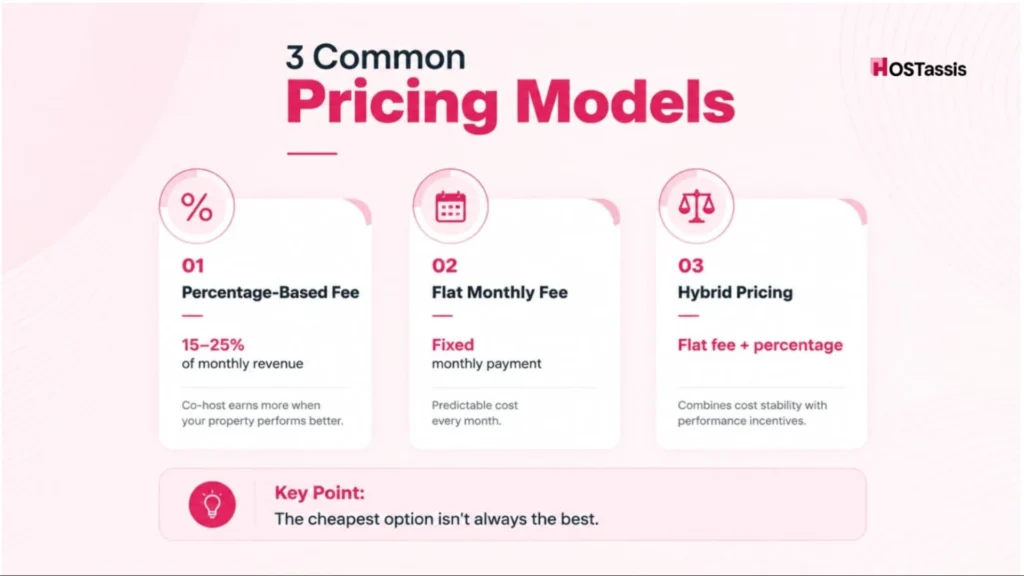
Most Airbnb co-hosts charge somewhere between 15% and 25% of monthly revenue, though the exact number depends on the services included, the size of the property, and how complex the market is. Flat-fee and hybrid models exist too, and a good co-host will walk you through exactly what you’re paying for instead of just quoting a number.
Flat Fee vs Percentage Models: Which One Actually Fits You?
A flat fee charges one fixed price regardless of project size or results, while a percentage model scales with value, aligning costs with performance but rising as your portfolio grows.
Flat Fee Co-Hosting
- Where It Works Well: Predictable, high earning listings where you’d rather know your exact cost every month than watch a percentage climb along with your revenue.
- Where It Falls Short: During slower seasons, a flat fee can feel expensive relative to what the property is actually bringing in, and depending on the provider, service depth may be more limited.
Percentage-Based Co-Hosting
- Where it works well: New hosts or unpredictable revenue months, since you’re never paying more than a slice of what you actually earn, the co-host only wins when you win.
- Where it falls short: Once your property scales up and starts earning significantly more, that same percentage can turn into a much bigger number than a flat fee would have been.
So Which Model Is Better?
Honestly, it depends on where you are as a host.
- New hosts usually do better with percentage-based pricing. There’s less risk if occupancy is inconsistent while you’re still finding your footing.
- Experienced hosts with strong, stable bookings often prefer flat fees, since they already know roughly what the property earns and want cost certainty.
- Multi-property owners and remote owners tend to need a custom mix; some properties might justify a flat fee, others a percentage, depending on how hands-on each one is.
HOSTassis builds pricing around the actual work involved in the complexity of the property, the flexibility of the tasks, and the level of support you need rather than pushing every host into the same package. You talk through what you actually need, and the quote reflects that, not a one-size-fits-all rate card.
Contract Length, Exit Clauses & Control
This is where a lot of hosts get burned not on the fee, but on the fine print. Before you sign anything, you should know exactly how long you’re committing, what notice you owe if you want out, and who owns what once the relationship ends.
Reasonable co-host agreements typically run month-to-month or in short, renewable terms rather than locking you into a year with no way out. A fair termination clause usually asks for a short notice period, enough time to transition smoothly, not a penalty for wanting to leave. And ownership should never be ambiguous: your listing, your reviews, and your guest history belong to you, the property owner, full stop. A co-host manages them; they don’t own them.
What a Fair Airbnb Co-Host Contract Should Include
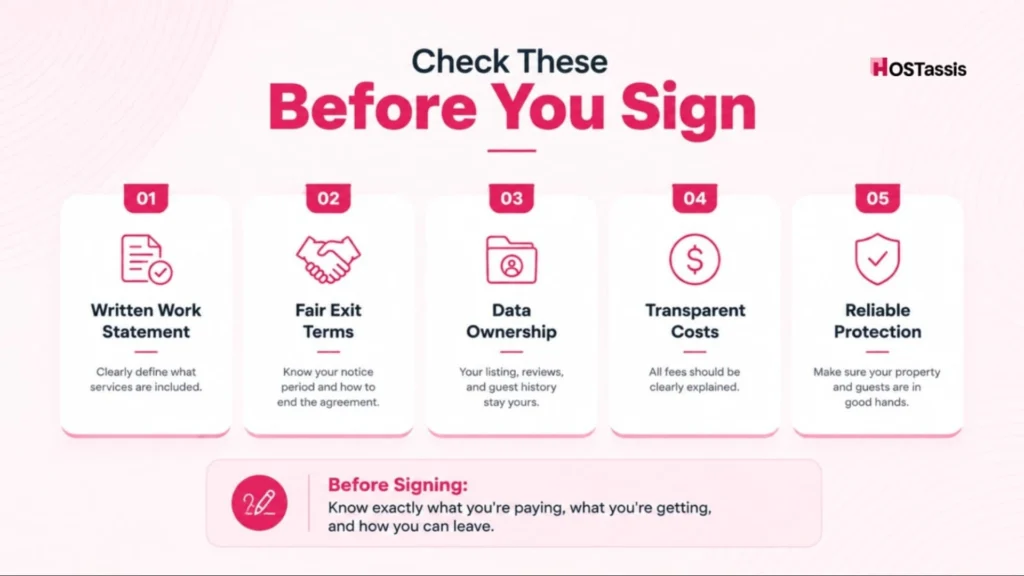
A fair Airbnb co-host contract clearly defines both parties involved, outlines precise daily responsibilities, and sets transparent payment terms, typically ranging from 10% to 25% of gross booking revenue.
- A written work statement with details-don’t just let them say “we’ll cover it.”
- Exit terms that don’t punish you for changing your mind
- Direct confirmation that your data-your listing, reviews included-belongs to you
- No “hidden cost” PDF. You see the whole picture broken down in actual dollars and percentages.
Can I remove my Airbnb co-host anytime?
Yes, if the contract includes reasonable exit terms, you can change your Airbnb co-host at any time as needed. Our agreement will clearly spell out all the terms and conditions. And if for any reason you don’t like it or don’t feel safe, you’ll have the option to remove your co-host.
Legal Responsibility: Who’s Liable If Something Goes Wrong?
Legal liability means a person or business is legally responsible for damages or penalties when they break a law, breach a contract, or fail to act with reasonable care.
In case of property damage, we will first check how the problem occurred and who caused it. “If a guest is at fault or otherwise responsible for the damage, they will be held accountable. However, if such an incident happens and we are notified, we will help you report the matter through Airbnb and get the compensation you deserve. We aim to address the problem promptly and protect your property.
Owner vs Co-Host: Who Does What
- The owner remains the legally responsible party for the property, for taxes, for regulatory compliance.
- The co-host operates delegated, and will provide communication, booking and operations services within the pre-authorised limits agreed in the operational protocols.
- Insurance and compliance still matter enormously. A good co-host helps you stay organized and on top of deadlines, but proper STR insurance and up-to-date permits are still on you.
Is an Airbnb co-host legally responsible?
Liability will depend on the circumstances and the fault. We are always careful, but we will not be responsible for any damage to the property caused by a guest or any previous event.
Local Short-Term Rental Regulations & Compliance
Short-term rental laws are a patchwork in the U.S. — what’s fine in one city can get you fined in the next. Licensing requirements, occupancy taxes, HOA restrictions, and city-specific caps on rental days all vary, and they change more often than most hosts realize.
This is a genuine risk area, and it’s one of the places a professional co-host earns their fee. Instead of researching municipal codes at midnight, you have someone tracking documentation, keeping your listing aligned with platform rules, and flagging risk before it turns into a fine. That’s not a substitute for checking your local ordinance yourself, but it does mean you’re not doing it alone.
How a Professional Co-Host Helps
- Keeps your licensing and permit documentation organized and current
- Makes sure your listing stays aligned with Airbnb’s own platform policies
- Flags compliance risks early, before they become expensive problems
HOSTassis treats compliance as part of the job, not an afterthought — because a five-star listing doesn’t mean much if the city shuts it down.
Data Access, Airbnb Account Security & Privacy
You can access, manage, and download your personal information through the Privacy & sharing section in your Airbnb Account Settings, giving you full control over your own data.
Here’s something every host should know before hiring anyone: you never need to hand over your Airbnb password to bring on a co-host. Airbnb has a built-in, official co-host system for exactly this reason, it gives another person the access they need to manage your listing without ever touching your login credentials or your payout information directly.
Safe vs Unsafe Co-Hosting Practices
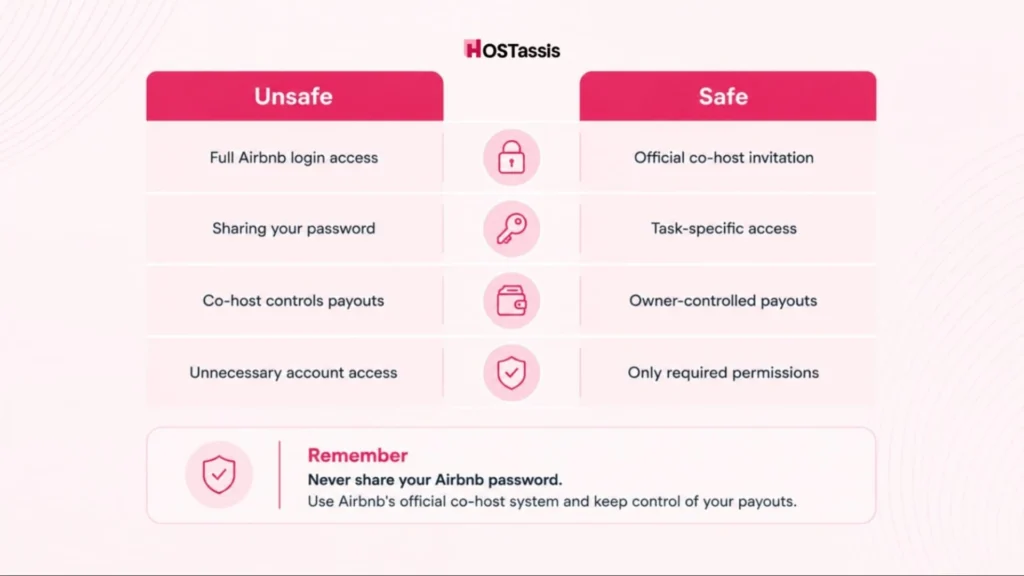
Unsafe:
- Being asked for full login access to your Airbnb account
- A co-host who wants control over your payouts
Safe:
- Being added through Airbnb’s official co-host invitation
- Owner-controlled payouts, every time, the money still comes to you
Do Airbnb co-hosts need full account access?
No, not all access is needed. The type of task and responsibilities will impact the amount of access required for a task. It is usually safer to give access for a specific need. This ensures proper management of the property and protects the owner’s information and security.
Red Flags to Avoid When Hiring an Airbnb Co-Host
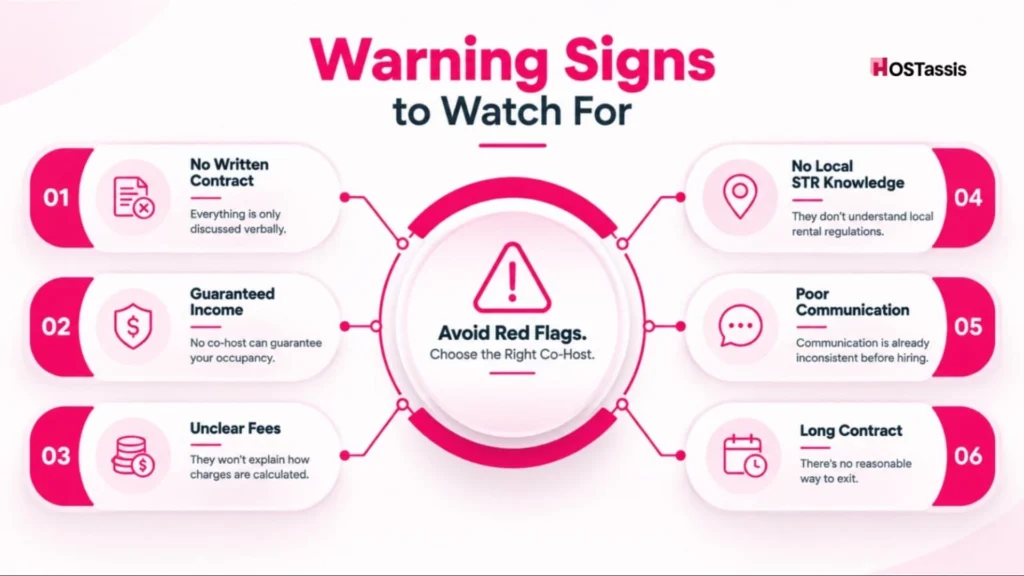
Hiring the wrong Airbnb co-host can lead to poor guest reviews, missed revenue, and
even property damage, which is exactly why watching for warning signs during the vetting process matters.
When hiring an Airbnb co-host, watch out for red flags like vague processes, a lack of real experience, or any hesitation around signing a written contract.
If you notice any of these, slow down:
- No written contract, everything’s “understood” verbally
- Guaranteed income promises (nobody can actually guarantee your occupancy)
- Refusing to explain how fees are calculated
- No real knowledge of local STR laws
- Poor or inconsistent communication before you’ve even signed anything
- Long contracts with no real way out
Any one of these is a reason to ask more questions. Two or three together, and it’s probably time to look elsewhere. Professional operators, HOSTassis included, don’t need to hide any of this, because there’s nothing to hide.
Smart Questions to Ask Before Signing a Co-Host Agreement
Before signing a co-host agreement, hosts must clarify scope of services, financial splits, expense handling, and exit terms to properly protect both their property and income. As most users on Reddit agree, co-hosting still demands active monitoring rather than being a purely passive arrangement, which makes clear guidelines essential from day one.
Before you sign anything, ask:
- Who controls pricing decisions on my listing?
- Who handles it if a guest damages the property?
- How are reviews monitored and responded to?
- What happens, step by step, if I decide to leave?
- How do you keep up with local short-term rental laws?
What should I ask an Airbnb co-host before hiring?
At minimum, ask about their fees, how legal responsibility is split, contract terms, how they access your account, what they know about local compliance, and how easy it is to exit if things don’t work out.
How to Actually Onboard a Co-Host
Successfully onboarding a co-host, whether for Airbnb, an event, or a platform like Zoom, comes down to clearly defining responsibilities, setting up the right digital access permissions, and aligning on communication style before actually going live.
Deciding to hire someone is the easy part; honestly, what happens right after matters a lot more.
- Add Them Through Airbnb’s Official System: Use Airbnb’s built-in co-host invitation feature so they get the access they need without you ever handing over your password or payout details.
- Set Access Levels First: Figure out upfront what they’ll actually be managing, messaging, calendar, pricing, whatever it is, and only give access to that.
- Run a Short Trial Period: Start with something like a 30-day trial before locking into anything long-term. It gives both sides a real shot at seeing how things actually work together.
- Review the First Few Bookings Together: After two or three reservations go through, check in. See if response times, guest satisfaction, and communication actually match what was promised upfront.
- Document the Handoff: House rules, emergency contacts, property quirks- all of it needs to be written down somewhere real, not just explained once over a phone call and forgotten.
Co-Host vs Property Management Company: What’s the Difference
A co-host assists you inside your own rental account for a lower fee, while a property management company takes full operational control under its own business profile, often at a higher cost.
Both claim to take work off your plate, but they don’t operate the same way at all.
- Control: A co-host works inside your account and still defers to you on final calls, a property management company often takes over pricing, policies, and guest communication completely.
- Fees: Co-hosts usually run 10% to 30% of revenue, while full property management companies tend to charge more, sometimes 25% to 40%, given how much broader the scope is.
- Flexibility: Co-hosting setups are typically easier to adjust or walk away from, property management contracts often lock you into longer terms with tighter commitments.
- Ownership Feel: With a co-host, it still feels like your business, just supported. With a management company, it can start feeling like your listing belongs to their portfolio instead.
- Best Fit: A co-host works well for hosts who want help but still want to stay involved, a management company fits owners who want to step back almost entirely.
Why Choose Us for Airbnb Co-hosting
Hiring the wrong co-host can quietly cost you reviews, revenue, and peace of mind, hiring the right one gives you all of it back. That’s exactly the difference we aim to make.
- Official, Secure Access Only: We work entirely through Airbnb’s official co-host system, no passwords shared, no payout access taken, your account stays yours.
- Transparent, Work Based Pricing: Our fees are built around the actual scope of your property, not a one size fits all rate card with hidden costs buried in the fine print.
- You Stay in Control: Every major decision, pricing, policies, guest approvals, still runs through you, we support the business, we don’t take it over.
- Real Onboarding, Not Guesswork: We set clear access levels, document every process, and welcome a trial period so you can see exactly how we work before committing long term.
- Compliance Handled Properly: Licensing, local short term rental laws, and platform policy alignment stay tracked and current, so nothing quietly turns into a fine.
- Flexible, No Long Lock-Ins: Fair exit terms mean you’re never stuck; if it’s not working, you can walk away without a penalty for changing your mind.
We don’t just manage your listing; we protect it, the way you would if you had the hours in the day.
Final Thoughts: Hiring a Co-Host Without Losing Control
Co-hosting isn’t risky when it’s done right. What’s risky is doing it blind, signing whatever’s put in front of you, handing over a password because someone asked, or assuming “they’ll handle the legal stuff” without checking who “they” actually are.
Once you know what a fair contract looks like, who’s legally responsible for what, and how Airbnb’s own co-host system protects your account, most of the fear falls away. The right partner doesn’t take over your business; they protect it, and they give you back the hours you were losing to guest messages at midnight.
That’s the whole point of working with a team like HOSTassis: less stress, more control, and a business that finally runs without you having to be glued to your phone.