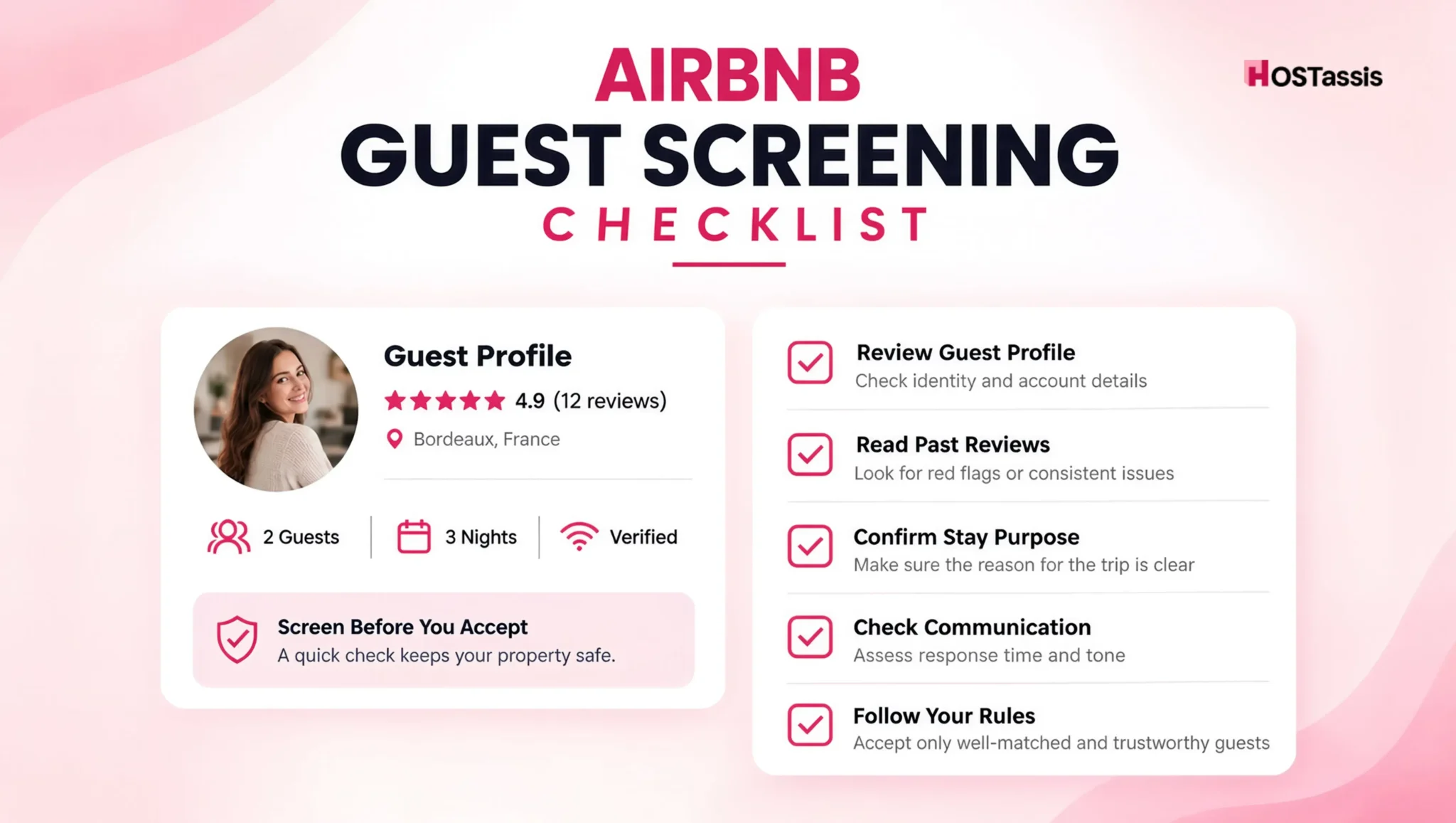
An Airbnb guest screening checklist helps hosts vet bookings the right way, catching red flags, preventing parties, and protecting the property, all while staying fully compliant with anti discrimination rules.
Guest screening is how you check who’s really behind a booking before you approve it, looking at their profile, past reviews, ID, and how they respond in messages. One bad guest can cost thousands in damage or wreck a rating you spent years building. A few minutes of screening before you hit accept is usually all it takes to avoid that, without turning your listing into a fortress.
What Is Airbnb Guest Screening?
Airbnb guest screening is the process of confirming who’s actually booking your place and checking how risky that reservation might be, whether that’s property damage, an unauthorized party, or outright fraud. It works in two layers: Airbnb’s own automated checks, like ID verification and machine learning risk scores, plus whatever extra vetting a host chooses to do themselves, usually just asking about the trip and who’s actually staying.
What Guest Screening Means: This isn’t a formal background check. It’s closer to a habit: looking at what Airbnb already shows you, a verification badge, a review history, a profile photo, and paying attention to how someone answers when you ask a simple question about their trip.
Why Every Airbnb Host Should Screen Guests:Plenty of hosts run great listings and still get burned because they accept every booking without a second look. A few minutes spent checking a guest before you hit accept can save you from a damage claim, a noise complaint, or a guest who was never planning to follow your rules anyway.
Airbnb’s Built-In Safety Features: Airbnb hosts a decent starting toolkit already: ID verification, reviews left by other hosts, and messaging that stays inside the app. None of it is bulletproof on its own, but most hosts don’t even use what’s already there.
5 Reason: Why Guest Screening Is More Important Than Ever
Guest screening is more critical than ever to protect rental properties, prevent unauthorized parties, and secure steady revenue.
Here’s what’s at stake without it:
- Fraud slips through. Fake identities and stolen payment info get booked and confirmed before anyone notices.
- Property takes the hit. Skip the vetting, and you’re more likely to deal with damage, theft, or a costly cleanup after checkout.
- Neighbors start complaining. Unscreened bookings are how party crowds sneak in, and that’s how hosts end up on bad terms with the whole street.
- Compliance gets messy. Cities are tightening occupancy rules and short-term rental laws, accurate guest info is what keeps hosts out of trouble.
- Insurance gets harder to hold onto. A clean claims history isn’t luck, it comes from knowing who’s actually staying in the property, and it’s often what keeps premiums lower.
Bottom line: screening isn’t a formality anymore. It’s the thing standing between a smooth booking and a legal or financial mess.
How Airbnb Screens Guests?
Airbnb screens guests through a mix of automated risk algorithms, identity verification, and booking requirements that hosts get to set themselves.
- Government ID Verification: Many guests are required to verify a government ID before booking. It won’t catch everything, but a verified badge is at least one thing worth glancing at before you accept.
- Profile Verification: A profile with a photo, a verified email, and a verified phone number tells you someone actually put effort into their account. A blank, brand-new profile isn’t automatically a red flag, but it’s worth a second look.
- Review History: This is probably the single most useful thing you have. A guest with several good stays behind them has already proven, more than once, that they respect rules and communicate reasonably.
- Payment Verification: Airbnb checks payment methods before confirming a booking, which cuts down on fraud quite a bit. Still, keep an eye out for anyone who wants to change payment details or push the conversation outside Airbnb’s system.
- Secure Messaging: Keeping every conversation inside Airbnb’s messaging protects you if something goes sideways later, since there’s a record. If a guest tries to move things to text or email early on, that alone is worth noting.
12 The Ultimate Airbnb Guest Screening Checklist
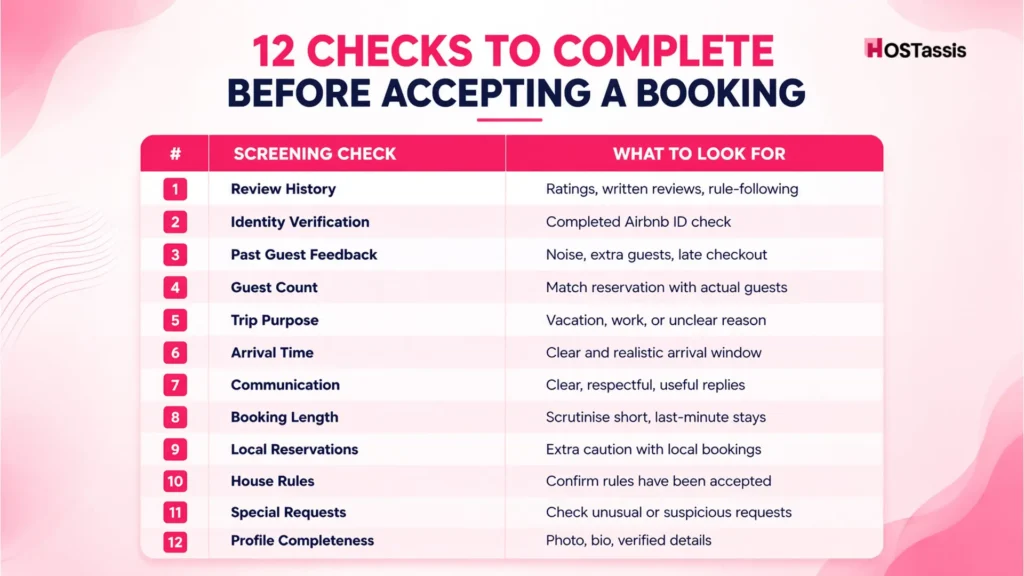
A solid screening checklist blends smart platform settings, careful profile review, direct messaging questions about the trip, and watching for red flags like off platform chats or mismatched guest counts.
Here’s the part that actually does the work: twelve checks worth running through before you confirm anything. Once it becomes a habit, it takes barely any extra time.
- Review previous guest ratings. Don’t just look at the star average, read the written comments about cleanliness, communication, and whether they followed the rules.
- Confirm identity. Make sure your guest has completed the Airbnb’s ID check, particularly if they’re staying long or the value of the place is higher.
- Read reviews from guests very carefully. Pay attention to how many guests are mentioned multiple times: noise, additional people in the room or late check-outs.
- Confirm the number of guests. Just ask directly, and compare that answer with what’s on the actual reservation.
- Ask about the purpose of the trip. A simple question usually reveals whether it’s a real vacation, work travel, or something a bit vaguer.
- Confirm arrival time. Guests who don’t offer a definite window are more difficult to work around and may show up late or unexpectedly.
- Check communication quality before booking. Slow or one-word replies now are usually a preview of how the stay itself will go.
- Review booking length. A very short, last-minute booking (particularly over a weekend) deserves more scrutiny than a planned week-long stay.
- Watch for local reservations. A guest booking a property in their own city is a known pattern tied to unauthorized parties.
- Confirm they’ve accepted the house rules. Send them directly and ask for a clear yes rather than assuming anyone reads the listing.
- Verify anything unusual in special requests, like early check-in with no real reason, or questions about neighbors and cameras.
- Check profile completeness. A photo, a bio, verified details, these are all small signs, but they add up.
Red Flags Every Host Should Watch For
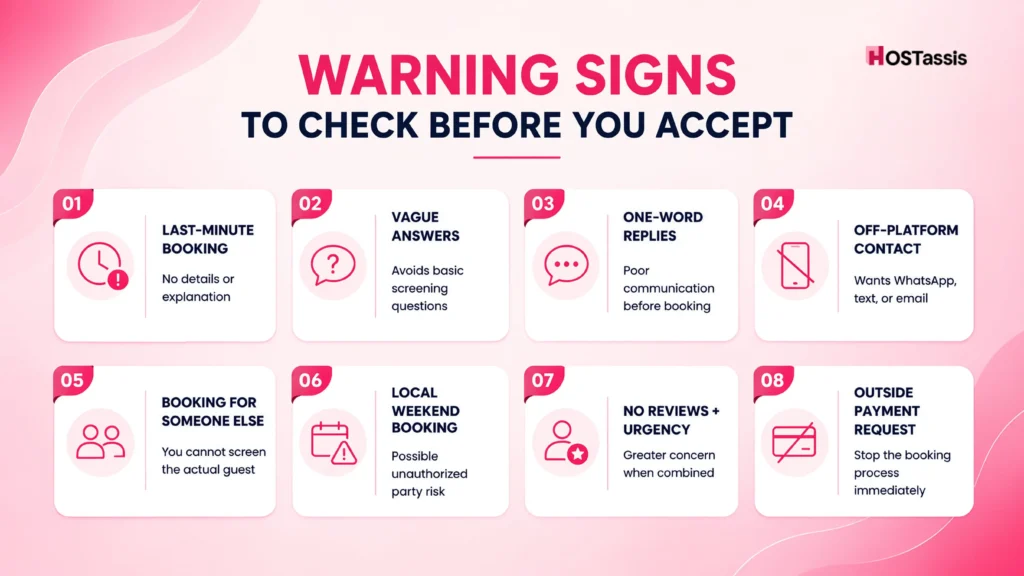
Hosts should stay alert for warning signs like a thin or incomplete guest profile, vague or evasive answers to simple questions, and any request to pay outside the platform, all common red flags worth taking seriously.
Past the checklist, certain patterns show up again and again in problem bookings. Once you notice them, they’re pretty easy to catch early.
- Last-minute bookings with no details attached are one of the most common signs of a party booking waiting to happen.
- Guests who dodge your screening questions, or give vague non-answers, are telling you something even if they don’t mean to.
- One-word responses before check-in often carry straight into how they treat the house rules once they’re there.
- Anyone asking to move the conversation to WhatsApp, text, or email early is trying to step outside Airbnb’s protections, and yours.
- A guest who says the booking is actually for a friend or family member removes your ability to screen the person who’s really staying.
- Multiple local guests booking together around a weekend or holiday is a well-known party pattern worth taking seriously.
- No reviews on their own isn’t a big deal, but paired with vague answers or urgency to book fast, it’s worth pausing on.
- Any request to pay outside Airbnb’s system should stop the process immediately, no exceptions.
How to Balance Safety With Great Hospitality?
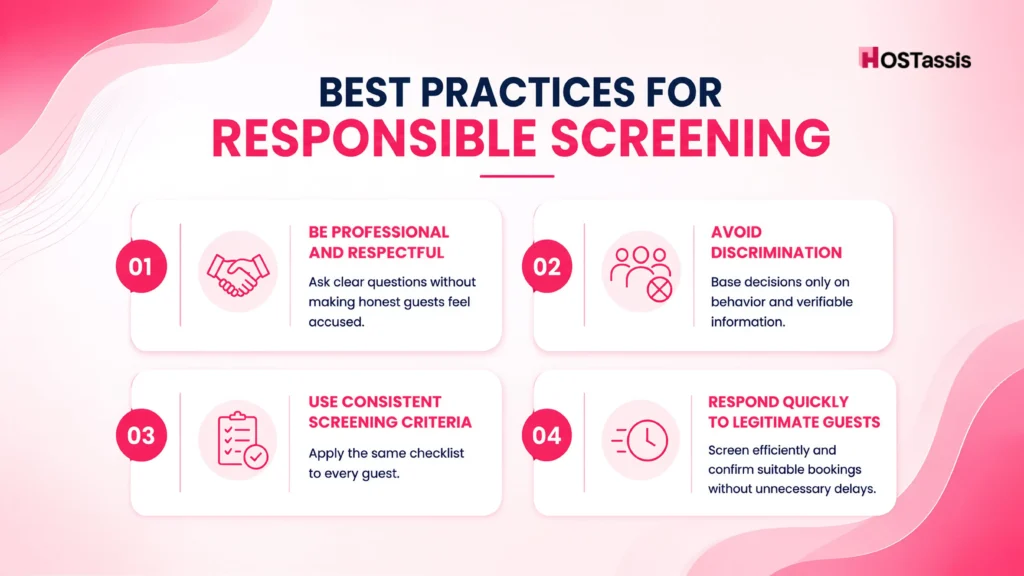
Real hospitality security works quietly. It means proactive guest communication, subtle design choices like better lighting and access control, and staff trained to handle situations with calm, respectful empathy
- Be Professional and Respectful: Ask your questions the way you’d want to be asked yourself, clearly, politely, without any accusation baked in. Most honest guests won’t mind a couple of extra questions if it feels like routine.
- Avoid Discrimination: Never base a screening decision on race, religion, national origin, or anything like that, both against Airbnb’s policy and against the law in most places. Stick to behavior and verifiable details only.
- Use Consistent Screening Criteria: Run the same checklist for every guest, every time. That consistency protects you legally and keeps things fair instead of reacting differently depending on a gut feeling.
- Respond Quickly to Legitimate Guests: Screening shouldn’t slow things down for the guests who are clearly fine. Reply fast, ask your questions upfront, and confirm the booking as soon as they check out okay.
Helpful Tools for Guest Screening
Guest screening tools handle the heavy lifting automatically, verifying identity, running background checks, and scoring risk, all to keep short term rentals and hotels safe from property damage and fraud.
You don’t have to do all of this by hand. A mix of Airbnb’s own features plus a few outside tools makes screening faster without cutting corners.
- Airbnb’s own verification features (ID checks, verified reviews, payment verification) cost nothing extra and should be your first line of defense.
- Smart lock systems let you issue a unique code per reservation and cut off access instantly if something feels wrong.
- Noise monitoring: devices, the sound-level kind, not recording devices, can flag party-level noise without invading anyone’s privacy.
- Property management software: like Guesty or Hospitable pulls messages, reviews, and booking history into one place, which makes patterns much easier to spot.
- Automated messaging tools that send your screening questions the second a request comes in to save time without skipping a step.
- Fraud detection platforms can flag suspicious payment activity or duplicate accounts before the reservation even reaches you. And if you’re managing more than one property, a co-hosting or virtual assistant service can run this whole process for you, so nothing gets missed on a busy week
What You Can and Cannot Ask During Screening?
Where exactly is the legal line here? It’s actually simpler than most hosts think.
- Safe to Ask: Trip purpose, headcount, arrival time, and whether they’re okay with house rules, none of that touches a protected category, so it’s all fair game.
- Risky to Ask: Occupation, family status, religion, anything that even brushes up against race, disability, or where someone’s from. Even with zero bad intent, these can tip into discrimination territory fast.
- Stay Behavior Focused: Base decisions on what you can actually verify, reviews, ID checks, how someone communicates, not assumptions about who they might be.
- Apply It Equally: Same questions, every guest, every single time. That consistency is what protects you if anyone ever questions a decision.
What To Do After Spotting a Red Flag?
Spotting the red flag is the easy part. Knowing what comes next is where hosts usually freeze up.
- Don’t React Immediately: Take a beat. Look at the whole picture, profile, reviews, message tone, before jumping to any conclusion.
- Ask a Follow Up Question: Half the time a vague answer just means someone was typing on their phone in a hurry. One direct follow up usually clears it right up.
- Decline Through the Platform: If something still feels off, decline through Airbnb itself, and keep the reason tied to policy or behavior, nothing personal.
- Report If Necessary: Fraud attempts, off platform payment requests, anything serious, report it. It protects you and keeps other hosts in the loop too.
- Document Everything: Keep every conversation inside Airbnb’s messaging. If a dispute ever comes up, that record does the talking for you.
Why Choose Us for Airbnb Co-hosting?
Screening every single booking properly takes real attention, and honestly, that’s usually the first thing to slip once you’re juggling more than one property. That’s exactly where we come in.
- Consistent Screening: Same checklist, every reservation, profile checks, review history, ID verification. Nothing gets skipped just because it was a hectic week.
- Compliant Questions: Everything we ask stays within Airbnb’s guidelines, focused purely on trip details and behavior, never anything personal.
- Red Flag Handling: If something feels off, we follow up, verify, and decline or report through the platform the right way, calm and fully documented.
- Full Documentation: Every conversation stays inside Airbnb’s messaging, so there’s a clear record sitting there if a dispute ever comes up.
- Faster Response: Genuine guests aren’t left waiting around, so screening never actually costs you a good booking.
- One Less Thing on Your Plate: We handle the vetting, you deal with fewer damage claims and a lot less stress.
We treat every reservation like it’s our own property on the line, checked properly, protected quietly.
6 Common Guest Screening Mistakes
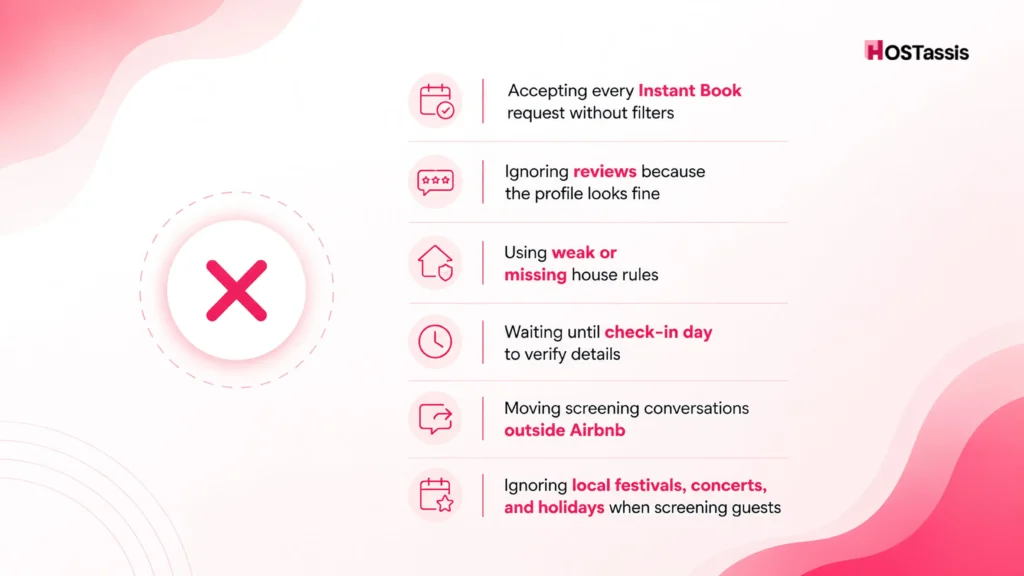
Most screening failures come down to five habits: accepting incomplete profiles, only checking the primary booker, skipping a standardized process, brushing off communication red flags, and leaving Instant Book open without any real filters.
Even hosts who’ve been doing this for years fall into habits that quietly undo the value of screening. Here’s where it usually breaks down.
- Accepting every Instant Book request without any filters removes your chance to actually look at a guest before they’re confirmed.
- Ignoring reviews because a profile “looks fine” is one of the easiest ways to miss a red flag that was right there.
- Weak or missing house rules give problem guests room to claim they never knew better.
- Waiting until check-in day to sort out details leaves no time to catch anything early.
- Letting screening conversations happen outside Airbnb’s messaging means you’ve got no record if a dispute comes up later.
- Local festivals, concerts, and holidays are exactly when local-guest party bookings spike, and exactly when hosts tend to let their guard down.
Frequently Asked Questions
Can Airbnb hosts reject guests?
Yes. Hosts can decline a reservation request as long as the reason isn’t tied to a protected characteristic like race, religion, or disability.
Is guest screening allowed on Airbnb?
Yes it is indeed. Airbnb authorises hosts to ask what is regarded as reasonable and verify info before accepting, if and to an appropriate extent, exercised reasonably.
How do I identify fake guest profiles?
Watch for a missing photo, no reviews, an unverified ID, and vague answers to your questions. None of these alone proves much, but together they’re a stronger signal.
What should I ask before accepting a reservation?
Number of guests, purpose of the trip, and confirmation they’ve read your house rules. Those three questions alone catch most problems.
Should I allow Instant Books?
Depends on your comfort level. Plenty of hosts keep it on but add requirements like verified ID and positive reviews so it filters out risky guests on its own.
What if a guest refuses to answer questions?
Take that as a warning sign. A guest who won’t answer basic, polite questions before booking probably won’t be transparent once they’re actually staying.
Final Thoughts
Screening was never really about rejecting more guests. It’s about making an informed call so both your property and the guest experience stay protected. A consistent checklist turns this from guesswork into something quick and repeatable. And if fitting this into an already full schedule feels like one task too many, that’s exactly the kind of work a dedicated Airbnb co-host or virtual assistant can take off your plate, so every booking still gets checked, even when you don’t have the time to do it yourself.