Good remote co-host management is not about handing over tasks and walking away. It is about having a clear system, the right tools, and people you can trust on the ground.
When everything is in place, your property runs smoothly whether you are in the same city or on the other side of the world.
You need clear roles, simple daily processes, automated guest messages, and a way to track performance. Everything works together through one simple central system. Things stay on track, confusion is reduced, and growth becomes much easier. Everything stays on track, confusion is reduced, and growth becomes much easier.
And if you want to skip the setup entirely, HOSTassis offers a friendly, easy co-hosting service built exactly for hosts who want stress-free remote management. We provide professional service and stay transparent to our hosts. With HOSTassis, you never lose control of your property.
Today, we will discuss a complete guide to managing your Airbnb co-host remotely.
What Is Remote Airbnb Co-Host Management?
Remote Airbnb co-host management is when someone handles the daily operations of your rental property from a distance, including guest communication, bookings, and cleaning coordination, so you do not have to do it all yourself.
A remote co-host never shows up at the door. A local co-host can do a quick visit, check on things in person, and handle last-minute situations on the spot. A remote co-host focuses on communication, coordination, and systems. They manage bookings, guest messages, pricing, and issue resolution by working with local teams. Guests or you don’t have to meet them in person.
People love this remote setup because it gives them freedom and flexibility. They can manage properties in different cities or countries without needing to travel or stay nearby. It also saves time, letting owners focus more on growing the business rather than handling daily tasks.
With the right system in place, everything stays consistent and runs smoothly. Another big reason is scalability. Hosts can manage multiple properties at once and grow faster, all while staying in control from anywhere.
There are a few key things that show you how a good co-host keeps everything under control from a distance
What Changes in a Remote Setup
When no one is physically present, the whole operation has to work differently. Here are some key changes:
No physical oversight. No one can walk in and check on things. Issues get caught through guest feedback, cleaner reports, and regular check-ins instead.
System dependency. Everything runs on tools and clear steps. If one thing breaks or someone skips a step,it shows up quickly in the guest experience.
Digital-first operations. All tasks and updates happen through apps and messages. Clear communication is the only way things stay on track.
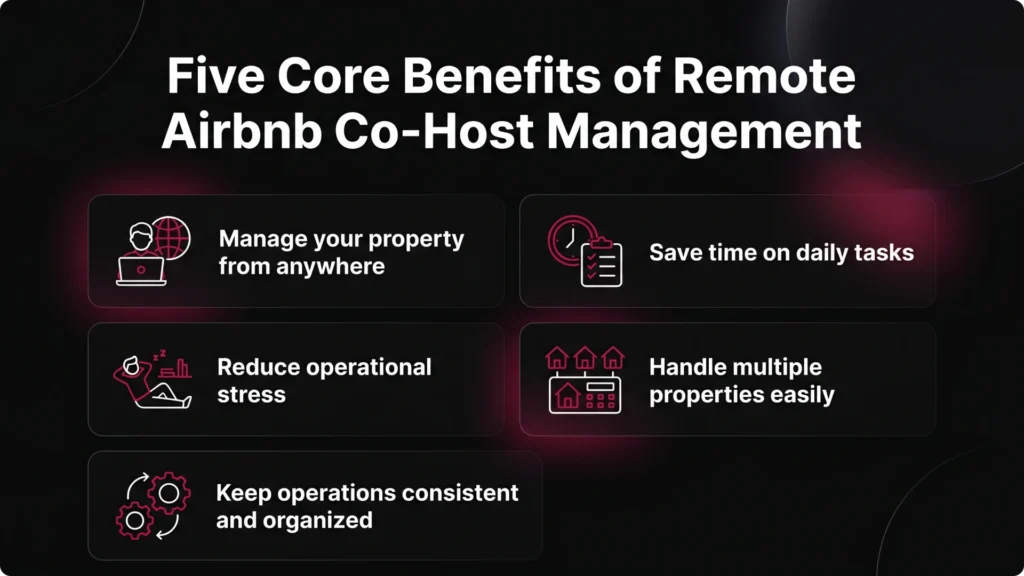
Benefits of Remote Airbnb Co-Host Management
Remote Airbnb co-hosting lets you manage properties from anywhere. It makes it easier to scale across multiple listings, respond to guests quickly with the help of tools and automation, and maintain a consistent, professional experience through clear systems and processes.
- Manage properties from anywhere without location limits
- Lower overhead compared to hiring local, in-person help
- Easy to scale across multiple listings or markets
- Faster response times with the right tools and automation in place
- More consistent guest experience through standardized systems and processes
5 Pillars of Remote Airbnb Management
There are a few key things that show you how a good co-host keeps everything under control from a distance.
Role Clarity
Clearly define who is responsible for what to avoid confusion in daily operations.
Process Standardization
Create simple step-by-step processes for tasks to keep everything consistent and easy to follow.
Automation
Use tools to automate messages, bookings, and routine tasks to save time and reduce manual work.
Performance Tracking
Track key metrics such as response time and guest reviews to measure how well things are running.
Communication Systems
Establish clear and reliable communication channels to stay connected and resolve issues quickly.
10 Steps to Successfully Manage an Airbnb Co-Host Remotely
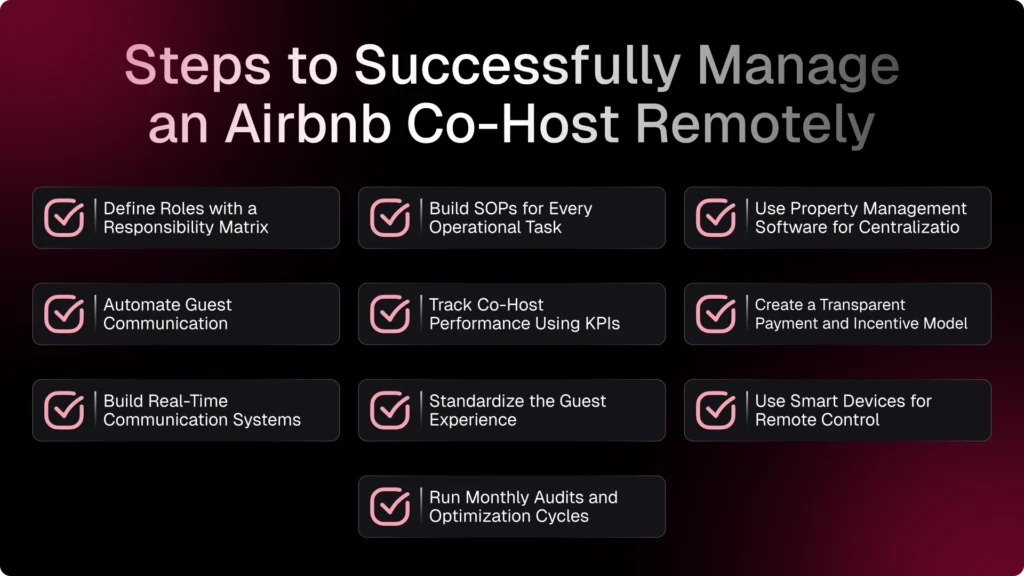
Successfully managing an Airbnb co-host remotely works best when you set things up right from the start. Keep roles clear, communication simple, and here are 10 steps to make it stress-free:
1. Define Roles with a Responsibility Matrix
The first step is to clearly define who does what, not in a general way, but in a clear and specific way. The owner, co-host, cleaners, and maintenance team should each know their role and focus on their own tasks.
- Owner handles pricing, listing strategy, big decisions, and performance oversight
- Co-host manages day-to-day operations, guest coordination, and on-ground response
- Vendors handle specific tasks like cleaning, repairs, or restocking on a scheduled or as-needed basis
When there is no structure, accountability gets lost quickly. When something goes wrong, and no one knows who was responsible, the same problem keeps happening again and again. A simple responsibility list can fix this.
2. Build SOPs for Every Operational Task
SOPs (Standard Operating Procedures). Sounds fancy, but they are written instructions for how things get done. The goal is simple. Your co-host should be able to handle any situation without having to call you first.
- Check-in and checkout: Step-by-step process, what gets checked, what gets photographed, what gets reported
- Cleaning workflows: room-by-room checklist, restocking quantities, photo sign-off before every new guest
- Emergency handling: what counts as an emergency, who to contact first, what your co-host can decide alone, versus what needs your approval
Write these once, store them in a shared location, and update them when things change. That is really all it takes.
3. Use Property Management Software for Centralization
When you use WhatsApp, email, Airbnb messages, and spreadsheets at the same time, tasks get missed, and double bookings can happen. One central platform keeps everything in one place for you and your co-host.
- Tools to look at: Guesty, Hostaway, and Hospitable are all solid options, depending on your portfolio size
- Booking sync: all your calendars update in one place, so there are no conflicts across platforms
- Task automation: cleaning jobs, check-in reminders, and maintenance follow-ups can be triggered automatically without anyone having to remember
Pick one tool and actually use it consistently. That matters more than picking the most expensive option.
4. Automate Guest Communication
Most guests repeatedly message the same questions. Automate them. Your response rate stays high, guests feel taken care of, and you and your co-host do not need to send the same message over and over each month.
- Pre-booking: Answer common questions before they are even asked with a strong listing description and quick auto-replies
- Check-in instructions: Send automatically 48 hours before arrival with everything the guest needs, including door codes, parking, and house rules
- Review generation: A well-timed message after the stay, asking for a review, gets more responses than waiting for guests to remember.
Set it up once and let it run.
5. Track Co-Host Performance Using KPIs
You cannot control what you do not track. Regularly checking your numbers helps you stay informed even when you are not physically there.
- Response time: How quickly are guest messages being answered
- Guest rating: Overall score and specifically the cleanliness and communication subcategories
- Cleaning quality: Monitored with guest reviews and photos after every turnover
- Occupancy rate: Is the calendar filling up, or are there gaps that need attention
Review these monthly at a minimum. If a number drops, you want to know about it early, not after it has already affected your reviews or revenue.
6. Create a Transparent Payment and Incentive Model
How you pay your co-host affects how invested they are in the property’s success. Be clear about the structure from the start and put it in writing.
- Fixed vs commission: A fixed monthly fee gives your co-host stability while a commission model ties their income to performance. Some hosts use both.
- Performance bonuses: A small bonus for maintaining a 4.9 rating or hitting an occupancy target gives your co-host a real reason to go the extra mile.
When a co-host feels valued and rewarded, they treat your property with more care and responsibility.
7. Build Real-Time Communication Systems
Good systems reduce the frequency of communication. But when something comes up, you need a fast and reliable way to connect. Random messages across different chats are not effective.
- Tools like Slack or WhatsApp: Work well for day-to-day property updates. Create a dedicated channel or group just for the property, so nothing important gets buried.
- Response SLAs: Set clear expectations for how quickly each message type should be answered. Routine updates within a few hours, urgent issues within 30 minutes. Put it in writing to avoid confusion.
Communication problems are usually not about the tool. They are about not having agreed on how to use it.
8. Standardize the Guest Experience
Every guest should have the same great experience regardless of who handled the turnover or which cleaner was on that day. Consistency builds your reputation and keeps the reviews strong.
- Amenities checklist: The same items are restocked to the same quantities every time. No guessing, no running out of basics
- Messaging tone: Friendly, clear, and professional. Whether it is an automated message or your co-host typing a reply, it should sound like it is coming from the same place.
- Brand consistency: Small details like how towels are folded, how the welcome area is arranged, and whether there is a handwritten note all come together to create an experience guests remember and talk about.
9. Use Smart Devices for Remote Control
Technology makes it easier to manage things without being on location. The right devices give you and your co-host real visibility and control without anyone needing to be on location constantly.
- Smart locks: Generate unique codes for each guest and each cleaner. No physical keys to manage, no lockouts, and a full access log you can check remotely
- Noise monitors: Tools like Minut notify you when noise goes above a set level, without recording any audio. This helps you enforce house rules while still respecting guest privacy.
- Remote access systems: Smart thermostats, leak detectors, and entry cameras help you monitor the property and spot problems early before they become costly.
10. Run Monthly Audits and Optimization Cycles
A remote operation that never gets reviewed slowly drifts. Small problems go unnoticed, processes get outdated, and performance quietly slips. A simple monthly audit keeps everything sharp.
- Performance reviews: Review your KPIs with your co-host every month. Identify what is working well and fix issues early while they are still easy to handle.
- Feedback loops: Read every guest review carefully. Patterns in the feedback usually point directly to something in your process that needs adjusting.
- Process improvement: If the same issue keeps coming up, the SOP needs to be updated. Treat your systems as living documents, not things you set once and forget
One short monthly call and a quick look at the numbers is usually all it takes to stay ahead of problems before they grow into something bigger.
Why Most Remote Co-Host Systems Fail
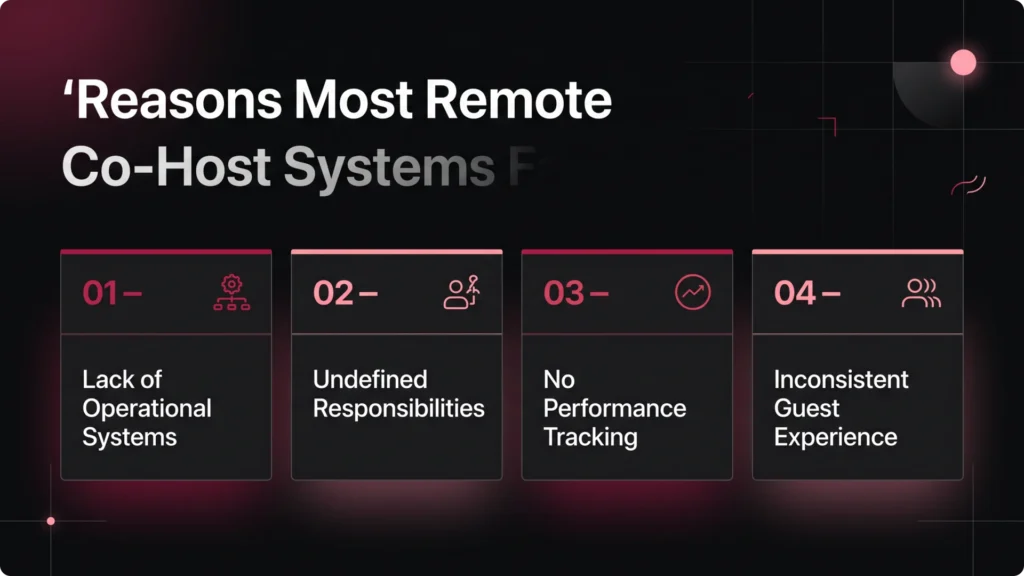
Most remote Airbnb setups fail because there is no clear system, no defined roles, and no performance tracking. Tasks get missed, communication breaks down, and the guest experience becomes inconsistent, making the whole operation feel unreliable.
Here are the details:
Lack of Operational Systems
Most co-hosts start without a clear system. There are no checklists and no standard way to manage cleaning, maintenance, or guest requests. Everything depends on memory and guesswork. When something goes wrong, there is no clear process to follow. As a result, tasks get missed, and guests notice.
Undefined Responsibilities
No one is sure who is responsible for what. The host thinks the co-host is handling it, and the co-host thinks the host is doing it. This confusion creates problems. Without clear roles, small tasks get missed, and bigger issues take longer to fix.
No Performance Tracking
If you are not tracking anything, you cannot see what is working. Things like response time, cleaning quality, guest complaints, and reviews show where problems are. Without tracking, you are just guessing. Some unprofessional co-hosts never set this up from the start.
Inconsistent Guest Experience
All these problems lead to the same outcome. One guest has a great stay, and the next walks into a dirty place with things not working and no response from anyone. This inconsistency hurts your reviews and your income. Guests do not care why it happened. They will leave a bad review and move on.
Here’s a quick list:
Why Most Remote Co-Host Systems Fail
- No systems or checklists in place
- Unclear roles between host and co-host
- Nobody is tracking reviews or response times
- Cleanings and maintenance are handled inconsistently
- Guest issues fall through the cracks
- No standard process when things go wrong
- Everything runs on memory instead of a structure
- Small problems pile up until guests notice
How to Hire and Manage the Right Airbnb Co-Host For Remote Setup
Your remote setup will make or break it, depending on the co-host you choose. A co-host who can communicate well, handle problems fast, and show up when needed is worth more than any tool or software.
Key Skills and Traits
The right co-host is fast, reliable, and thinks on their own if they own these skills
Communication. They need to respond fast and keep you updated without you having to chase them. If a guest messages at 10 pm, you want someone who handles it before midnight. Slow communicators cause bad reviews.
Reliability. It means they show up every time. Cleanings stay on schedule, maintenance gets checked, and keys are in place. A missed task can ruin a guest’s stay and cost you a five-star review.
Problem-solving. Sometimes things go wrong. Pipes leak. Guests get locked out. Cleaners cancel at the last minute. You need someone who can handle it on their own without calling you for every small issue. In short, you need to hire a first thinker co-host.
Vetting and Trial Process
Before you handover your responsibilities to a co-host,make sure they are enough trustworthy
Interview. Ask real questions about past situations. How did they handle a difficult guest? What do they do when a cleaner cancels? You want specifics, not general answers about their responsibilities.
Scenario Testing. Give them a few real situations and ask how they would respond. A guest says the hot water is not working. A cleaner shows up two hours before checkout. Their answers tell you a lot about how they actually think under pressure.
Trial Period. Start with one or two listings before handing over everything. Watch how they communicate, how they handle issues, and whether they follow the systems you set up. A short trial saves you from a long, bad fit.
FAQs
1. Can you manage Airbnb remotely?
Answer: Yes, using automation tools, SOPs, and a reliable co-host system.
2. How much should you pay a co-host?
Answer: Typically 10%–30% depending on responsibilities.
3. What tools are required?
Answer: Property management software, communication tools, and smart devices.
4. How do you ensure cleaning quality remotely?
Answer: Use SOP checklists, photo verification, and performance tracking.
Get Your Remote Co-Host From HOSTassis
If you own a short-term rental on Airbnb, managing it alone can get overwhelming fast. HOSTassis offers a remote co-hosting service where a team handles the day-to-day work of running your listing from a distance. This includes guest communication, booking management, cleaning coordination, and keeping your listing optimized.
Our team is available around the clock to handle check-ins, guest messages, special requests, and any issues that come up. They also use tools like Guesty, Hospitality, and Hostaway to keep everything organized and running smoothly. The goal is simple: less work for you and a better experience for your guests.
Conclusion
Remote co-hosting is not just a trend; it is quickly becoming the smarter way to run a short-term rental. Hosts all over the world are realizing that you do not have to be on-call 24/7 to run a great listing. With the right systems and the right co-host managing things on your behalf, your property can perform just as well, sometimes even better, than if you were doing it all yourself.
The short-term rental space is only getting more competitive, and guests are expecting more than ever. Having a dedicated co-host means someone is always on top of things, from responding to messages quickly to making sure the place is spotless before every check-in. That kind of consistency is what gets you better reviews, more bookings, and ultimately more income.