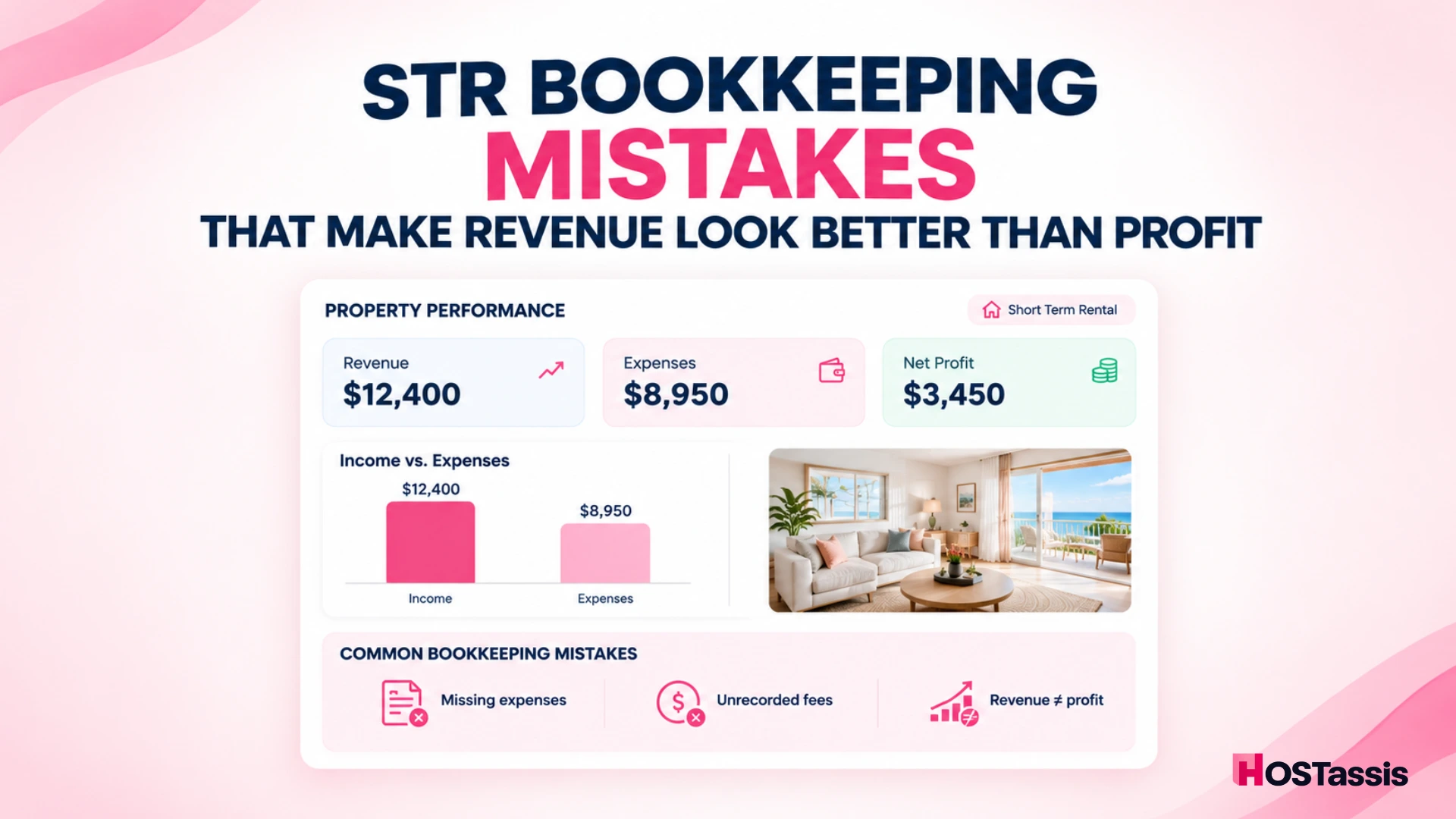
STR (Short-Term Rental) bookkeeping means accurately tracking your Airbnb business’s income and expenses. Ineffective expense tracking decreases STR revenue by hiding costs. If you don’t consistently track all your income and expenses, you won’t know where your money is going or whether you’re spending it on things that are actually profitable for your business.
The most common STR bookkeeping mistakes are recording only the net Airbnb payout as income, not keeping personal and business expenses separate, and keeping all property finances in one account. From the outside, these mistakes may seem ineffective and ignorable, but internally they can turn a profitable business into a loss-making one day by day. Research cited by PriceLabs suggests STR managers may lose 10–20% of monthly property spending to costs that aren’t billed or reimbursed. This could mean around $19,200 in lost revenue per property each year.
STR hosts could lose 10- 20% of their monthly property spending to untracked expenses such as repairs, cleaning, and supplies. Hosts who don’t track expenses may miss out on 20-40% of eligible deductions. For example, if a host earns $50,000 a year, they could miss out on $ 10,000- $ 20,000 in potential deductions.
Three Practical Fixes
- Use a simple monthly close. At the end of the month, check the company’s Airbnb payouts against the bookings to see if they match and ensure that all earnings and charges are properly accounted for.
- Keep income and expenses separate. Use a separate account for rental income, and track expenses for each property, including cleaning, repairs, supplies, utilities, and platform fees. This helps you see how much profit each property makes.
- Record the full booking amount. The entire booking amount should be recorded. If a guest pays $1,000 and Airbnb deducts $150 in fees, record $1,000 as income and $150 as an expense instead of merely the $850 payout of cash. This will record your actual income and expenses.
STR Financial Terms
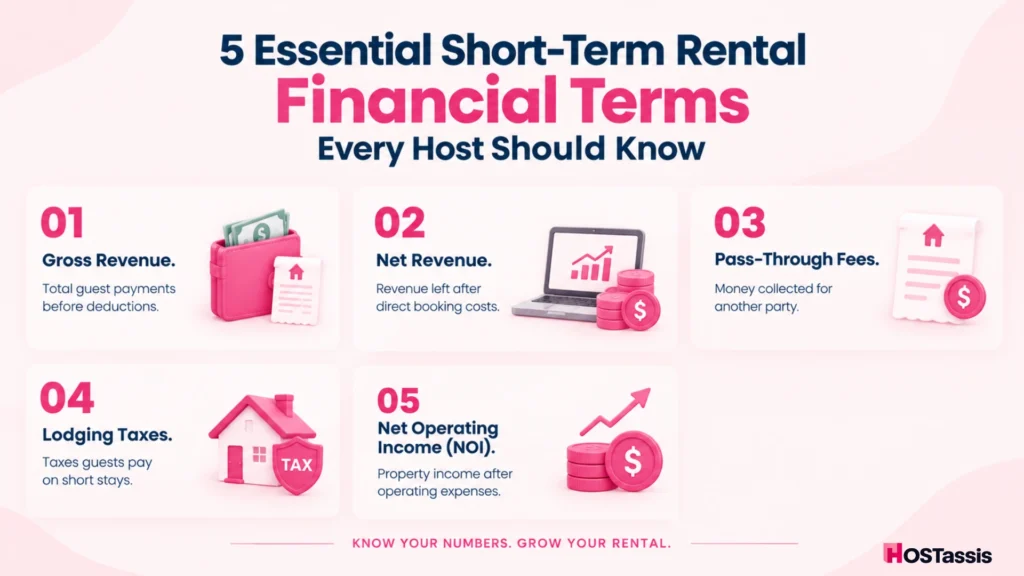
For hosts, understanding short-term rental financial terms is crucial because you need them to track income, expenses, and overall profitability. Below are the 5 essential terms every host should know.
1. Gross Revenue: Gross Revenue means the consideration payable to you by a Guest for the supply of accommodation, excluding any taxes or expenses incurred. Its value will include the nightly amount, cleaning fee, pet fee, additional guest fee, or other charges payable by a guest, and represents the revenues of your business, excluding profit and taxes
Example: If a guest pays $250 for the stay and a $60 cleaning fee, gross revenue is $310.
2. Net revenue: Net revenue is the money left after deducting expenses directly related to bookings. These costs may include platform fees, payment-processing fees, refunds, cancellations, and cleaning costs. It gives a clear view of how much your bookings are earning.
Simple formula: Net revenue = Gross revenue − direct booking costs.
Example: If gross revenue is $310 and platform and cleaning-related costs are $85, net revenue is $225.
3. Pass-through fees: Hosts collect fees from guests and deliver it to another party in this case. This money doesn’t count as your profit. Examples include lodging taxes, tourist taxes, and some cleaning or damage-protection fees. Track these fees separately so you know how much your rental business actually makes.
4. Lodging taxes: Lodging taxes are taxes hosts charge guests for short-term stays, such as hotel or vacation-rental stays. Hosts usually collect payment from guests at booking and remit it to the local government. These taxes should not be counted as rental profit.
Hosts should keep them separate to prevent confusion between rental profit and these taxes.
5. Net Operating Income (NOI): Net Operating Income (NOI) shows how much profit a rental property makes from its daily operations. It is calculated after deducting regular operating expenses, but before loan payments, income taxes, and depreciation.
Simple formula: NOI = Gross Revenue − Operating Expenses. Operating expenses include cleaning, utilities, maintenance, supplies, property management fees, Airbnb fees, insurance, and repairs.
Top STR Bookkeeping Mistakes That Impact Revenue
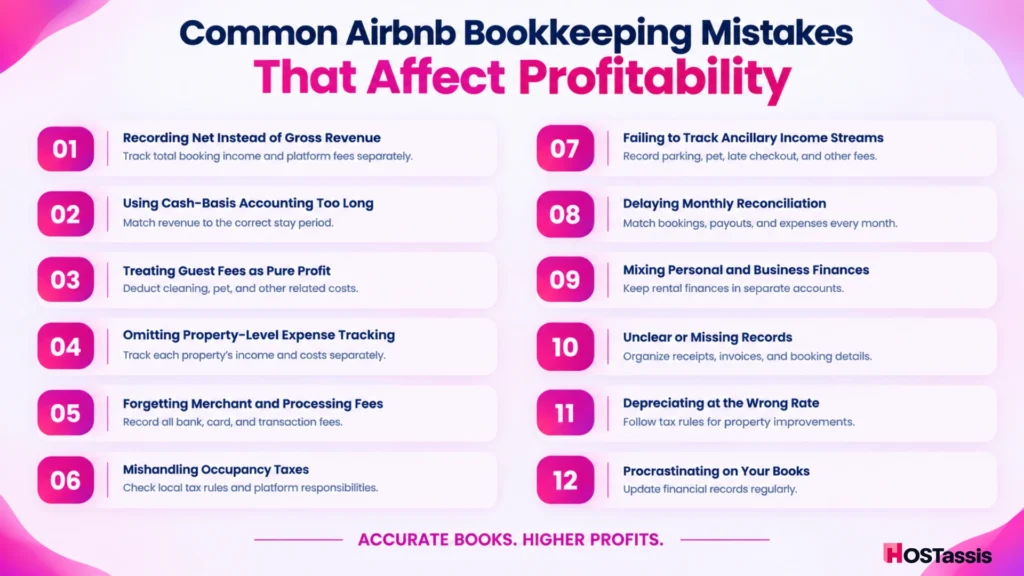
Without accurate records, hosts may struggle to understand their actual earnings. Many short-term rental hosts focus on bookings and guest reviews and ignore checking the bookkeeping. When payouts, fees, taxes, refunds, and property costs are not recorded correctly, a host cannot see which listing is profitable or where money is leaking. To fix this, avoid the key bookkeeping mistakes outlined below.
1. Recording Net Payouts Instead of Gross Revenue
Many hosts record only money that goes directly to their bank account, while Airbnb takes its service fees before transferring the rest to the host’s account. That means the host records less income than the guest actually paid.
For example, if a guest pays $1,000 and Airbnb keeps $150, the host may receive $850. Some hosts record only $850 as income. This makes both revenue and platform costs look lower than they really are.
Impact on Revenue: This makes it harder to understand the Airbnb or platform fee and the real profit of your business. It also makes it difficult to compare booking platforms and see whether direct bookings could help save money.
2. Staying on Cash-Basis Accounting Too Long
Cash basis accounting is a method in which cash inflows (revenues) and cash outflows (expenses) are recorded when they occur. While this method works well for individual hosts and new entrants, it may not accurately reflect the company’s finances.
For example, if your client pays $ 1,000 and Airbnb deducts $150 in fees, you will receive $850. Many hosts record only that $850 as income, even though they paid more. As a result, your tax liabilities will be lower than in the case when all money would go directly to you.
Impact on Revenue: Cash-basis accounting can make the financial picture sometimes higher or sometimes lower than it actually is. This makes it harder to understand seasonal trends, measure the success of promotions, and plan for slower months. Sometimes hosts may struggle to pay the cleaner or other workers on time.
3. Treating Cleaning and Guest Fees as Pure Profit
Some hosts think cleaning fees, pet fees, extra-guest fees, and late-checkout fees are extra profit, but if you look closely, you can see these fees also come with costs.
For example, a cleaning fee pays your cleaner to come to your business. An extra-guest fee may cover more laundry, electricity, and supplies. These fees aren’t actual profit because they cover the extra costs they create.
Impact on Revenue: Some hosts mistake these fees for real profit; they think they are earning more from them. They set their prices below the market rate and offer services that actually lose more than they make. As a result, actual profit can’t rise, even in peak season.
4. Omitting Property-Level Expense Tracking
Some new hosts mix all expenses into the same categories, such as “maintenance,” “supplies,” or “utilities,” without separating them by property. But this doesn’t work well for all property types or for more than one listing.
Each property has its own cleaner, repair history, utility use, furnishing needs, well amenities, and guest behavior. You cannot manage all kinds of expenses in a single expense category. This also can not show the earnings and expenses for each of your properties.
Impact on Revenue: Without tracking each property separately, you can’t tell which one is actually the best performer. Sometimes a property looks profitable only because it includes costs from other properties. You may keep spending money on a listing that isn’t profitable enough or miss the chance to cut costs where it matters most.
5. Forgetting Merchant and Processing Fees
Hosts sometimes track only the booking amount and payout but overlook minor deductions: payment-processing charges, currency-conversion fees, bank transfer fees, credit-card fees, and platform-related transaction costs. These fees may seem unnoticeable on one booking, but across 3 or 5 bookings, they add up and increase your business costs.
Impact on Revenue: If you skip recording every minor and major expense, your profit figure becomes inaccurate. You will be confused about where the hidden costs are coming from. Your property management will become a mess.
6. Mishandling Occupancy and Lodging Taxes
Occupancy taxes are often misunderstood because the rules vary by city, county, or state. Some places call it a lodging tax, hotel tax, or room tax. Others call it a transient occupancy tax, tourist tax, or sales tax. The main thing is whether the tax applies to your property and who collects it and sends it in.
Skipping Lodging Taxes
This is a misconception that Airbnb and other booking platforms handle all kinds of taxes. Airbnb and Vrbo collect and pay specific taxes in some locations. So, taxes that booking platforms do not collect are the hosts’ responsibility.
To handle this correctly:
- Understand your local lodging-tax requirements before listing.
- Identify applicable hotel, occupancy, room, sales, stay, and tourist taxes.
- Confirm whether Airbnb or Vrbo collects and remits each tax for your exact location.
- Keep documentation showing what the platform collected and what remains your responsibility.
Charging the Wrong Tax Rate
Another common issue is applying one flat tax rate to every booking. In many places, multiple jurisdictions may impose a tax: city, county, state, tourism district, or special lodging authority.
To reduce this risk:
- Calculate the combined tax rate across all applicable jurisdictions.
- Check the rules using the property’s full street address, not just the city name.
- Review tax rules when laws, boundaries, or platform agreements change.
- Separate tax collected from actual rental revenue in your books.
Impact on Revenue: If you handle your taxes incorrectly, you may face unpaid taxes, fines, extra charges, audits, and refunds. When a platform collects tax, poor recordkeeping makes it hard to track what was collected and deducted. Tax issues distract you from your core operations and keep you behind your competitors.
7. Failing to Track Ancillary Income Streams
Hosts often track the money they earn from nightly bookings but forget to record other income sources. These may include parking fees, early check-in and late check-out fees, pet fees, crib or bike rentals, laundry services, local activities, damage-claim payments, and other extra services offered to guests.
These fees may seem small, but they can add up and significantly increase your rental earnings. If hosts don’t record these extra earnings, they may miss out, and you won’t be able to know how much revenue your property actually earns.
Impact on Revenue: When you don’t track income from extra services, it’s hard to know which services bring in good money. You may keep offering a service that takes a lot of time but earns very little. At the same time, you may miss opportunities to promote extra services guests are willing to pay for.
If you do not track this income this makes your actual earning lower than it actually is. As a result, you may think you are not using the right strategies for effective pricing, even when your property earns more than you realize.
8. Delaying Monthly Reconciliations
Monthly reconciliation means recording and checking your booking records, payouts, bank deposits, refunds, platform fees, and expenses to ensure everything matches the actual records. Many hosts don’t pay attention to this process regularly because payments may cover several bookings, refunds can take weeks to arrive, and money from multiple reservations may arrive in a single bank deposit.
In addition, failing to reconcile mistakes can have more severe consequences. Unpaid funds, duplicates, or unaccounted refunds or cleaning charges from a few weeks or months ago become hard to trace and recover in time.
Impact on Revenue: When you delay reconciliation, it becomes harder to find where your business is losing money. You may miss payments from bookings, forget to record refunds, overlook tax-deductible expenses, or make pricing decisions based on incorrect financial records.
9. Mixing personal and business finances
Many hosts use the same bank account for personal spending, rental income, repairs, and security deposits. This can make it hard to calculate actual rental income. This gets even bigger when you manage multiple properties or businesses owned by different people.
Two common mistakes are:
- Using the same bank account for several purposes
- Adding security deposits to regular business funds.
Impact on Revenue: When a host mixes personal and rental money, or keeps them in a single bank account, it makes it hard to see actual profit and track expenses. It can also create tax problems when you mix money from different businesses. But keeping your earnings separate and using separate bank accounts for each income stream can help you track your income without confusion and maintain clear financial records.
10. Unclear or Missing Records
Many hosts depend on memory, screenshots, messages, guesses, or different spreadsheets to manage their finances.They don’t keep any actual evidence to track everything. As a result, they may lose important receipts, struggle to track their monthly earnings, or forget to record booking changes, refunds, and damage claims.
Good and consistent records should clearly show how much guests paid, how much Airbnb charged, what cleaners received, how much was spent on the property, and why refunds were issued.
Impact on Revenue: Unclear or incomplete records can affect your revenue in several ways. You may miss valid tax deductions because you have no proof of your expenses. You may make financial decisions based on guesses instead of accurate records. Clear records also make it easier to handle insurance claims, taxes, and financial reviews by lenders or investors.
11. Depreciating at the Wrong Rate
Depreciation is the process of allocating an asset’s cost over the years it is used. It is usually provided for furniture, equipment, and appliances, as well as improvements to property.
Some Airbnb hosts make mistakes when they record these costs. They may treat expensive furniture or renovations as a one-time expense, depreciate small supplies, or spread the cost over the wrong number of years.
The right system depends on several factors, including the item’s price, regional tax regulations, and whether it was a small repair or a complete overhaul. You can turn to a tax expert to get help with this type of documentation and correctly reflect the deductions in your tax return.
Impact on Revenue: If you use the wrong depreciation rate, it can affect your Airbnb property’s profit and taxes. For example, if you spend $5,000 on a big property upgrade and record the full amount as an expense in one year, your profit may appear much lower than it actually is under the correct depreciation method.
On the other hand, if you spread the cost over too many years, your yearly expenses may appear lower than they should be. As a result, your taxable income may appear higher, and you could end up paying more taxes than necessary.
Both mistakes can give you an incorrect picture of your property’s financial performance. You may think your property earns less or more profit than it actually does. This can also make it harder to set rental prices, plan future expenses, and manage your cash flow.
12. Procrastinating on Your Books
Besides maintaining proper bookkeeping, an Airbnb host has many other responsibilities. They need to communicate with guests, arrange cleaning services, handle maintenance issues, and update their listings. As a result, they sometimes forget to track financial records until tax season.
This can cause many problems later. When a host delays tracking all finances, such as booking details, Airbnb payouts, receipts, and messages, to determine income and expenses, it takes extra time and increases the risk of recording errors and missing transactions.
Impact on Revenue: When a host delays bookkeeping, it creates serious financial problems for Airbnb hosts. When you leave your financial records unchecked for too long, it becomes harder to track your income and expenses.
You may forget to record expenses that could reduce your taxes, miss Airbnb payments, or discover tax problems too late to fix easily.
You may also make poor pricing decisions without up-to-date financial information. For example, you might think your property is making a good profit, but cleaning costs, maintenance expenses, and Airbnb service fees may be reducing your actual earnings.
Regular bookkeeping is the only way to avoid these problems. It shows a clear picture of how much money each property earns, which booking platforms bring in more revenue, and where you spend the most money. With this clear picture, you can control unnecessary expenses, set effective rental prices, and make wise decisions to increase profit.
How to Avoid Common Bookkeeping Mistakes in Your Short-Term Rental Business
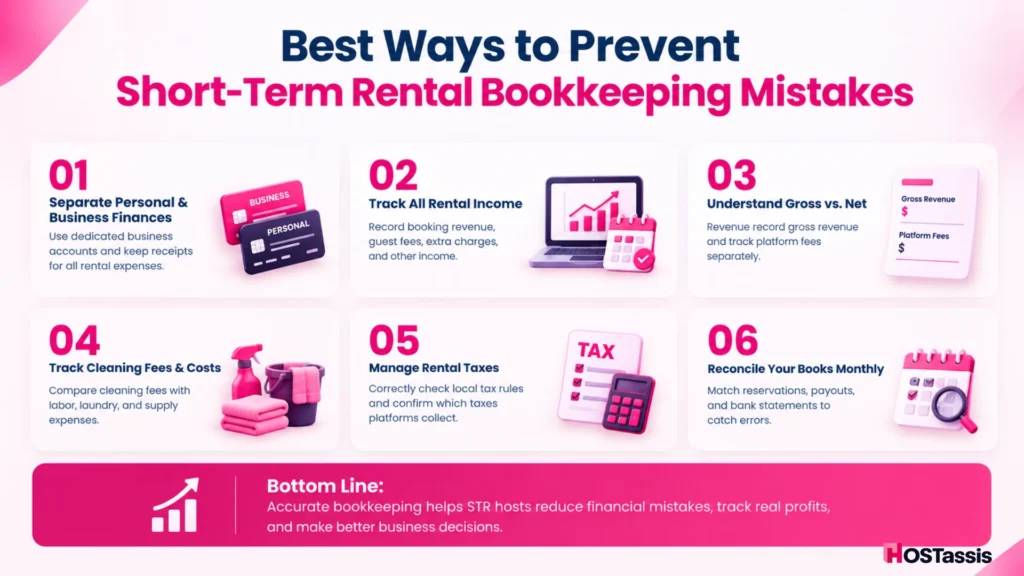
Good bookkeeping is more than just keeping receipts. For short-term rental hosts, it means understanding how much profit each property makes and how booking platforms, cleaning fees, and taxes affect their earnings. One of the biggest mistakes is treating the payout from a booking platform as total income. This is because the payout does not clearly show all the fees, taxes, refunds, and other charges. Here are some effective ways to avoid from these mistakes:
1. Separate Personal and Business Finances
When you mix personal and rental income and expenses, the host may have many expenses that are difficult to track and use to estimate profit. To simplify the process and ensure transparency in front of tax auditors, use the following guidelines for managing personal expenses in Airbnb accounting:
- Use a separate bank account: Keep all rental income and expenses, including cleaning, maintenance, supplies, and insurance, in a specific business account.
- Use a business credit card: Pay for property-related purchases with a separate card instead of your personal one.
- Keep records of personal payments: If you use your own money for a rental expense, keep the receipt and record the date, property name, reason, and payment details before paying yourself back.
- Avoid personal expenses: Do not use your rental account for personal trips, household bills, or other personal expenses unless they are rental-related.
You should also have a simple rule for personal payments. For example, if you buy something for your Airbnb with personal money, you can pay yourself back only when you have a receipt and record the expense under the correct property.
Keeping your personal and rental finances separate helps you avoid confusion, track your actual profit, and prepare monthly financial reports more easily.
2. Track All Short-Term Rental Income
Many hosts record only payments that enter their bank account; however, they must record every income source to get clear revenue figures. Track each income source separately to identify which items contribute most to revenue.
- Money earned from nightly bookings
- Cleaning fees paid by guests
- Charges for additional guests
- Fees for guests bringing pets
- Payments for early check-ins or late checkouts
- Money earned from parking, cribs, BBQs, bikes, or other equipment
- Payments received from direct bookings
- Commissions earned from recommending other businesses or services
- Damage-claim payments, where applicable
Recording all expenses can give you a clear picture of your actual rental income. This way, you can easily see where you spend your money and where your real income comes from. It will help you make good decisions for your property.
3. Calculate Gross vs. Net Rental Income
The total amount that guests pay before any fees are deducted is known as Gross rental income, and the amount hosts actually receive in their bank account after all the deduction is Net rental income.
A simple booking record should include:
| Items | Examples |
| Guest-paid booking total | $1000 |
| Cleaning fee | $100 |
| Platform service fee | $150 |
| Refund or adjustment | $0 |
| Net bank deposit | $950 |
Record a $1,100 gross amount as income, then record the $150 platform fee as an expense. If you record only the $950 deposit, you will understate both revenue and costs, making it impossible to compare the value of Airbnb, Vrbo, Booking.com, and direct bookings.
4. Track Cleaning Fees and Expenses
Not all of the fees you collect from guests are profit. You have to pay your cleaners (or turnover team) for cleaning between guests, laundry and cleaning supplies, linen replacement, and other cleaning costs.
Each month, compare:
- Cleaning fees collected
- Cleaner or turnover-team payments
- Laundry costs
- Cleaning supplies
- Linen replacement
- Extra cleaning after parties, pets, or damage
If your cleaning fee is $90, but you spend $120 on it, you lose $30 on every stay before platform fees. To fix this, increase your cleaning fee, lower laundry costs, ensure that cleaning rules are clearly explained to the guests, set clearer guest expectations, or adjust your stay rules. This will control cleaning costs and protect your profit.
5. Handle Short-Term Rental Taxes
Short-term rental taxes vary by city, county, state, and country. Do not assume that Airbnb or another platform handles everything.
- Check local tax rules: Determine which taxes apply to your Airbnb listing, such as tourist tax, occupancy tax, or sales tax.
- Check what Airbnb handles: Confirm which taxes Airbnb handles and which it doesn’t, and whether it collects and remits tax for your location.
- Keep tax records: If Airbnb pays the taxes on your behalf, save the tax report as proof. This money is generally not part of your income.
- Record taxes correctly: If you collect taxes from guests yourself, do not count that money as your income. Keep it separate because you need to pay it to the tax authority.
- Check each property’s tax rules: If you have properties in different cities or areas, check the tax rules for each one, as they may be different.
6. Reconcile Rental Income and Expenses Monthly
Monthly reconciliation means checking your booking records, platform payout reports, and bank statements to make sure everything matches.
Each month, check that:
- Every bank deposit matches one or more platform payouts.
- Every payout can be traced to specific reservations.
- Platform fees, cleaning fees, refunds, and taxes are recorded correctly.
- No booking is counted twice.
- No refund, damage claim, or canceled reservation is missing.
- Cleaner, maintenance, and supply payments match receipts or invoices.
This short checklist catches mistakes early, when they’re still easy to fix. It also helps you during the stressful tax season and busy schedules.
7. Use Bookkeeping Software for Short-Term Rentals
Spreadsheets may work well for managing one property with a few bookings. But when you manage multiple properties, booking platforms, cleaners, and co-hosts, it will get really hard for you to organize everything. You will end up with a lot of mistakes.
Use this simple progression:
| Business stage | Best setup |
| One property, few bookings | Spreadsheet plus separate bank account |
| Growing host | Accounting software plus organized expense categories |
| Multi-property host | Property management system connected to accounting software |
| Multi-platform operator | Centralized booking data, property-level reports, monthly reconciliation |
When you manage properties and want to make a profit, you have to play smart. Your business can be easier when you use the right tools. A property management system (PMS) helps you to track reservations, cleaning schedules, and bookings from different platforms. And accounting software helps you manage your income, expenses, and taxes. This way, you can easily check how much a guest paid, what fees were deducted, how much you spent on cleaning, and which property earned the money.
Conclusion
In the very first place, you have to stop counting your bank payout as your total income. Keep a separate record of platform fees, refunds, cleaning costs, taxes, and other minor expenses. This gives you a clear financial picture of how much profit you actually make from each booking.
Also, don’t wait until tax season to do your bookkeeping. Tracking your bookings, payouts, bank deposits, and expenses each month takes time, but it also helps you find missing refunds, unpaid bills, duplicate records, and extra costs before they become bigger problems.
If you manage more than one property, keep separate income and expense records for each one. This way, you can easily see which property makes more profit and which one has higher expenses.
In simple words, good bookkeeping helps you make better financial decisions. When you know your actual income and expenses, you can set better prices, avoid unnecessary costs, choose the right booking platforms, and improve your services. This helps you build a short-term rental business that earns good profit, not just more bookings.
Frequently Asked Question
Here are some key questions and answers that will help you make wise decisions.
Why Expense Tracking Becomes Difficult in STR Operations
STR expenses include many small, regular costs like cleaning, laundry, repairs, and taxes. Payments may cover multiple bookings, making it difficult to track expenses for each property.
Why can’t hosts rely solely on bank statements for accounting?
Bank statements only show the final payout, not the full guest payment or deductions. They cannot show your actual income, expenses, or profit.
What’s the most common accounting mistake hosts make?
Recording only the money you receive after deductions makes your rental income and expenses look lower than they really are.
How does a PMS help with taxes?
A PMS helps you keep an eye on bookings, cleaning fees, and taxes for each property, so preparing your taxes becomes easier.
Do hosts still need to file occupancy taxes if platforms collect them?
It depends on local tax rules. If the platform collects and pays the tax, keep the reports as proof. Otherwise, the host may need to collect, file, and pay it.