
Dynamic pricing means changing your Airbnb nightly rate based on real-time demand, seasonality, local events, and what competitors are charging instead of locking in one flat price all year. Professional hosts rely on it to grab peak season money and still fill slow nights, instead of losing both.
In this post, we’ll cover what dynamic pricing actually is, how it works behind the scenes, the most common strategies hosts use to set it up, and which tools can help you automate it so by the end, you’ll know exactly how to start pricing your listing smarter.
What is Airbnb Dynamic Pricing?
Airbnb dynamic pricing is a system that automatically adjusts a listing’s nightly rate based on real time demand factors like season, local events, day of the week, and how far in advance a guest books, instead of keeping one fixed price all year. Hosts can set this up through Airbnb’s built in Smart Pricing tool, or by using third party revenue management software that studies the local market and updates rates daily.
Picture two identical listings in the same building. One charges $150 every single night, no matter what. The other charges $110 on a quiet Tuesday in February and $310 during a festival weekend in June. Same walls, same bed, same view. The second host walks away with way more at the end of the year, and it’s not because their place is nicer. It’s because their price actually listens to the market.
Airbnb is now building this directly into the platform with AI. On Airbnb’s Q2 2026 earnings call (August 6, 2026), CEO Brian Chesky announced that Airbnb is developing its own in-house AI pricing model, one that reads hotel rates, Airbnb rates, local events, and booking lead times to generate a recommended nightly price hosts can accept with a single tap. Chesky described pricing as “one of the biggest single levers for growth” the company has, calling it “many multiples bigger” than Reserve Now, Pay Later, a feature that already accounts for over a fifth of all Airbnb bookings.
Fixed Pricing vs Dynamic Pricing
Fixed pricing is what most new hosts start with. You pick a number, maybe based on what feels fair, and you leave it alone for months. It’s low effort. It’s also blind. You have no idea if you’re leaving $80 a night on the table during a busy stretch, or scaring away bookings on a dead week because your price never moved.
Dynamic pricing checks the market constantly. It asks questions like:
- How many nights nearby are already booked
- What similar listings are charging right this second
- Is there a concert, conference, or holiday coming up
- Are guests booking far ahead or last-minute
| Feature | Fixed / Standard Pricing | Dynamic Pricing |
| Setup & Effort | Set once, forget itRequires very little maintenance. | Adjusts automaticallyReacts to real-time market changes. |
| Market Awareness | NoneSame price regardless of demand. | ConstantTracks and reacts to live market demand. |
| Peak Season | Often underpriced Leaves money on the table. | Captures higher rates Maximizes profit when demand spikes. |
| Slow Season | Often overpricedScaring off potential bookings. | Lowers pricesStays competitive to fill empty nights. |
| Best For | Hosts who want simplicity over profit. | Hosts who want to maximize revenue. |
A host charging $150 flat in July while the block around them sells out at $220 isn’t being humble. They’re just leaving money behind.
Why Dynamic Pricing Matters?
Short-term rental demand doesn’t move in a straight line. A Saturday in July and a Wednesday in January are basically two different businesses with different guests, different urgency, different willingness to pay. Charge the same rate for both and you’re always losing on one side: either the slow night sits empty because you priced it like it was peak season, or the busy night goes for cheap because you never bothered to adjust. Run one property and you can maybe get away with eyeballing it. Run three or more, and pricing stops being something you tweak once a month it becomes the actual job.
Here’s what’s driving hosts to switch over:
- It fills gaps during the slow months. Properties using dynamic pricing see about 11% fewer empty nights during downturns, and on peak nights, rates climb roughly 9% higher no more guessing whether to discount out of panic.
- It fixes a pricing bias that’s been costing hosts money. When rates come from an algorithm instead of a manual guess, underrepresented hosts have closed revenue gaps by around 71%, picking up nearly $14 more per night on average. The bias wasn’t intentional, it was just baked into how people price by feel.
- It catches events static calendars miss. A concert, a marathon, a playoff game two miles away the newer 2026 pricing models weight this kind of hyper-local signal twice as heavily as before, which is why they’re catching 25-40% price spikes that a fixed seasonal calendar just doesn’t see coming.
- It affects where you show up in search. Airbnb’s search algorithm this year is reportedly favoring listings that price dynamically so if you’re still hand-setting rates, you’re not just leaving money on the table, you might be getting buried in results too, especially with listings up 2.7% and average occupancy sitting around 57.4%.
- It takes the emotion out of pricing. Most hosts price based on a gut feeling “that sounds about right” instead of what the market actually says. An algorithm doesn’t have a gut feeling.
- It reacts faster than you can. A flight gets cancelled, a storm rolls in, a big event gets announced and demand shifts within hours sometimes. Manual pricing catches up days later, if at all.
- It’s the only thing that scales. Pricing one unit by hand is annoying but doable. Pricing fifteen units by hand, every day, across different markets. That’s not a system, that’s a full-time job nobody signed up for.
- It makes revenue predictable. Fewer panic discounts, smoother occupancy which means when you’re reporting numbers to an owner or investor, you’re not explaining away a rough month.
- It saves last-minute bookings. As a date gets closer without bookings, the system drops the price automatically instead of that date just sitting there earning nothing.
- It’s becoming table stakes, not an edge. The more hosts who switch to dynamic pricing, the more the ones who don’t become the easy targets to underprice. Eventually this isn’t optional, it’s just what staying competitive looks like.
How Dynamic Pricing Works?
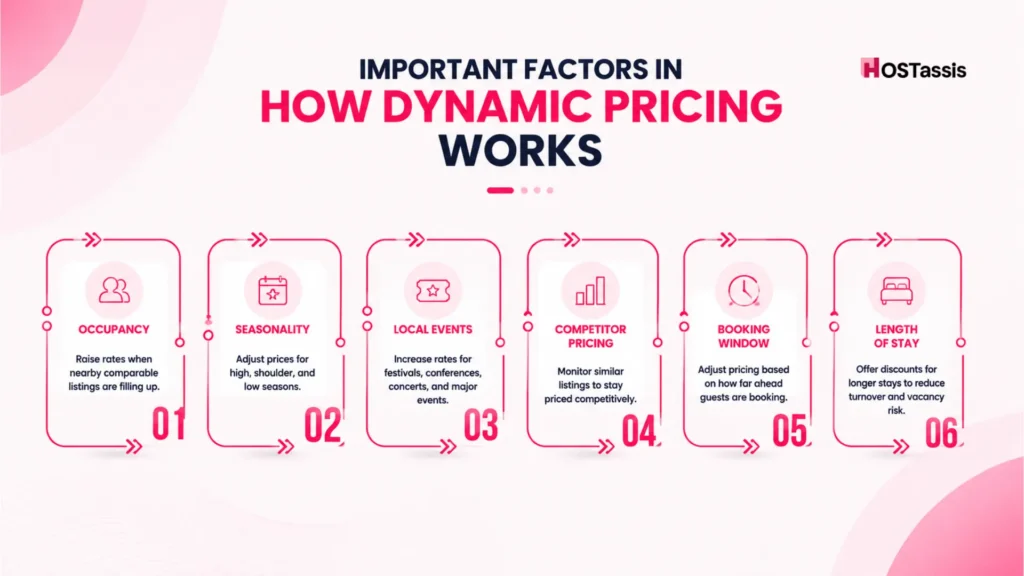
No single number decides tonight’s price. It’s a handful of signals stacked together.
Occupancy
If most comparable listings nearby are already booked for a weekend, that’s the market telling you guests have fewer choices left. That’s your cue to push the price up, not hold it flat out of habit.
Seasonality
Every market has its own heartbeat. Beach towns light up in summer. Ski towns light up in winter. Business-focused cities often go quiet around the holidays. Copying a generic seasonal chart won’t work. You need to know your specific market’s actual rhythm.
Local Events
One weekend can outperform an entire slow month. A marathon, a festival, a big conference, any of these can justify doubling your usual rate, because hotels down the street are doing the exact same thing.
Competitor Pricing
Watching what similar listings around you are charging, and how fast their calendars are filling, tells you almost instantly whether you’re priced too high, too low, or just right.
Booking Window
Someone booking six months out is not the same guest as someone booking six days out. Early planners tend to hunt for deals. Last-minute guests often have fewer options left and are far less picky about price.
Length of Stay
A guest staying seven nights straight costs you less in cleaning, turnover, and empty gaps than seven guests staying one night each. That’s exactly why a discounted nightly rate for longer stays usually still adds up to more total revenue.
Pricing Factors Professional Hosts Monitor
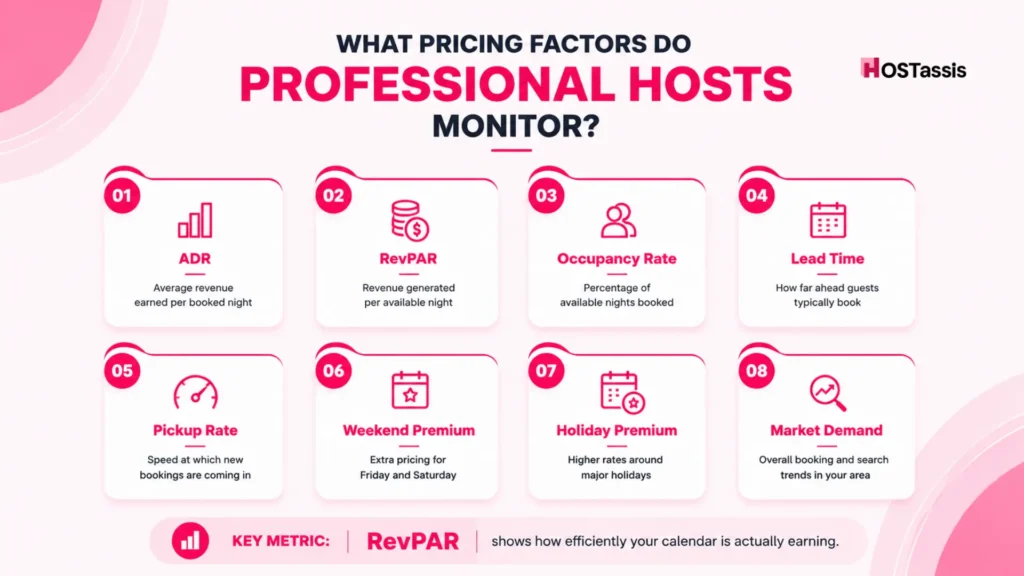
Beyond the six drivers above, serious hosts track a specific set of numbers every single week, not just once a season.
- ADR (Average Daily Rate): total revenue divided by nights booked, showing what you’re actually earning per night
- RevPAR (Revenue Per Available Night): ADR combined with occupancy, the real measure of how efficiently your calendar earns
- Occupancy Rate: the percentage of available nights that get booked
- Lead Time: how far ahead guests typically book you
- Pickup Rate: how fast new bookings are rolling in over the last week or month, an early warning sign if pricing is off
- Weekend Premium: the markup on Friday and Saturday nights
- Holiday Premium: the extra markup around major holidays
- Market Demand: broader search and booking trends across your whole area
If you only track one number, make it RevPAR. A host can post a great ADR and still lose money if half the calendar sits empty.
Common Dynamic Pricing Strategies
Dynamic pricing is a strategy that automatically adjusts product or service prices in real-time based on market demand, competitor pricing, timing, inventory levels, and customer behavior to maximize profit and sales.
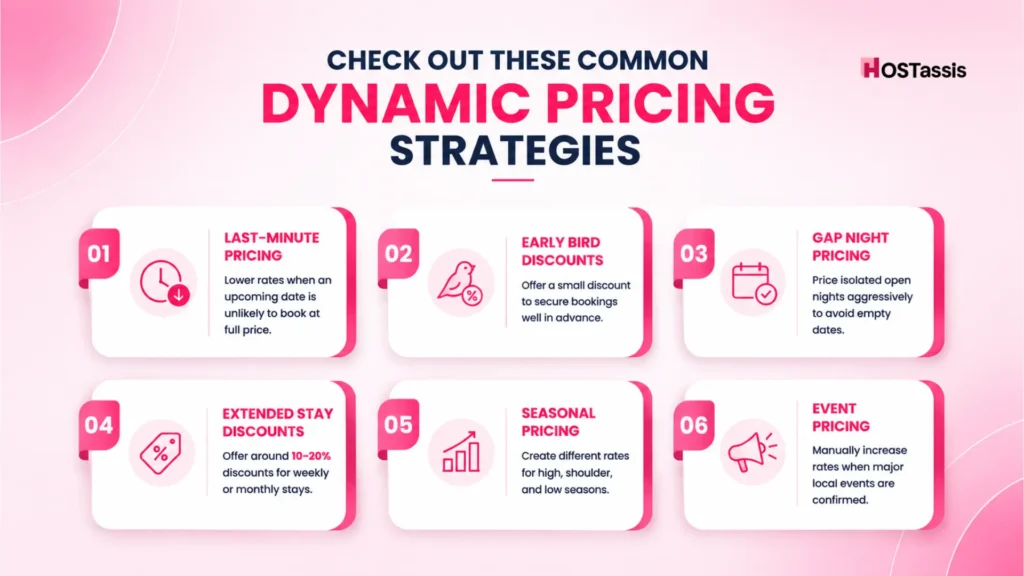
Last Minute Pricing
The idea here is simple: if a date is still empty and check-in is getting close, drop the price instead of letting it sit there earning nothing. Once it’s obvious a night won’t book at full rate, a smart discount beats zero revenue every time.
How to use it:
- Discounts gradually don’t drop the price all at once, ease into it as check-in approaches.
- The longer a date stays open, the bigger the discount should get.
- Watch actual demand and occupancy in real time and adjust from there, rather than following a fixed formula.
What to watch: The biggest mistake here is discounting too soon or too hard. If a guest would’ve paid full price anyway, you just gave that money away.
Early Bird Discounts
This one’s the opposite play. Instead of waiting until the last minute, you reward guests who book far in advance. It gets money in the door earlier and takes some of the guesswork out of whether a date will actually fill later on.
How to use it:
- Keep the discount small for guests booking well ahead of time.
- Pick a window that makes sense could be 30 days out, could be 90.
- Don’t apply it everywhere; save it for dates where locking in early bookings actually matters.
What to watch: Don’t get too generous. If that date was going to sell at full price regardless, you’ve just cut into your own revenue for no reason.
Gap Night Pricing
Every host runs into this a single night or two stuck between two bookings that nobody wants because it’s just awkward to book around. These gap nights are tough to sell as-is, so a bigger discount can make them worth someone’s time.
How to use it:
- Keep an eye out for those one- or two-night holes in your calendar.
- Discount those specific dates more aggressively than the rest.
- Loosen up your minimum-stay requirement so a guest can actually book that short window.
What to watch: Before you say yes to a cheap one-night stay, do the math on cleaning and turnover. Sometimes it’s not even worth it after costs.
Extended Stay Discounts
Give guests a lower nightly rate for committing to a week, a month, or longer, and in exchange you get fewer turnovers, less vacancy risk, and revenue you can actually count on ahead of time.
How to use it:
- Weekly and monthly discounts usually land somewhere around 10-20% off.
- Tweak the discount up or down depending on the season and how demand’s looking.
- Lean into longer stays especially when things are slow it keeps occupancy steady.
What to watch: Run the numbers to make sure that discounted rate still covers your costs, and check that it isn’t crowding out a shorter stay that would’ve paid you more.
Seasonal Pricing
Not every month deserves the same price tag. Seasonal pricing means splitting the year into high, shoulder, and low periods, and setting a different base rate for each so you’re not making pricing decisions on the fly every time demand shifts.
How to use it:
- Figure out which months are your high season, which are shoulder, and which are slow.
- Give each period its own base rate.
- Look at past bookings and what’s happening locally before locking in those numbers.
What to watch: Don’t set it and forget it demands shifts from what you expected, so check back in regularly and adjust.
Event Pricing
When something big is happening nearby a concert, a festival, a conference, a game demand spikes, and your normal pricing won’t capture that. Event pricing means bumping rates up specifically for those windows.
How to use it:
- Stay on top of what’s happening locally festivals, conferences, games, whatever draws crowds.
- Mark the dates where you expect a real jump in demand.
- If your automated pricing tool isn’t reacting fast enough, step in and raise the rate yourself.
What to watch: Keep tabs on the local events calendar ahead of time, and don’t get greedy pushing rates past what people are actually willing to pay can hurt you just as much as underpricing.
Airbnb Smart Pricing vs Professional Revenue Management
If you want something simple, free, and completely hands off, Airbnb’s built in Smart Pricing does the job fine. If you want more control, deeper market insight, and pricing that’s actually optimized for revenue, professional revenue management is the better fit. Smart Pricing leans on Airbnb’s own internal demand data to nudge your rates up or down within the min/max range you set. Professional revenue management digs a lot deeper into competitor rates, local events, booking momentum, seasonality, and whatever else is specific to your market.
Choose Airbnb Smart Pricing
Go with Smart Pricing if you want something automated and don’t feel the need to squeeze out every last dollar of pricing opportunity.
- It’s free and already sitting right there in your Airbnb dashboard.
- Barely any setup, barely any ongoing management needed.
- Works fine for a single listing host who doesn’t have the bandwidth to fiddle with prices constantly.
- Take a lot of the daily “what should I charge tonight” guesswork off your plate.
- A solid starting point if you’re new and still learning your market.
- Tends to prioritize keeping your calendar full over squeezing max rate.
What to consider: You don’t get much insight into why it picked the rate it did. It can underprice dates that are clearly in high demand, miss events that only locals would know about, react slowly when demand shifts fast, and it has no real way of knowing what makes your specific property better than the one down the street.
Choose Professional Revenue Management
Go this route if revenue is the priority and you want pricing that actually reflects what’s happening in your market, not just Airbnb’s broad averages.
- Keep an eye on competitor rates in real time.
- Factors in festivals, conferences, concerts, and other local events.
- Tracks whether bookings are picking up or slowing down.
- Uses seasonal patterns specific to your actual market, not a generic model.
- Adjusts faster when demand shifts.
- Lets you manually override rates when something local changes the picture.
- Pays off more and more as you add properties to manage.
What to consider: This usually means paying for a pricing tool, spending more time actively managing things, or paying someone else to do it for you.
Which Should You Choose?
If you’ve got one listing and just want something simple that doesn’t eat up your time, Smart Pricing is a perfectly fine place to start. But if you’re running multiple properties, your market swings a lot with demand, or you’re actually relying on this income, professional revenue management gives you the data and control to price a lot smarter.
Ask yourself:
- Am I managing just one listing, or several?
- Do I care more about maximizing revenue, or keeping things simple?
- Does my area see a lot of events or sudden spikes in demand?
- Is my property unique enough that it shouldn’t be priced like every other listing nearby?
- Do I want to actually understand why my rates move the way they do?
- Am I okay paying for better data and more control?
- Do I realistically have time to watch and adjust prices myself?
Once you answer those honestly, the choice usually becomes pretty obvious. Simplicity and automation with Smart Pricing, or control and optimization with professional revenue management.
Best Dynamic Pricing Tools
Four top Airbnb pricing platforms compared, so hosts can match the right tool to their listing size and revenue goals.
PriceLabs
If you’ve spent any time in host Facebook groups or forums, you’ve seen PriceLabs mentioned nonstop. It’s become kind of the default choice for a lot of hosts, and for good reason. You set the rules, PriceLabs handles the day to day adjusting based on demand. You’re not glued to your dashboard every morning trying to figure out what to charge.
Features to Use:
- Dynamic daily pricing
- Minimum and maximum price settings
- Event based pricing adjustments
- Seasonal pricing rules
- Last minute and far out discounts
- Minimum stay customization
Benefits: Rates move with the market on their own, but you still shape the strategy behind it. Best of both worlds, really.
Why Choose It: Want strong automation without giving up your say in how pricing works? This is it.
Wheelhouse
Wheelhouse feels different the moment you open it. Clean, uncluttered, doesn’t throw a hundred settings at you right away. The Base Price suggestions alone make it easy for someone who’s never touched a pricing tool before to get comfortable fast.
Features to Use:
- Base Price recommendations
- Automated daily pricing
- Demand and market adjustments
- Seasonal pricing
- Minimum and maximum rates
- Custom pricing rules
Benefits: Dynamic pricing stops feeling like a black box. You can actually see and adjust how aggressive your pricing gets.
Why Choose It: If you want something simple that still listens to your instincts as a host, Wheelhouse makes sense.
Beyond
Beyond plays a different game entirely. It’s not about nudging tomorrow’s rate up or down, it’s built for hosts thinking about revenue at a portfolio level. Property managers running a dozen units tend to gravitate here.
Features to Use:
- Automated dynamic pricing
- Market and demand analysis
- Revenue management tools
- Portfolio level pricing
- Booking and performance insights
- Pricing strategy adjustments
Benefits: Everything lives in one place. No more jumping between listings trying to piece together the bigger picture.
Why Choose It: Got multiple properties and outgrown basic pricing tools? Beyond is built for that stage.
AirDNA
AirDNA doesn’t touch your prices at all, honestly. What it does is give you the homework before you set a rate. Who’s your competition charging, how’s occupancy trending, where’s demand headed this season.
Features to Use:
- Comparable property research
- Market demand analysis
- Occupancy data
- Average daily rate insights
- Seasonal trend analysis
- Local market research
Benefits: You stop guessing what “feels right” and start pricing off what the market is actually doing.
Why Choose It: If understanding your market matters more to you right now than automating your rates, start here.
Mistakes That Reduce Revenue
Most revenue loss doesn’t come from bad luck, it comes from pricing habits that quietly cost hosts money every month. Here are the six most common ones:
- Setting one price and never touching it again as seasons shift
- Ignoring what competitors charge and pricing purely on gut feeling
- Panic discounting last-minute bookings out of fear that the night stays empty
- Missing local events because the calendar in the pricing tool was never updated
- Using the same weekend premium in January as in July
- Treating Smart Pricing’s suggested range as the ceiling instead of a rough starting point
FAQs
Does dynamic pricing actually make more money, or just move it around?
It genuinely adds up to more total revenue for most hosts. It captures upside during high-demand periods that flat pricing would completely miss, and it protects occupancy during slow stretches with targeted discounts.
How often should the price actually change?
Daily, if you’re using an automated tool. Weekly, at the very least, if you’re doing it by hand.
Is Smart Pricing good enough for a single listing?
For a low-effort host with one property, sure, it’s a decent baseline. For anyone counting on this as real income, a dedicated tool usually pays for itself fast.
Do pricing tools cost money?
Most charge either a flat monthly fee or a small cut of booking revenue. For an active listing, the extra revenue almost always covers the cost.
Final Thoughts
Dynamic pricing isn’t something you set once and forget. It’s a habit of watching demand and reacting to it before your competitors do. Hosts who treat their calendar as a living, breathing thing instead of a spreadsheet they filled out in January are the ones who end the year ahead, no matter which tool sits behind the numbers.