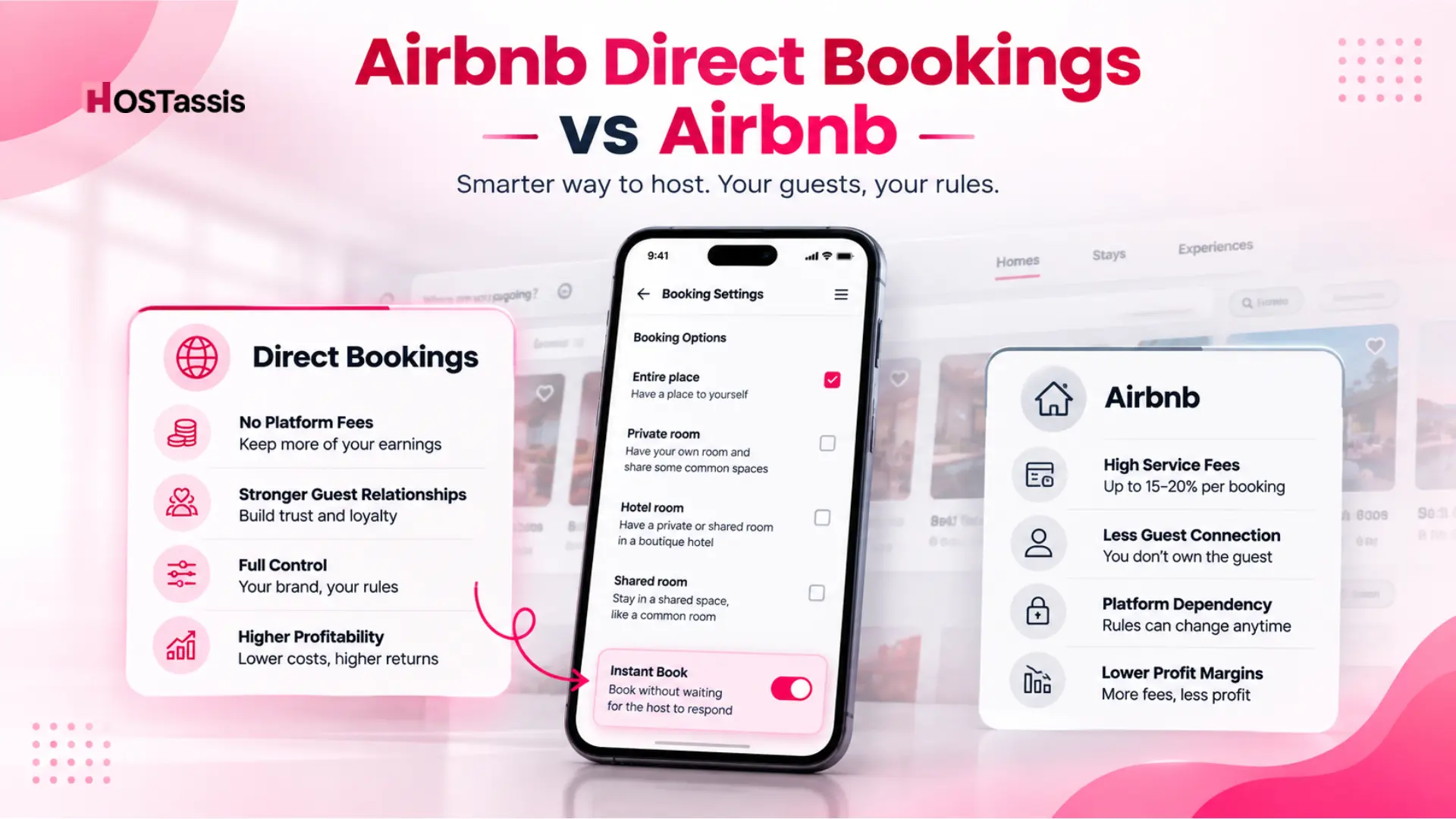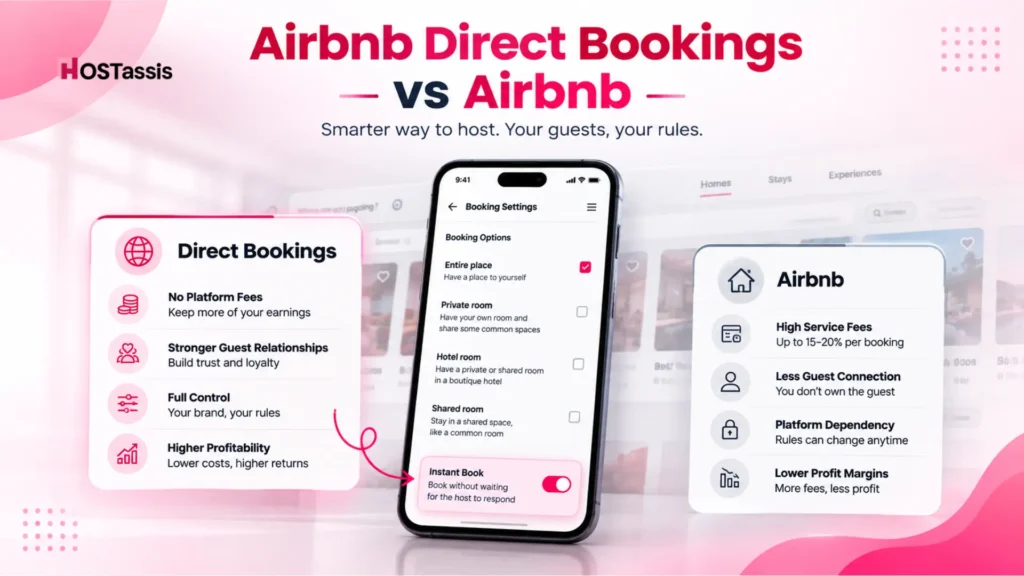
A direct booking happens when a guest reserves directly with the host skipping Airbnb entirely. No marketplace fees, no platform restrictions, just full control in the host’s hands.
Direct bookings put more money in your pocket per stay. You skip Airbnb’s combined host and guest fees, which run 17 to 20% on most reservations, and pay closer to 2 to 3% for payment processing instead. Airbnb still wins on speed, though. It puts your listing in front of guests who are already searching, on day one, with zero marketing effort from you. Neither channel beats the other outright. Hosts making the most money in 2026 run both, and let each one earn its keep in a different way.
What Are Airbnb Direct Bookings?
A direct booking happens when a guest books through your own website instead of Airbnb, VRBO, or Booking.com. They already know who you are, whether that’s from a Google search, an Instagram post, a friend’s recommendation, or a stay they had with you before, so there’s no platform standing between you and the payment.
What that actually gets you:
- A guest who found you on their own, not through Airbnb’s search ranking.
- Payment that runs through your own processor, whether that’s Stripe, Square, or a booking engine’s built in checkout.
- Full control over pricing, without a smart pricing tool or platform fee nudging your rate around.
- Cancellation terms you wrote yourself, not one of Airbnb’s handful of preset policies.
- No commission on the booking itself. You still pay a payment processing fee, usually around 2.9% plus $0.30 per transaction, but that’s it.
How Do Direct Booking Websites Work?
They work the same way any e-commerce checkout does. A guest picks dates, pays, and gets a confirmation. Nothing routes through a marketplace in between.
- The guest lands on your site from a Google search, an Instagram bio link, or an email you sent them.
- They check real availability, synced through a channel manager so nothing double books.
- They pick a property or room and pay through an embedded booking engine.
- A confirmation email goes out automatically, often with an upsell attached. Early check in, airport pickup, a welcome basket, something small that adds to the total.
Why Are More Professional Hosts Investing in Direct Bookings in 2026?
Because staying fully dependent on one platform has gotten expensive and unpredictable. Three things are pushing hosts toward their own channel:
- Guest fees have crept up. Airbnb charges guests a service fee of 14.1% to 16.5% of the booking subtotal, on top of what the host pays. Add both sides together and a lot of bookings lose close to a fifth of their value to platform fees.
- Rules and rankings shift with little warning. A search algorithm update, a new cancellation policy, or a routine account review can change a host’s visibility or payout overnight, often with little explanation given.
- A suspended account means zero income, if that’s the only channel a host has. No website, no email list, no backup. The calendar just goes empty.
How Airbnb Works Compared to Direct Bookings
Both exist to fill your calendar. They just go about it in opposite ways.
Airbnb’s Marketplace Model
Airbnb is a two sided marketplace. It charges both the host and the guest, and that money funds search traffic, trust and safety, and round the clock support. The scale behind it is hard to compete with on your own. Airbnb now has over 5.5 million hosts and has hosted more than 2.5 billion guest arrivals across 220 plus countries, and it posted $3.6 billion in revenue in Q2 2026 alone, up 17% from a year earlier. That’s the traffic engine a brand new listing gets to plug into for free.
Direct Booking Business Model
A direct booking site is something you build once and keep for good. It’s slower going at the start, since there’s no algorithm sending you guests, but every visitor, every email address, every review belongs to you. None of it disappears if a platform changes its policy.
The Biggest Differences Between Both Approaches
- Speed: Airbnb delivers demand instantly. A direct channel takes months of SEO, ads, and repeat bookings to build momentum.
- Who owns the guest: Airbnb keeps most contact details locked inside its own messaging system. A direct booking hands you the guest’s actual email and phone number.
- Cost structure: Airbnb takes a percentage of every booking. A direct site’s costs are mostly fixed: hosting, a booking engine, payment processing.
- Who sets the rules: Airbnb decides your cancellation options and pricing tools. On your own site, you write the terms that protect your margin.
Airbnb Direct Bookings vs Airbnb: Complete Comparison
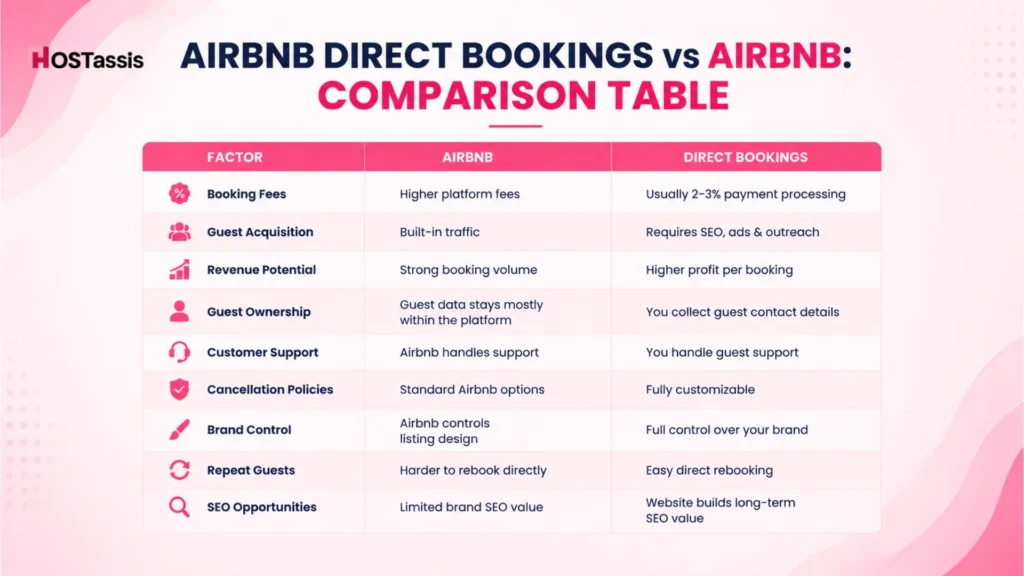
Airbnb offers massive reach but takes hefty fees and guest data; direct bookings return full profit, ownership, and policy control start on Airbnb, then graduate to direct as trust builds
1. Booking Fees: Airbnb’s fee structure isn’t a single flat number anymore. Under the split fee model most hosts are still on, the host pays a 3% service fee (4% for listings in Brazil, and 4% for Mexico starting June 2026), and the guest separately pays 14.1% to 16.5% on the booking subtotal. Add it up and 17 to 20% of the transaction is gone before a host sees the payout. A direct booking usually costs 2 to 3% in payment processing. Over a full year of bookings, that difference adds up to real money.
2. Guest Acquisition: Airbnb brings guests to you automatically through its search ranking. A direct channel needs active work: SEO, ads, social content, reaching out to past guests. Airbnb’s acquisition cost is baked into its fee. Direct acquisition is slower to build but gets cheaper per booking as the channel matures.
3. Revenue Potential: Direct bookings usually win on profit per stay, simply because less gets skimmed off the top. Airbnb usually wins on volume, especially for a listing with no audience of its own yet. A brand study by RedAwning found that stronger brand presentation across listings drove an 87% lift in bookings and a 53% improvement in view to book conversion, a reminder that trust signals move revenue even on Airbnb itself, not just off it.
4. Guest Ownership: Airbnb keeps most guest contact information inside its own system. A direct booking hands you the guest’s actual email and phone number, which is what turns one stay into years of repeat business.
5. Customer Support: Airbnb handles disputes and guest issues around the clock, and that’s part of what the fee pays for. On a direct booking, every message, complaint, or late night emergency lands on you or your team. There’s no safety net underneath it.
6. Marketing Responsibility: Airbnb markets its own brand, not your specific listing. Your visibility inside search still comes down to your photos, pricing, and reviews. A direct site only grows if someone is actually marketing it: SEO, email, paid ads.
7. Cancellation Policies: Airbnb offers a small set of standard policies, and since October 1, 2025, every standard short stay policy includes a built in 24 hour free cancellation window, as long as the booking was confirmed at least 7 days before check in. Airbnb itself says 44% of guests rank free cancellation among their top booking priorities, which is part of why flexible listings get a boost in search. Worth knowing before tightening your policy too far. On your own site, you write the policy, and there’s no ranking penalty for making it stricter.
8. Brand Control: On Airbnb, every listing lives inside the same template: same layout, same fonts, same booking flow as the listing next door. On your own site, the colors, the story, and the checkout experience are entirely yours to design.
9. Repeat Guests: Airbnb’s messaging system makes it deliberately awkward for a guest to rebook you outside the platform. A direct site is built for the opposite: fast, one click rebooking that skips the search entirely.
10. Trust & Credibility: Airbnb’s review system does the trust building for you with first time visitors who’ve never heard of your property. On your own site, you have to earn that trust yourself, through guest reviews, security badges, and a site that doesn’t feel sketchy or slow.
11. SEO Opportunities: An Airbnb listing builds no search authority for your brand at all. The domain value belongs to Airbnb, not you. A website you own compounds SEO value for years, still pulling in organic traffic long after you’ve stopped actively promoting it.
12. Long-Term Business Growth: Airbnb keeps a host dependent on fees and policies they don’t control. A direct booking channel builds something real instead: a website, an email list, a brand, and all three tend to get more valuable the longer you run them.
7 Benefits of Accepting Direct Bookings
By accepting direct bookings, hosts avoid commission cuts from booking platforms and retain 100% of the room rate. This also helps them build stronger, personal connections with guests, turning one-time visitors into repeat customers.
- More revenue stays with you. Lower fees mean a bigger margin per stay.
- You build real relationships, not just booking numbers in a dashboard.
- Every reservation adds a contact you can market to later.
- Repeat guests rebook in seconds, instead of starting a fresh platform search.
- You control pricing outright, running your own promotions whenever you want.
- Upsells actually work better. Early check in, airport pickup, whatever fits, right at checkout.
- The listing becomes a real brand, not just a room inside someone else’s marketplace.
Challenges of Direct Bookings
Honestly, competing with big OTAs and their massive marketing reach, guest trust, and smooth technology is tough. Sure, direct bookings dodge those steep 15 to 30 percent commission fees, but winning guests over still isn’t easy.
- Traffic doesn’t show up on its own. Without Airbnb’s search engine, driving visitors is genuinely hard.
- Guests don’t trust you yet. Building that from scratch takes time.
- Payment security is entirely on you. There’s no platform-provided processor to lean on.
- Guest support becomes a full time job, at any hour, with nobody backing you up.
- Marketing costs something real. Time, or money, usually both.
- A website never really finishes. Updates, backups, security checks. It’s ongoing.
Who Should Focus on Direct Bookings?
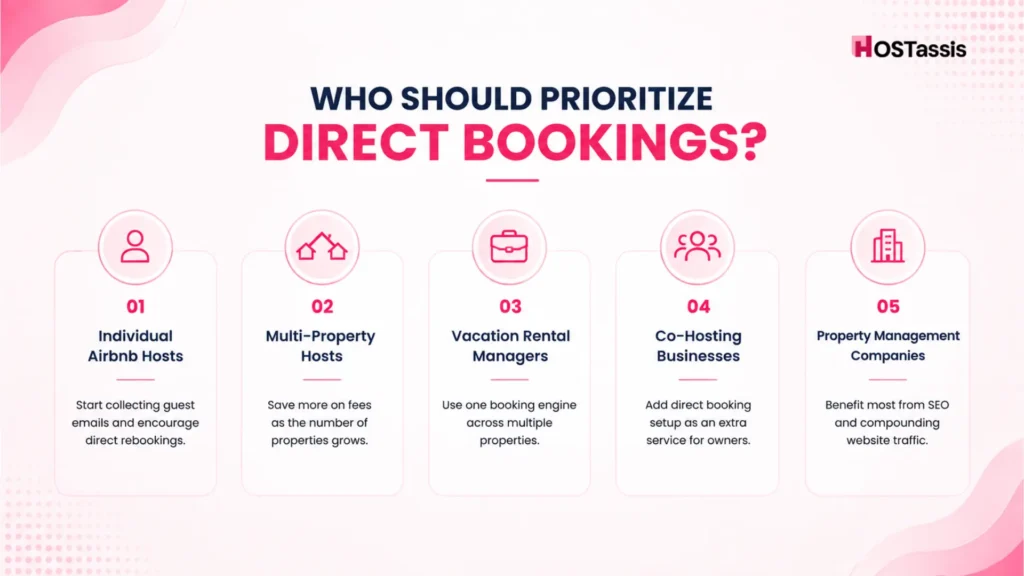
It depends less on ambition and more on how many properties you’re running and how much time you actually have.
- Individual hosts: One property with solid reviews can already start collecting emails and offering a small rebooking discount.
- Multi property hosts: More properties means more fee savings stacked up, so direct bookings pay off the fastest here.
- Vacation rental managers: A shared booking engine across properties cuts reliance on any single OTA.
- Co-hosting businesses: Offering direct booking setup as an extra service keeps property owners loyal.
- Property management companies: Large portfolios benefit most from SEO, since the traffic compounds across every listing at once.
How to Get More Direct Bookings?
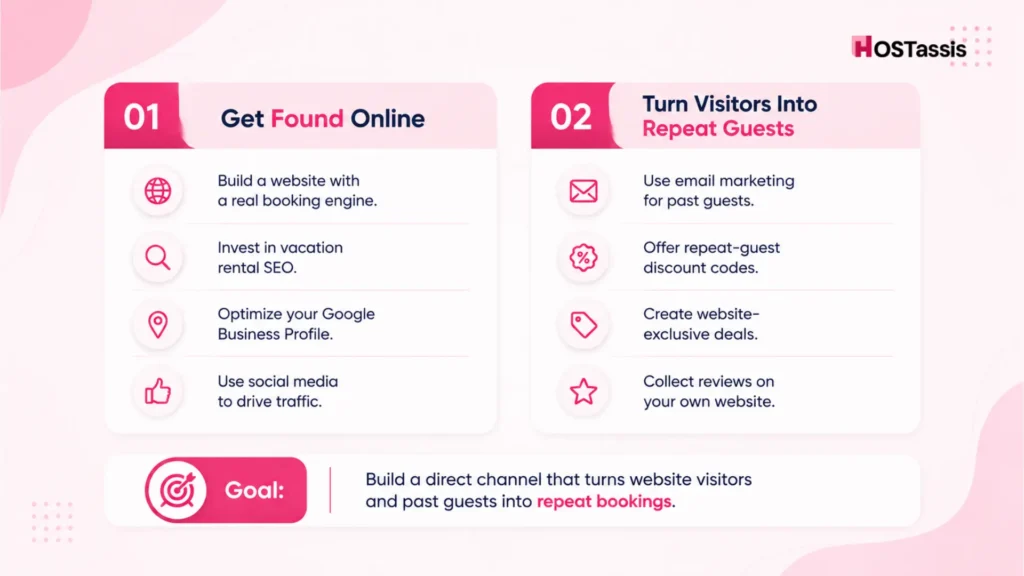
Direct bookings don’t happen by accident. A working website, real SEO, and consistent follow up are what actually turn a visitor into a paying, repeat guest.
Get Found Online
- Build a real website with a working booking engine, not just a contact form that makes people wait for a reply.
- Invest in vacation rental SEO, so people find you on Google without needing a direct link.
- Optimize your Google Business Profile, so you show up in local map searches too.
- Use social media to send warm, already interested traffic straight to your booking page.
Turn Visitors Into Repeat Guests
- Email past guests with fresh offers instead of letting the relationship go cold.
- Give repeat guests a standing discount code they can use anytime, no expiration pressure.
- Run deals that only exist on your site, nothing matching them on Airbnb.
- Collect reviews on your own site too, not only inside Airbnb’s review system.
Tools That Help Manage Direct Bookings
Direct bookings sound simple until two calendars clash and the messages start piling up. A few categories of tools keep pricing, availability, and payments running without much manual effort.
Keeping bookings organized:
- Channel managers keep every calendar in sync and stop double bookings before they happen.
- Booking engines plug into your site and show guests live availability.
Keeping guests coming back:
- Payment processors handle secure card payments and pay out quickly.
- CRM software stores guest info and runs follow up campaigns without you doing it manually.
Setting all of this up takes real time, and this is usually where hosts lose steam. HOSTassis exists for exactly that gap: a co hosting team that handles guest communication, listing optimization, calendar syncing, and even branding details like guidebooks and thumbnails, so there’s actually time left to build a direct booking channel instead of just planning to someday.
Things Every Host Should Know Before Going Direct
Direct booking success takes more than skipping fees, it means managing risk, cost, trust, and timing all at once.
- Policy Risk: Airbnb isn’t a fan of hosts poaching guests for direct bookings, and doing it too openly or too often can actually get a listing suspended, so this move needs some careful timing.
- Website Setup Cost: Building a direct booking channel isn’t free either. Hosting, booking engines, tools like Lodgify or Hostaway, these all come with real monthly costs that add up.
- VRBO and Booking.com Fees: Airbnb gets most of the attention, but VRBO and Booking.com charge their own commissions too, and it’s worth comparing all three before deciding where to put your energy.
- Guest Trust Factor: A lot of guests still stick with Airbnb simply because of its buyer protection and dispute resolution guarantee. That trust gap is something a direct site has to work hard to close.
- Break Even Timeline: Nobody flips a switch and starts profiting from direct bookings overnight. It usually takes months of steady traffic and repeat guests before the channel actually pays off.
- Use a Checklist: Turning all of this into a simple checklist makes it a lot easier to actually track progress, instead of just reading through the theory and forgetting it later.
Airbnb’s 2026 Fee Structure Shift: What Hosts Should Know
Here’s a detail most direct booking comparisons skip entirely. Airbnb doesn’t charge every host the same way anymore. There are now two fee structures running side by side. The familiar split fee model charges the host 3% and the guest 14.1 to 16.5% separately. A newer single fee structure folds everything into one combined charge the guest sees upfront.
Airbnb has confirmed the split fee option is being phased out for certain hosts, who get migrated to the single fee model, and it’s added a pricing adjustment tool inside the host app to help hosts without third party pricing software rebalance their rates during the switch. If you’re comparing Airbnb’s real cost against a direct channel, it’s worth checking which structure your account actually falls under, since the take rate isn’t identical for every host anymore. Airbnb’s own service fee guide breaks down which one applies to you.
Common Mistakes Hosts Make
A lot of hosts slip up on the basics, poor communication, no house manual, or letting cleanliness slide. Whether you’re running an Airbnb or hosting guests at home, dodging these mistakes makes all the difference for a smooth stay. ..
- Dropping Airbnb too soon, before the direct channel has built enough traffic to stand on its own.
- Skipping SEO entirely, so the website exists but nobody ever finds it.
- Not collecting guest emails, even from bookings that already happened.
- Building a slow, confusing website that loses guest trust before they even reach checkout.
- Never following up, which quietly kills repeat bookings and referrals.
Why Choose Us for Airbnb Cohosting?
Let’s be real, running an Airbnb properly eats up way more time than most owners expect. Guests text at odd hours, cleaners bail last minute, and prices need tweaking constantly. That’s pretty much why we’re here.
- Full Guest Communication: We reply as messages come in, noon or 2am, doesn’t matter.
- Smart Pricing and Calendar Management: Calendars stay synced so double bookings don’t happen, and rates get adjusted so you’re not quietly losing money.
- Listing Optimization: Sharper photos, better descriptions, stuff that actually makes people stop scrolling and click.
- Reliable Cleaning and Turnover: Once someone books, the place gets handled properly, no scrambling at the last minute.
- Branding That Builds Trust: A decent guidebook or a clean looking thumbnail makes a listing feel legit instead of thrown together.
- More Free Time, Less Stress: While we deal with the daily stuff, you actually get time back for what matters.
We treat your property like it’s our own, because a good Airbnb isn’t just about getting booked, it’s about guests wanting to return.
Frequently Asked Questions
Can I accept direct bookings while using Airbnb?
Yes. Most successful hosts run both. Airbnb brings in new guests, and your own site handles repeat stays and referrals.
Are direct bookings more profitable?
Usually, per booking. Airbnb’s guest fee runs 14.1 to 16.5%, plus roughly 3% from the host, against about 2 to 3% for direct payment processing. That gap is where the extra profit comes from.
Do I need my own website?
Yes. Without a website and a booking engine, there’s no way for a guest to actually find you and pay you directly.
Is direct booking legal?
Yes, it’s legal across the U.S. You still have to follow your local short term rental rules and pay the taxes that apply.
How do I process payments securely?
Use a processor built for hospitality. Stripe is common, or you can lean on a booking engine’s built in payment system.
Can beginners get direct bookings?
It’s possible, but slower. New hosts usually need some reviews and a track record before guests trust them off platform, so most start on Airbnb and add a direct channel once that trust exists. Airbnb’s own guidance on cancellation policies is a useful reference for how flexible terms affect guest trust, whether you’re booking through Airbnb or your own site.
Final Thoughts
Airbnb and direct bookings aren’t really competing with each other. They’re doing two different jobs. Airbnb brings in new guests fast, backed by a platform that welcomes billions of arrivals a year. Direct bookings turn those same guests into repeat revenue without the recurring fee. The hosts doing well in 2026 run both channels at once, without dropping either. That’s where HOSTassis fits in, handling the day to day Airbnb work while you build out the direct booking side without burning out.