Building an Airbnb that runs without you for 7 days really comes down to swapping out your daily involvement for automation, a reliable local team, and clear procedures everyone actually follows. Messaging, pricing, check-ins through smart locks, standardized cleaning checklists, all of it needs to run on its own, with your team having clear authority to handle routine decisions and documented steps for the usual headaches, lockouts, complaints, emergencies. Test it slowly too, start with 24 hours away, then work up to a full week, so eventually your role becomes exception based, you only hear from anyone when something genuinely unusual or high risk actually comes up.
Building a 7 day self running Airbnb means shifting from daily operator to system designer. It requires automating tasks and delegating operations effectively.
An Airbnb business can run without you if you build real systems for guest messaging, cleaning, maintenance, pricing, and emergencies. Instead of doing everything yourself, write down each process, automate what makes sense, and hand off clear responsibilities to people you trust. That’s how the property keeps running smoothly even when you’re unreachable for a week.
Why Do Most Airbnb Hosts Struggle to Step Away?
Most Airbnb hosts find it difficult to step away simply because they have built a demanding job for themselves, not a truly automated, self-sustaining business.
Most people get into Airbnb hosting because they want freedom. Then reality sets in. You’re replying to guest messages at midnight, calling the cleaner every morning before work, and taking maintenance calls in the middle of dinner. If your listing stops functioning the moment you step away, you haven’t really built a business. You’ve built yourself a demanding job that happens to pay well.
A properly run Airbnb keeps guests happy even when you’re off the grid for a week. The goal isn’t to disappear completely. It’s to put systems in place so the business doesn’t need you hovering over it every hour of every day.
Can an Airbnb Business Really Run Without You?
An Airbnb business can absolutely run without your physical presence, but only with the right automated systems in place and a reliable local team backing it up.
Yes, but only if your operations are built on documented systems rather than your personal memory and constant hands on involvement. Hosts who can genuinely step away for a week have swapped guesswork for process, automation, and a small team they trust.
There’s a real difference between passive income and true operational independence. Owning a rental doesn’t automatically make it passive. Plenty of “passive” listings still eat up twenty plus hours of a host’s week without anyone noticing.
- The property should earn money whether or not you check your phone that day
- One listing or ten, the same systems apply, they just scale with you
- Most hosts stay too involved for too long because they never wrote down what they actually do
- Running without you doesn’t mean walking away forever. It means the business survives a week without hearing from you
Why Most Airbnb Businesses Can’t Function Without the Owner?
Most Airbnb businesses can’t run without the owner or a dedicated Airbnb co-host simply because short term rentals are high touch hospitality operations, not the truly passive investment they’re often marketed as.
Airbnb businesses stay dependent on their owner when tasks, decisions, and knowledge only exist in that person’s head instead of being written down and shared.
This tends to play out the same way for almost every host who hasn’t built proper systems yet.
- The owner receives every guest message personally, no matter how small the question
- The owner calls or texts the cleaner directly before each turnover
- The owner schedules and confirms every repair themselves
- The owner is the only one who knows how to handle anything unusual
- The moment the owner goes quiet for a day, the whole operation stalls
Five gaps keep showing up in almost every dependent business: nothing’s documented, everything’s done manually, delegation barely exists, there’s no real emergency plan, and communication shifts depending on who’s asking. Fix those five, and most of the dependency just disappears on its own.
10 Steps to Build an Airbnb Business That Can Run Without You
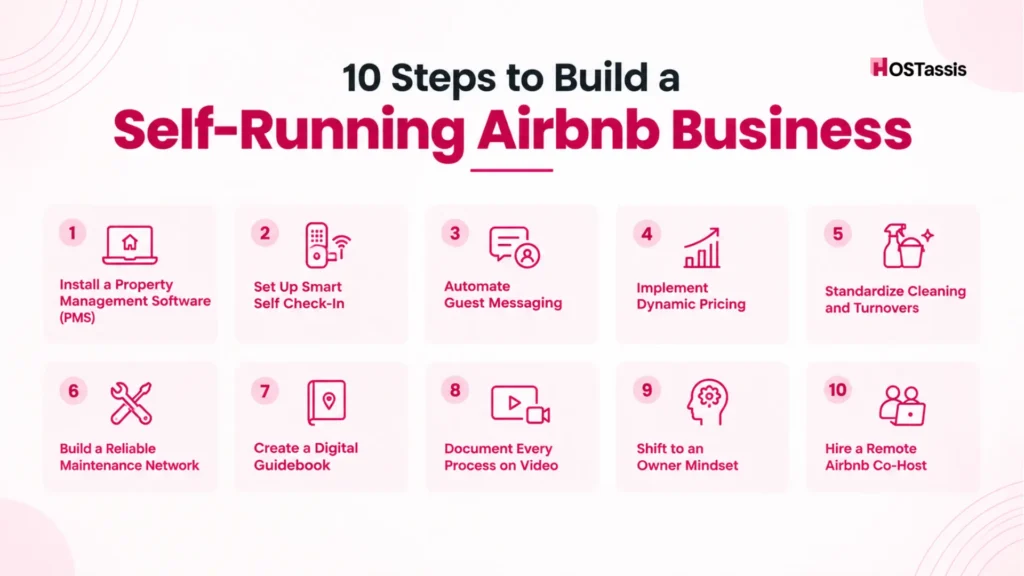
Building an Airbnb that runs without you basically means stop being the daily operator and start thinking like a systems designer, someone who leans on automation and a solid team instead of doing everything by hand.
1. Install a Property Management Software (PMS)
- Hook up a central hub like Hostfully so your calendar stays synced across every platform.
- Manage guest chats, reservations, and booking details in one dashboard instead of five different apps fighting for your attention.
2. Set Up Smart Self Check-In
- Get a secure smart lock or keypad installed.
- No more manual key handoffs, no more coordinating late night arrivals over text.
3. Automate Guest Messaging
- Build out templates for check-in instructions, house rules, and check-out notes.
- Set them to fire off automatically based on booking and arrival times, so nobody’s waiting on you to hit send.
4. Implement Dynamic Pricing
- Use something like PriceLabs to track local supply and demand.
- Let it adjust nightly rates on its own instead of guessing what to charge every week.
5. Standardize Cleaning and Turnovers
- Put together a strict, step by step checklist so quality doesn’t slip depending on who’s cleaning that week.
- Hire a local service that gets an automated alert the second a guest checks out.
6. Build a Reliable Maintenance Network
- Find a handyman you can actually count on for emergencies.
- Keep basic supplies and extra linens stocked on site so nobody’s scrambling last minute.
7. Create a Digital Guidebook
- Share local recommendations, Wi-Fi codes, and appliance instructions through something like Touchstay.
- Cuts down on answering the same three questions every single stay.
8. Document Every Process on Video
- Just record yourself doing the task, updating a listing, processing a refund, whatever it is.
- Save it, and you’ve basically built a training library without writing a single manual.
9. Shift to an Owner Mindset
- Spend maybe an hour a week actually looking at occupancy and average daily rate.
- The rest of your time should go toward growth, not getting pulled into every little fire.
10. Hire Remote Airbnb Co-Host
- An experienced co-host can handle guest communication, bookings, cleaning, and daily operations, saving you time and hassle.
- Hostassis provides expert co-hosting support to automate your Airbnb and manage everything without your daily involvement.
What Tasks Should Never Depend on One Person?
Critical tasks, financial approvals, and system access should never rest on just one person, that’s exactly how catastrophic failures and security risks end up happening.
| Task | Should It Be Systemized? | Why |
| Guest messaging | Yes | Prevents delayed replies |
| Cleaning | Yes | Keeps quality consistent |
| Check-ins | Yes | Guests arrive smoothly |
| Maintenance | Yes | Issues get fixed faster |
| Calendar updates | Yes | Avoids double bookings |
| Pricing | Yes | Protects revenue |
| Owner reporting | Yes | Keeps finances visible |
If any task on that list still lives only in your head, that’s exactly where you should start.
Your 7-Day Airbnb Independence Checklist
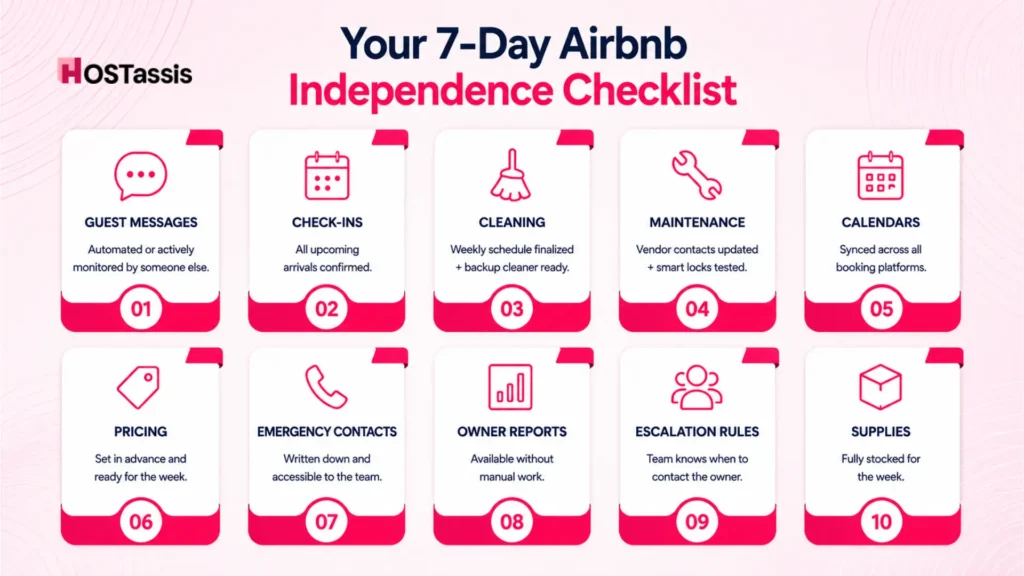
Before you step away, walk through this list and confirm every system below can actually run without your immediate attention.
- Guest messages are automated or being actively watched by someone else
- Upcoming check-ins have been confirmed with each guest
- The cleaning schedule is finalized for the week, and a backup cleaner is lined up just in case
- Maintenance contacts are current, and smart locks have been tested and work properly
- Calendars are synced across every booking platform you use
- Pricing is already set and won’t need daily adjustment
- Emergency contacts are written down somewhere your team can actually find them
- Owner reports are accessible without you having to pull them manually
- Your team knows exactly when to escalate an issue to you
- Supplies and inventory are stocked for the full week
Common Mistakes That Keep Hosts From Taking Time Off
Most hosts stay stuck because they believe every single decision needs their personal sign-off, and that habit quietly limits how far the business can grow.
- Answering every guest message personally, even the routine ones
- Never lining up a backup cleaner before something goes wrong
- Not building relationships with maintenance vendors ahead of time
- Skipping documentation because it feels faster to just do the task themselves
- Adjusting pricing by hand instead of letting a system handle it
- Operating without written procedures or an emergency contact list ready
- Never reviewing performance, so small problems quietly grow into big ones
The Right Team Structure for a Self-Running Airbnb
Building a self running Airbnb means shifting from doing the work yourself to managing the people who do. The right structure relies on layered redundancy, so daily operations keep moving without you.
The Property Owner sits at the top, focused on revenue and big decisions, not daily hosting. Right below is a Co-Host, VA, or STR Property Manager, the central point of contact who oversees reservations, guest communication, turnovers, and vendors, escalating only what genuinely needs the owner’s call.
Workflow: Property Owner → Co-Host/STR Manager → Guest Communication VA + Cleaning Team + Maintenance Vendors → Bookkeeper
The co-host acts as the hub. The VA handles guest messages, cleaners manage turnovers and restocking, and vendors respond to repairs by urgency. Financials flow to the bookkeeper. With clear SOPs and backup vendors at each point, most decisions get resolved within the team, not by the owner.
5 Technology That Helps an Airbnb Business Run Without You
Building a self running Airbnb means shifting from doing the work yourself to managing the people who do. The right structure relies on layered redundancy, so daily operations keep moving without you.
Technology can take a lot of the repetitive work off your plate, but the best automation stack supports a process that’s already working, it doesn’t replace one that isn’t. These seven tools cover the parts that matter most when running a short term rental remotely, from reservations and pricing to turnovers and keeping an eye on the property.
1. Property Management System (PMS)
A PMS acts as the command center, pulling reservations, guest info, automated messaging, tasks, and daily operations into one dashboard. For hosts running multiple listings, it means less jumping between properties and manually tracking every single stay.
Guesty or Hostaway
2. Channel Manager
A channel manager keeps availability, rates, and reservations synced across Airbnb and every other booking channel. When a guest books on one platform, the calendar updates everywhere else automatically, cutting down on manual updates and the risk of a double booking.
Lodgify or Smoobu
3. Dynamic Pricing Software
These tools adjust nightly rates on their own based on demand, seasonality, booking pace, local events, day of the week, and how much availability is left. Instead of manually tweaking rates every few days, hosts set the rules once and let the system handle routine pricing decisions.
PriceLabs or Beyond
4. Smart Locks and Keyless Entry
Smart locks handle one of the most hands on parts of hosting, guest access. Unique or time limited codes make self check-in and check-out easy, and cleaners, co-hosts, and maintenance vendors can get their own separate access, no physical key handoffs needed, no reason to be on site.
Schlage Encode or Yale Assure Lock
5. Automated Guest Messaging
Messaging automation sends booking confirmations, pre-arrival info, check-in instructions, Wi-Fi details, and check-out reminders right on schedule. A co-host or VA only needs to step in when something actually requires a real, human response.
Hospitable or OwnerRez
6. Turnover and Task Management Software
These tools automatically create cleaning and inspection tasks whenever a reservation gets added or changed. Cleaners get their schedule, follow the checklist, upload photos when done, flag missing inventory or maintenance issues, and the host or co-host sees all of it without ever physically checking a turnover themselves.
Turbo or Breezeway
7. Remote Property Monitoring
Noise monitors, smart thermostats, leak sensors, all of it adds a layer of remote oversight. They flag things like excessive noise, water leaks, or anything abnormal, so the co-host or property manager can jump on a small problem before it turns into an expensive one.
Minut or NoiseAware
Signs Your Airbnb Business Is Ready to Scale
Your Airbnb business is ready to scale once current operations run smoothly on their own, generate consistent profit without constant attention, and depend on solid automated systems rather than you.
If operations keep running smoothly without your constant involvement, you already have the foundation needed for sustainable growth.
- Reviews stay consistently strong across nearly every stay
- Your team is reliable without needing a daily check-in from you
- Systems are written down somewhere, not just remembered
- Operations feel predictable week to week instead of chaotic
- Occupancy stays stable without last-minute scrambling
- Reporting is clear and available whenever you need it
- Day-to-day stress feels manageable rather than constant
Things Every Host Should Know Before Going Fully Hands Off
Going fully hands off trades higher profits for genuine free time, though the property owner still carries full legal and financial responsibility, no matter how automated the operation becomes.
- Real Cost Breakdown: Building a hands off system isn’t free, PMS software, channel managers, pricing tools, and a co-host or virtual assistant usually add up to a few hundred dollars a month or more, depending on how many properties are involved.
- Actual Timeline to Independence: Most hosts don’t get there overnight, month one usually goes into documenting processes, month two brings in automation and delegation, and by month three the systems are tested enough to actually step away.
- What Happens When Systems Fail: Backups fail too sometimes, a backup cleaner might be unavailable or a co-host might make the wrong call, so every system needs a second layer of contingency, not just one backup plan.
- Single Property vs Multiple Property Approach: One property can often run on simple checklists and part time help, but ten properties need real infrastructure and dedicated roles, the principles stay the same, the execution doesn’t.
- How to Hire and Vet a Co-host or Cleaner: Finding the right person matters as much as the system itself, look for local experience, real references, and a trial run before handing over full responsibility.
- Legal and Liability Considerations: Bringing on contractors or a co-host means thinking about liability coverage, clear contracts, and real insurance, not just a verbal agreement and good faith.
- The Guest Experience Trade-off: Full automation doesn’t always mean the same warmth, some guests notice the difference, and the best systems still leave room for a personal touch where it counts.
Why Choose Us for Airbnb Co-hosting?
Choosing our Airbnb co-hosting service saves you valuable time, maximizes your rental income, and completely removes the daily stress that comes with managing a property.
- Full System Setup: Guest messaging, cleaning schedules, pricing, we handle the whole tech stack so you’re not glued to your phone all day.
- Reliable Local Support: We vet cleaners and maintenance vendors properly, so one no show doesn’t turn into a full blown guest emergency.
- Backup for the Backup: Every system we set up has a contingency plan sitting behind it, because the first plan rarely holds on its own.
- Everything Documented: Workflows and contacts are written down somewhere real, not floating around in one person’s head, so nothing stalls just because someone’s unreachable for a day.
- Contracts, Not Handshakes: We work with proper agreements and coverage in place, actually protecting your property instead of relying on good faith alone.
- Still a Personal Touch: Automation covers the routine stuff, but guests still feel like someone genuinely cares whether their stay goes well.
We handle all of it, so your Airbnb actually runs the way it’s supposed to.
Frequently Asked Questions
Can an Airbnb business become passive income?
It can get close, though rarely fully passive. Strong systems and a reliable team cut daily involvement significantly, but some oversight always stays with the owner.
How long does it take to build self-running systems?
Most hosts see real independence within a few months of consistent documentation and delegation. It depends on how many properties are involved and how hands-on the current setup already is.
What should I automate first?
Guest communication. It’s the highest volume task and the one most likely to hurt your reviews the moment it slips.
Do I need a property manager?
Not necessarily full time. A co-host, virtual assistant, or a small trusted team can often cover the same ground for far less money.
Can I manage Airbnb while traveling?
Yes, as long as your systems don’t depend on you being reachable every hour of the day.
How do I prepare for emergencies while I’m away?
Write down exact steps for the common emergencies, and make sure your team has vendor contacts, access codes, and escalation instructions before you actually leave.
What’s the biggest mistake hosts make when scaling?
Adding properties before fixing the systems for the one they already have. More listings just multiply an already broken process.
Can one person manage multiple Airbnb properties?
Yes, but only with systems and delegation already in place. Without them, each new property adds hours that eventually become unmanageable.
Conclusion
A successful Airbnb business isn’t measured by how many tasks you personally handle in a day. It’s measured by how well things keep running when you’re not the one handling them. Build reliable systems, write down your workflows, hand off clear responsibilities, and bring in technology only where it genuinely helps. Do that, and you end up with a business that delivers a consistent guest experience without needing your constant attention.
The point was never to work less overnight. It’s to build something that gets stronger, more predictable, and easier to grow, one system at a time, until the week you disappear feels like just another ordinary week for the business.