Gross revenue on an Airbnb owner statement isn’t real profit, it hides operating expenses, fixed costs, capital reserves, and the true value of your own time.
Many Airbnb hosts judge how well their business is doing by looking at booking revenue. That number rarely matches what actually ends up in their pocket. An owner statement shows the full picture: what’s left after commissions, cleaning, maintenance, taxes, and management fees are taken out. Once a host learns to read that statement properly, the monthly payout stops being a surprise.
Why Your Airbnb Revenue Isn’t Your Real Profit
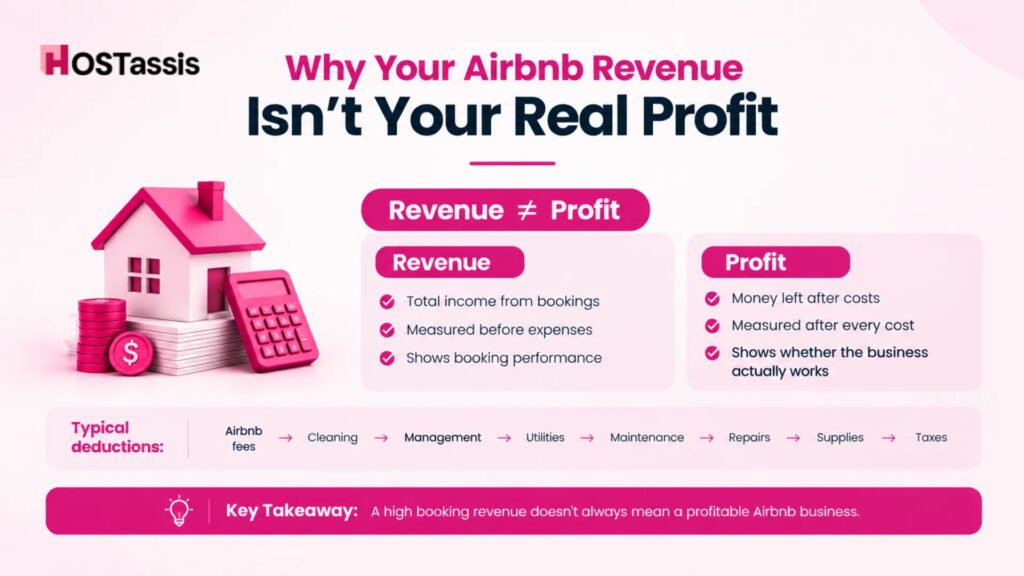
Your gross Airbnb revenue represents the total amount collected from guests, not the actual profit retained after accounting for all operating costs.
There’s a specific kind of satisfaction in opening the Airbnb app and seeing $12,000 worth of bookings for the month. It feels like the number that matters most. It isn’t. That figure is gross revenue, not income, and the gap between the two is where most hosts get caught off guard. By the time Airbnb’s fee, cleaning costs, a management percentage, utilities, repairs, and the occasional emergency call-out have all come off, what actually lands in the bank account can be a fraction of what the booking calendar promised. The owner statement is the document that explains that gap. Once a host knows how to read it, the monthly numbers finally make sense.
What Is an Airbnb Owner Statement?
An owner statement is a financial report that breaks down a property’s income, fees, and expenses over a given month, ending in the payout the owner actually receives. It’s the accounting behind the booking number, not a substitute for it.
Hosts running their own listing usually build this themselves in a spreadsheet, pulling figures from Airbnb’s payout history and their own receipts. Hosts working with a co-host or property manager get it as a finished report, sorted by category, typically sent alongside the payout itself. Property managers issue these mainly so owners have something concrete to check their fee against, rather than just taking their word for it. It helps to keep two things separate here. The Airbnb payout is the cash that hits the bank account. The owner’s statement is what explains how that cash figure came to be.
Why Revenue Doesn’t Equal Profit?
Revenue is every dollar a guest hands over. Profit is whatever is left once the cost of actually running the property has been paid out of that. A host tracking only the first number is, in a real sense, running the business blind.
Follow the money the way it actually moves. Booking income comes in. Airbnb takes its service fee off the top. Cleaning gets paid. The management fee, if there is one, comes off next. Then utilities, maintenance, repairs, supplies and taxes each take their share. Whatever survives that chain is the real profit number, and it’s almost always smaller than hosts expect the first time they sit down and add it all up.
| Revenue | Profit |
| Total income from bookings | What’s actually left in the bank |
| Measured before any costs | Measured after every cost |
| Looks impressive on its own | Tells you if the business actually works |
A host chasing a bigger revenue number while ignoring rising costs can end up making less money even as bookings go up. It happens more often than people think, and it’s usually invisible until someone reads the statement instead of just the payout.
What’s Included in an Airbnb Owner Statement?
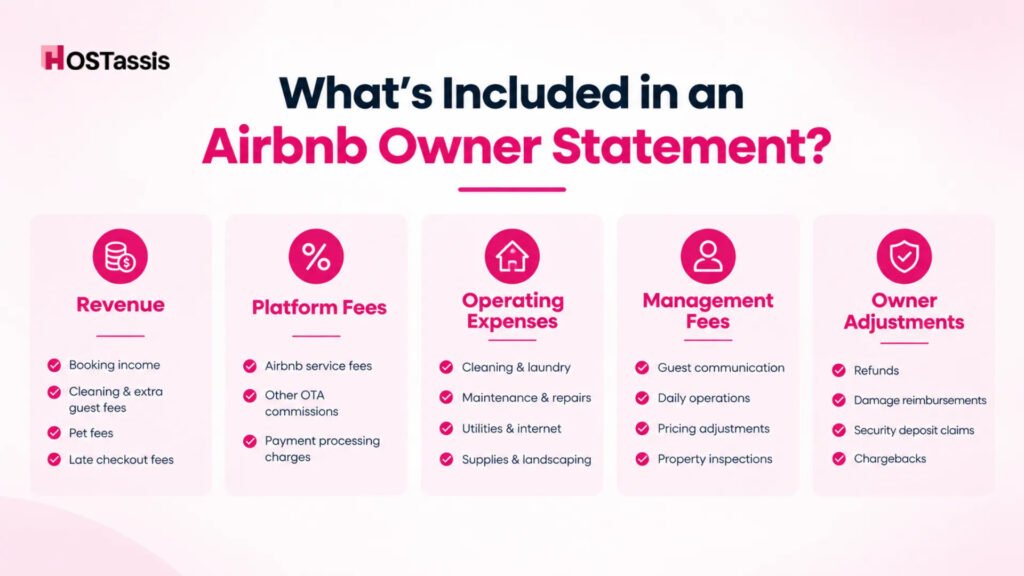
An Airbnb owner statement provides a clear breakdown of gross rental income, itemized deductions, expenses, and the final net payout for a specific property over a given period.
Here’s what typically goes into one:
- Property & Statement Details — the reporting month, property name or address, and owner info at the top, so there’s no confusion about which unit and period it covers.
- Gross Booking Revenue — every dollar charged to guests, nightly rates and cleaning fees included, usually broken down reservation by reservation or by channel.
- Platform & Processing Fees — whatever Airbnb, Vrbo, or the payment processor takes off the top.
- Co-Host or Management Fees — the manager or co-host’s cut, shown clearly as either a flat rate or a percentage.
- Property-Level Expenses — maintenance, repairs, restocked supplies, cleaning costs, ideally with receipts attached to back it up.
- Net Payout to Owner — the bottom line: what’s actually left after every fee and expense is subtracted.
- Performance Metrics — nights booked, occupancy rate, and average daily rate, giving a quick read on how the property performed.
- Pending Items — anything still unresolved: a damage claim, a held security deposit, upcoming maintenance that hasn’t hit the books yet.
Most hosts don’t build these by hand; tools like Hostaway or ready-made templates handle the heavy lifting.
The Most Common Hidden Costs Airbnb Owners Overlook
Running a short-term rental involves several recurring expenses well beyond the mortgage and basic listing fees, often consuming 30% to 50% of gross revenue.
Most hosts budget for the obvious costs like cleaning and the platform fee. It’s the smaller, recurring stuff that quietly eats into profit, because none of it looks significant on its own.
A short list of the ones that tend to catch people off guard:
- After-hours emergency maintenance, which almost always costs more than a daytime call
- Replacement linens and towels that wear out faster than expected
- Lost key or lockbox code replacements
- Batteries for smart locks and other connected devices
- Periodic deep cleans on top of standard turnover cleaning
- Seasonal maintenance, HVAC servicing especially
- Water leaks and whatever repairs follow them
- Broken appliances, more common in older units
- Furniture replaced due to normal guest wear
- Guest welcome supplies restocked at every turnover
- Credit card processing fees on direct bookings
- Monthly software subscriptions for pricing or messaging tools
- Insurance premiums
- Permit or license renewal fees
None of these show up as one big charge. They arrive twenty or eighty dollars at a time, spread across the year, which is exactly why they’re so easy to underestimate until someone actually adds up twelve months of statements.
How to Read an Airbnb Owner Statement Like a Business Owner?
Reading an Airbnb owner statement like a business owner means treating it as a mini profit and loss statement rather than just a simple bank receipt, one that breaks down the financial health, operational costs, and true profitability of a short-term rental over a calendar month.
Checking the payout figure and moving on tells a host almost nothing about why that number turned out the way it did. Reading a statement properly means going through it the way a small business owner reviews a profit and loss report, one line at a time.
- Verify total booking revenue against actual reservations for the period
- Go through each fee on its own instead of accepting the total
- Compare cleaning costs against occupancy to see if they’re tracking together
- Look for maintenance charges that seem unusually high or repeat too often
- Work out the real profit margin, not just the payout amount
- Set the current month against the last few for comparison
- Flag anything that looks off and ask about it directly
None of this takes more than fifteen minutes once it’s a habit. But it’s the difference between reacting after a bad month and catching the cause while it’s still small enough to fix.
7 Warning Signs Your Airbnb Expenses Are Too High
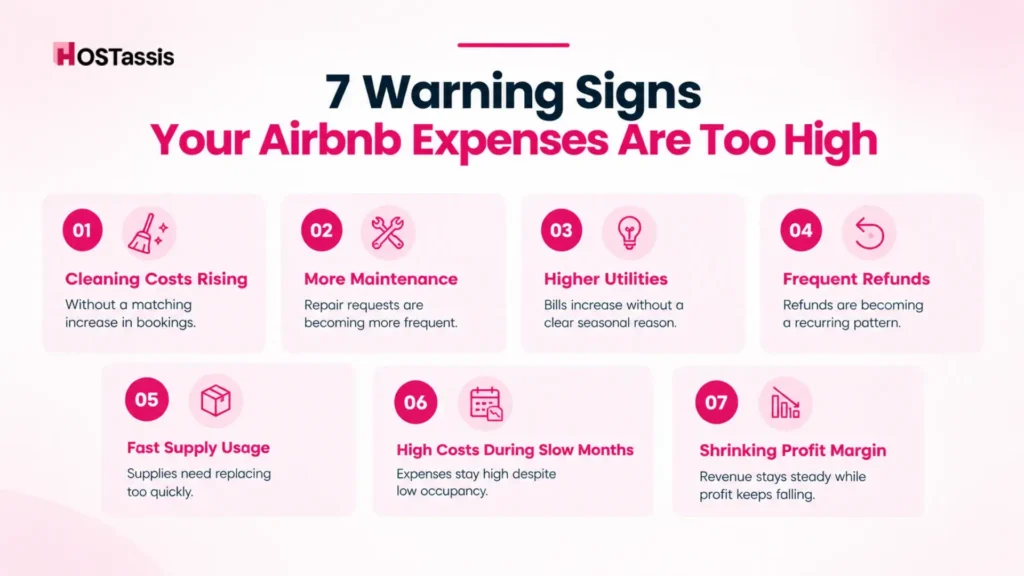
A handful of patterns in an owner statement usually show up before a real profitability problem does.
- Cleaning costs rise every month without a matching rise in bookings
- Maintenance requests come in more often than they used to
- Utility bills climb with no clear seasonal reason
- Guest refunds happen often enough to feel like a pattern, not an exception
- Supplies need restocking faster than the turnover schedule accounts for
- Costs stay high even during a slow, low-occupancy month
- Profit margin keeps shrinking even while revenue holds steady or grows
Any one of these on its own might mean nothing. Two or three showing up together, month after month, is usually worth a closer look.
How to Improve Airbnb Profit Without Increasing Nightly Rates?
You can boost your Airbnb profit without raising nightly rates by cutting operational costs, increasing occupancy, and offering paid add-ons that guests are happy to pay for.
- Fix small maintenance issues before they turn into expensive repairs
- Set clear house rules to reduce avoidable property damage
- Track inventory so supplies get reordered on schedule, not during a panic
- Build cleaning schedules around actual turnover patterns instead of a fixed routine
- Buy linens and consumables in bulk to lower the per-unit cost
- Schedule preventive maintenance so it never becomes an emergency call
- Watch utility usage, HVAC especially, through a smart thermostat where possible
- Review vendor contracts once a year instead of letting them auto-renew
- Tighten guest communication so small issues don’t turn into refund requests
- Set clear check-in and check-out instructions to cut down on avoidable complaints
Key Airbnb Financial Metrics Every Owner Should Track
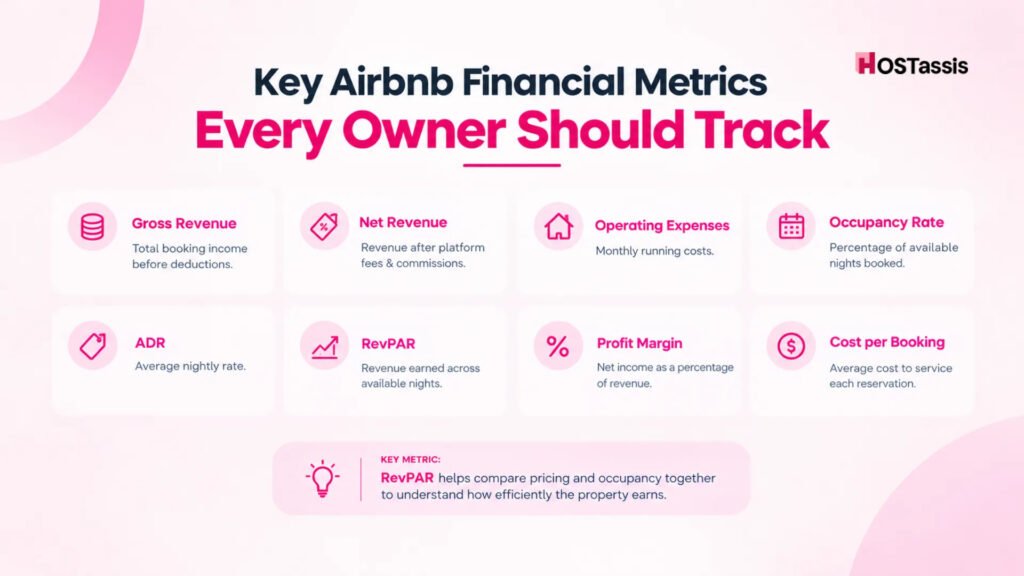
Revenue on its own doesn’t say much about a property. These are the numbers that actually explain how it’s performing.
| Metric | What It Actually Tells You |
| Gross Revenue | Total income from bookings before any deductions |
| Net Revenue | What’s left after platform fees and commissions |
| Operating Expenses | Monthly running costs, the biggest driver of real profit |
| Occupancy Rate | Percentage of available nights actually booked |
| ADR (Average Daily Rate) | The average nightly rate guests are actually paying |
| RevPAR (Revenue Per Available Night) | ADR multiplied by occupancy rate, showing how much a property earns across every available night, booked or not |
| Profit Margin | Net income as a percentage of revenue, the clearest read on business health |
| Cost per Booking | Average cost to service a single reservation, from cleaning through guest support |
RevPAR is the one hosts tend to skip, but it might be the most useful of all of them. A property with a high nightly rate and low occupancy can post the exact same RevPAR as one charging less but booked far more often, and that comparison usually says more about pricing strategy than either number does alone.
Mistakes Owners Make When Reviewing Monthly Statements
Business owners often make critical mistakes when reviewing their monthly statements, mainly by confusing bank balances with true profitability and skipping the line-by-line trend checks that actually reveal what’s going on.
The recurring mistakes look like this: ignoring month-to-month trends instead of comparing statements side by side, treating one large maintenance charge as a one-off instead of checking whether it’s becoming a pattern, mixing personal spending into the property’s books, never setting aside a reserve fund for repairs, and letting recurring software or subscription fees renew without asking if they’re still needed. None of these look serious in a single month. Stacked over a year, they’re usually the reason the annual numbers don’t add up the way a host expected.
Should You Manage Airbnb Finances Yourself or Hire a Property Manager?
The right answer has less to do with how many properties someone owns and more to do with how much time they actually have to sit down and read through numbers every month.
| Self-Managed | Professional Management |
| Manual tracking across spreadsheets | Structured, audit-ready statements |
| Vendor coordination handled directly | Ongoing operational support |
| Full workload falls on the owner | Time-saving |
| Time-intensive | Vendors already vetted and managed |
| Itemized reporting done monthly | Personal bookkeeping |
A single-property host with time to spare can usually keep on top of this without much trouble. Someone running two or three listings, or someone who keeps finding line items on their statement they can’t quite explain, tends to reach a point where handing off the accounting side makes more sense than doing it alone. That’s the gap HOSTassis’s STR-focused accounting service is built to fill: monthly reports, expense tracking, and profit analysis built around how short-term rentals actually operate, not a generic bookkeeping template that has no idea what a cleaning cycle is.
What a Real Owner Statement Actually Looks Like?
An owner statement is a monthly financial report from a property manager that details a rental property’s income, expenses, and net cash flow.
Numbers make more sense when they are laid out in sequence rather than listed as isolated categories.
- Booking revenue for the month: $5,000
- Airbnb service fee: approximately $150
- Cleaning costs across all turnovers: $600
- Management fee at 20 percent: $1,000
- Utilities, internet, and routine maintenance: approximately $350
- Guest refund for a broken AC unit: $200
- Final net payout: approximately $2,700
The gap between $5,000 in bookings and $2,700 in actual payout is not a sign that something went wrong. It reflects the standard cost of operating a short term rental. Problems only arise when a host treats the booking total as the real number without ever reviewing the breakdown behind it.
How to Calculate Break-Even Occupancy?
To calculate break-even occupancy for a rental property, divide the sum of operating expenses and debt service by the potential gross income at full occupancy.
Every property has a point at which it stops losing money and starts generating real profit, and identifying that point is essential for accurate financial planning.
- Fixed monthly costs (mortgage or rent, insurance, flat software subscriptions): $2,000
- Adjusted nightly rate after cleaning and platform fees: $100
- Break-even calculation: $2,000 ÷ $100 = 20 nights
A property with $2,000 in fixed monthly costs and a $100 adjusted nightly rate must book approximately 20 nights a month simply to cover baseline expenses. Occupancy beyond that threshold is where actual profit begins. Hosts who track this number can accurately assess performance during slower months instead of assuming a decline in bookings automatically signals a financial problem.
Why Choose Us for Airbnb Cohosting
Most hosts do not lose money because their property performs poorly; they lose clarity because nobody breaks the numbers down properly. That is where we make the real difference.
- Transparent Monthly Statements: Every report is itemized and audit-ready, with revenue, fees, expenses, and net payout laid out clearly, not buried in a single lump sum.
- Real Profit Tracking: We track net income, not just booking totals, so owners always know exactly what they are earning after every cost is accounted for.
- Break-Even Awareness: We help owners understand their actual break-even occupancy, so a slower month reads as expected, not alarming.
- No Hidden Line Items: Every fee is explained in dollars and percentages upfront; nothing appears on a statement without a clear reason behind it.
- Expense Oversight: We flag unusual maintenance costs, rising cleaning fees, or recurring charges before they quietly eat into profit month after month.
- STR-Specific Accounting: Our reporting is built around how short-term rentals actually operate, cleaning cycles, turnover patterns, and seasonal shifts, not a generic bookkeeping template.
We do not just manage bookings; we make sure every dollar earned is accounted for, so owners always know exactly where their money goes.
Frequently Asked Questions
What is an Airbnb owner statement?
A monthly report showing a property’s income, fees, and expenses, ending in the actual payout the owner receives.
Why is my Airbnb payout lower than my booking revenue?
Because platform fees, cleaning costs, management fees, and operating expenses are all deducted before the payout goes out. The two numbers were never going to match.
What expenses reduce Airbnb profits?
Commissions, cleaning, maintenance, utilities, supplies, insurance, and management fees are the main ones. The smaller recurring costs add up too, more than most hosts expect.
How often should I review owner statements?
Every month, as soon as it comes in. Waiting until year-end makes it much harder to catch a small problem before it repeats itself a few more times.
What is a healthy Airbnb profit margin?
It depends heavily on the market and property type, so there’s no single number that applies everywhere. Watching the trend across several months tells a host more than comparing to some generic benchmark ever will.
Can I reduce Airbnb operating expenses?
Yes, mostly through preventive maintenance, buying supplies in bulk, negotiating vendor contracts, and tightening guest communication so fewer issues turn into refund requests.
What’s the difference between revenue and net income?
Revenue is everything collected from guests. Net income is what’s left once every cost of running the property has been taken out of it.
Do professional property managers provide owner statements?
Yes, it’s a standard part of their monthly reporting, and it’s worth asking to see a sample before signing on with one.
Conclusion
An owner statement is not just a payout summary. It’s the clearest record a host has of how their property is actually doing, once every fee and expense has been counted. Reading through it properly, line by line, is what separates hosts who are genuinely growing a rental business from hosts who are just hoping the numbers keep working out on their own.