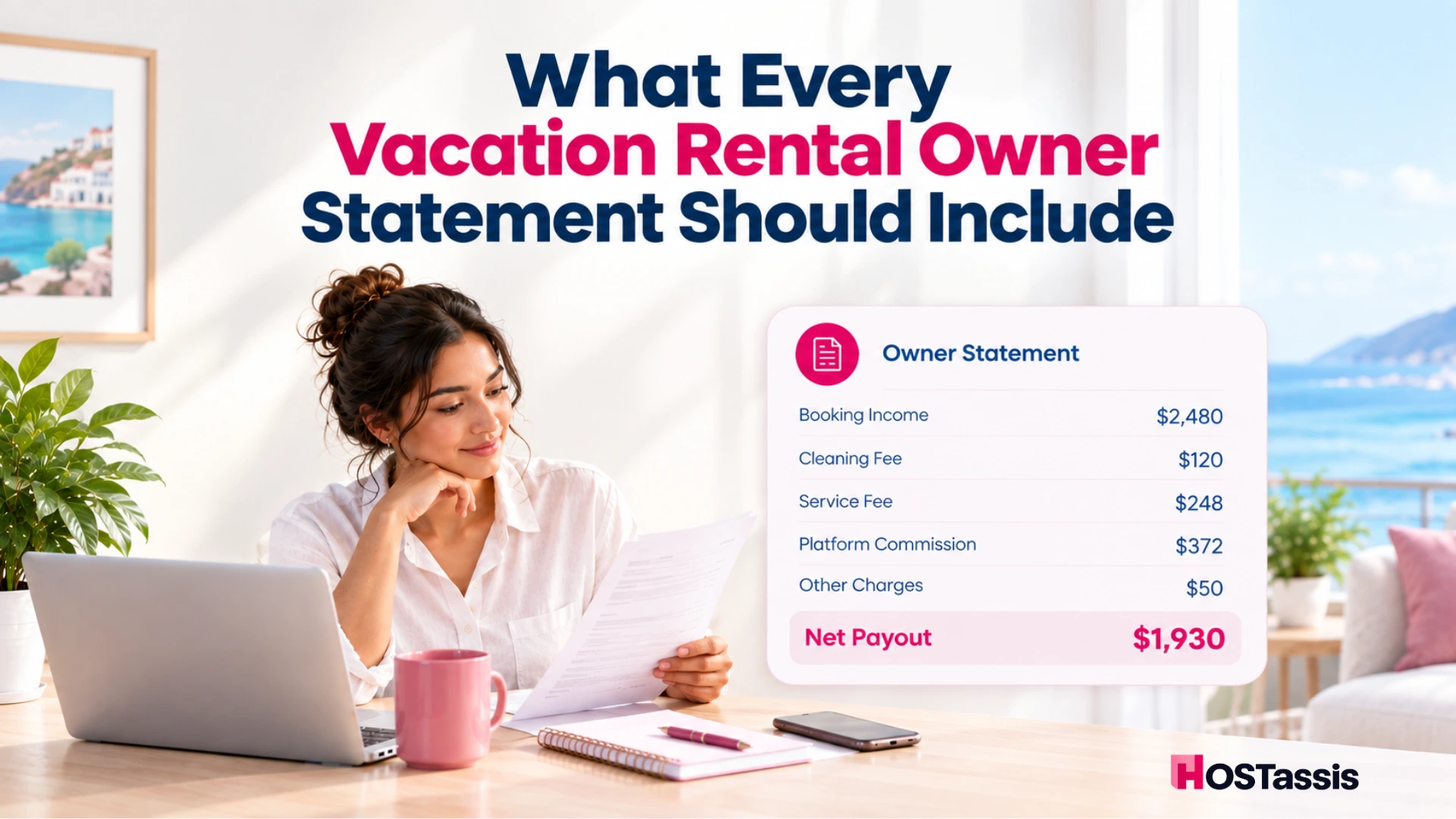
A professional owner statement should show gross revenue, itemized deductions, performance metrics, and final net payout, with every dollar traceable on one clear, audit-ready page reconciling to the bank transfer.
Most owners never actually read their statement line by line. They glance at the total, compare it to last month, and move on. That works fine until the number looks wrong and there’s nothing on the page detailed enough to explain why. This guide breaks down exactly what a complete, trustworthy owner statement should contain, so you know what to expect from your property manager and what to question if it’s missing.
How Detailed Should an Owner Statement Be?
An owner statement should be fully itemized and transparent, showing exact dates, specific vendors, and individual transaction breakdowns, rather than lump-sum totals that leave owners guessing.
The goal is reservation-level revenue, meaningful expense categories, and references an owner can follow up on, not a wall of undifferentiated line items. If a questioned charge can be traced back to the transaction that created it, the statement has done its job. If it can’t, more detail is needed, not less.
What Is a Vacation Rental Owner Statement?
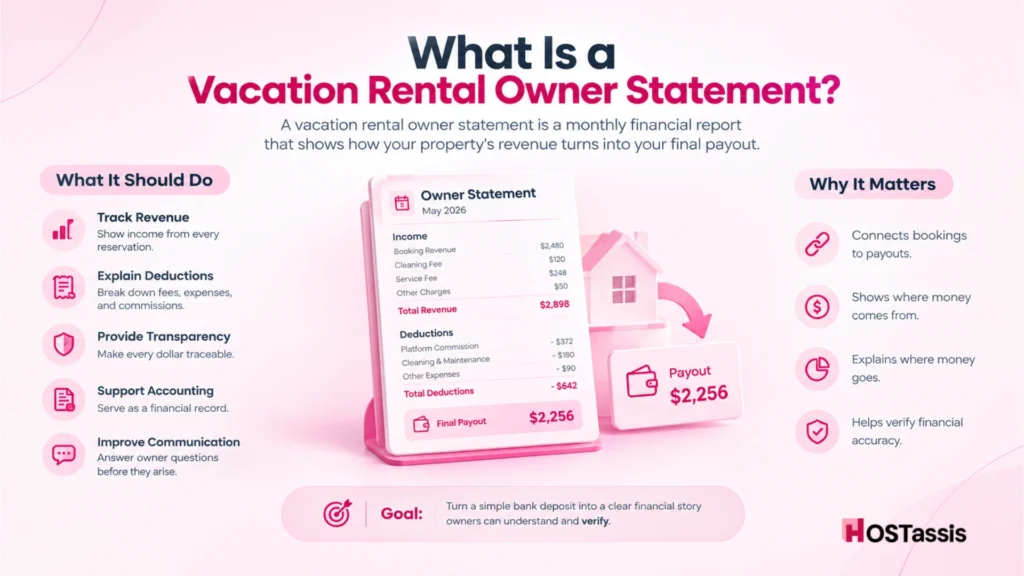
A vacation rental owner statement, sometimes called a short term rental owner statement depending on who’s writing it, is a recurring financial report, usually monthly, that a property manager sends to summarize a specific property’s revenue, deductions, and final distribution. It is not the same thing as a full profit and loss statement or a tax document.
Think of it as the paper trail behind the payout. The bank deposit tells you how much arrived. The statement tells you how that figure was actually built. A good one works as both:
- An accounting record, showing every number and where it came from
- A communication tool between manager and owner, answering questions before they need to be asked
For an Airbnb or Vrbo property specifically, the same basic structure applies. The owner statement should connect each reservation to accommodation revenue, guest paid fees, platform deductions, operating expenses, management fees, adjustments, and the final owner distribution, regardless of which channel the booking came through.
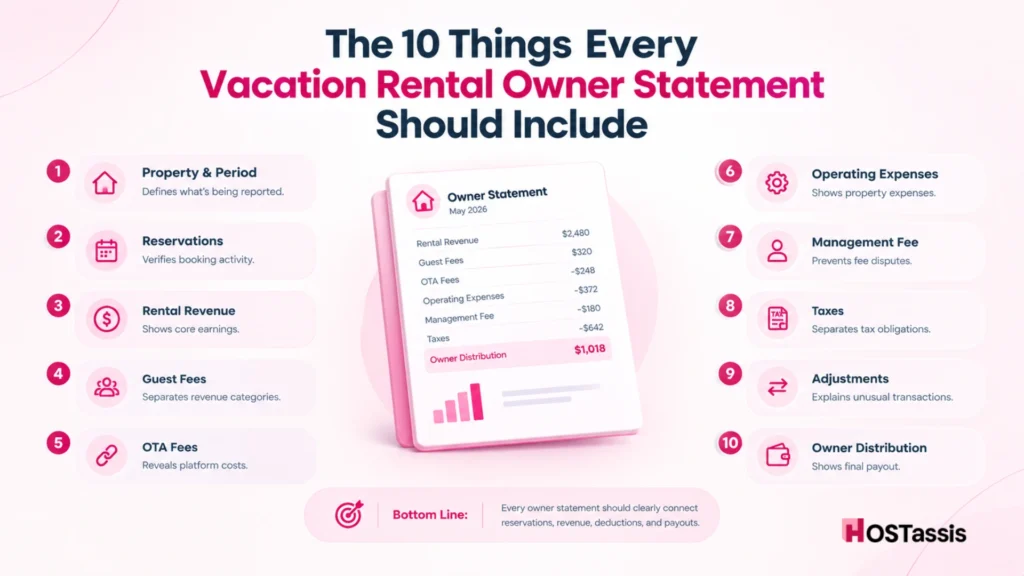
The 10 Things Every Vacation Rental Owner Statement Should Include
| Section | What It Should Show | Why It Matters |
| Property & Period | Property, owner, dates, currency | Defines exactly what’s being reported |
| Reservations | Channel, dates, nights, booking value | Lets owners verify activity against their calendar |
| Rental Revenue | Accommodation income | Shows core earnings, separate from fees |
| Guest Fees | Cleaning, pet, other charges | Keeps revenue categories from blending together |
| OTA Fees | Airbnb/Vrbo/Booking.com deductions | Shows the real cost of each booking channel |
| Operating Expenses | Cleaning, supplies, maintenance | Reflects actual property running costs |
| Management Fee | Rate, calculation base, amount | Prevents disputes over what the fee was charged on |
| Taxes | Collected, remitted, or still payable | Stops taxes from being mistaken for owner income |
| Adjustments | Refunds, cancellations, corrections | Explains any figure that isn’t a straightforward booking |
| Owner Distribution | Amount paid or owed | Shows what actually reaches the owner |
1. Property, Owner and Statement Period
An owner statement header should clearly state the property’s legal address, the owner’s registered name, and the exact reporting period it covers.
- The property name or address
- The owner’s name and the management company
- The reporting period and the date the statement was generated
- The currency used
One thing owners often overlook is whether the numbers are organized by stay date, booking date, or payout date. All three can be mathematically correct and still produce different totals for the same month.
Say a reservation is booked on September 28 for a stay that begins October 5. On a booking date statement, that revenue shows up in September. On a stay date statement, it shows up in October. On a payout date statement, it might land in either month depending on when the funds were released. None of these approaches is wrong, but comparing a booking date statement against your own stay date calendar will make the numbers look off even when nothing is actually missing.
What to verify: Confirm which reporting basis your management agreement or statement template uses, and stick to comparing statements on that same basis month over month.
2. Reservation Level Booking Details
Reservation-level booking details capture the specific data points, guest information, and stay parameters needed to record, verify, and manage each individual booking.
- Booking reference number
- Channel it came through
- Check in and check out dates
- Number of nights
- Revenue tied to that specific booking
A statement that only shows one combined revenue figure for the month gives you nothing to check it against. Reservation level detail is what turns a statement from a summary into something you can actually audit.
What to verify: Match each reservation’s reference, dates, nights, and booking amount against your own property calendar or channel dashboard.
3. Accommodation Revenue and Guest Paid Fees
The total amount a guest pays isn’t the same as the revenue an accommodation business actually keeps, since fees and commissions come out along the way.
- Cleaning fees
- Pet fees
- Late checkout charges
- Any other amount a guest paid on top of the room rate
Not every dollar a guest hands over counts as the same kind of revenue. Keeping guest paid cleaning fees separate from the actual cleaning expense makes it easier to see what was charged to the guest versus what the property actually spent on turnover services. The two numbers don’t have to match, and treating them as one figure hides that difference. Payout summaries from major platforms already separate gross booking amounts from deductions, so an owner statement should hold to the same standard.
4. OTA Commissions and Platform Fees
Online Travel Agencies typically charge baseline commissions between 10% and 30% per booking, though extra fees can push the actual total even higher.
- Each channel’s commission shown on its own line
- Payment processing fees separated from booking commissions
- A total that owners can trace back to a specific platform’s rate
If a statement only shows a single lump figure for fees, there’s no way to verify it against what Airbnb or Vrbo actually charged. Platform earnings dashboards already break this out, so an owner statement should match that level of transparency rather than simplify it away.
5. Cleaning, Maintenance and Property Expenses
Cleaning, maintenance, and property expenses are the operating costs needed to keep a rental safe, clean, and fully functional for every guest.
- Cleaning and laundry costs per turnover
- Restocked supplies
- Repairs, with a brief note on what was fixed
- Utilities, when billed through the manager
- Any approved vendor charge, ideally with an invoice reference
A single line labeled “miscellaneous” is usually the clearest sign that something needs a closer look. Expenses that repeat every month should read differently on the page than a one time repair, and a genuine emergency shouldn’t be buried inside a routine cost category.
What to verify: Make sure any material repair or vendor charge can be traced to an invoice, a photo, or a pre approval you gave for the work.
6. Management Fee and the Fee Calculation Base
A management fee is the periodic charge a property manager charges for overseeing the rental, while the fee calculation base is the specific revenue figure that percentage is applied against.
The management fee should show three things:
- The rate
- The base it’s calculated against
- The final dollar amount
A line that simply says “Management fee: $850” tells you nothing. What you actually need is something closer to “15% of accommodation revenue,” or whatever base your contract specifies. It also matters whether cleaning fees, taxes, or other pass through charges are included in that base or excluded from it. This is consistently the single most disputed line on any property management owner statement, and it’s usually a dispute that a clearly written fee line would have prevented.
A worked example makes this easier to follow. If accommodation revenue for the month is $4,800 and the management agreement sets the fee at 15% of accommodation revenue, the line should read something close to:
“Management fee, 15% of accommodation revenue ($4,800): $720.”
Written that way, an owner doesn’t need to take the total on faith. They can run the same percentage against the same base and land on the same number themselves.
What to verify: Check the stated percentage or flat rate against your management agreement, and confirm the calculation base (accommodation revenue, gross booking revenue, or something else) matches what you signed.
7. Taxes Collected, Remitted or Still Payable
Taxes collected, remitted, and still payable simply mark the different stages of a property manager handling occupancy or lodging tax on the owner’s behalf.
Every tax line should state plainly:
- Who collected it
- Who’s responsible for remitting it
- Whether that obligation has already been handled or still sits with the owner
Some occupancy or lodging taxes are collected and remitted directly by the booking platform. Others get collected by the property manager, and some are simply passed through as the owner’s own responsibility. A statement that treats every tax dollar as generic revenue makes it easy to overstate what the property actually earned. This isn’t tax advice for your specific location, so check with a tax professional for anything specific to your property.
8. Refunds, Cancellations, Chargebacks and Adjustments
A refund is a voluntary repayment issued directly by the merchant, while a chargeback is a forced reversal disputed through the guest’s bank.
A month rarely consists of clean, positive bookings only:
- Guests cancel
- Disputes happen
- A prior statement sometimes needs a correction after the fact
When these adjustments are folded quietly into the main revenue figure, the statement stops being a reliable record of what actually happened that month, and comparing one period to the next turns into guesswork.
9. Opening Balance, Owner Reserve and Closing Balance
An opening balance is the starting amount at the beginning of a period, an owner’s reserve is money set aside for future needs, and a closing balance is what remains at the end.
If a reserve or running balance exists, the statement should show:
- Balance carried over from the prior statement
- Reserve amount held for future expenses
- Owner deposits or withdrawals during the period
- Closing balance carried into next month
The arithmetic should be traceable from one end to the other. If the opening balance doesn’t logically lead to the closing balance once every line item is applied, something on the statement is missing or mislabeled.
10. Final Owner Distribution
A final owner distribution is the last transfer of a period’s earnings from the property manager to the owner, after every deduction has been applied.
The statement should state:
- The exact payout amount
- The date or status of that payment
- Confirmation that it ties directly to the bank deposit the owner actually received
This isn’t the place for a full breakdown of how payouts move through processing and banking systems. That’s worth understanding on its own. What matters here is simple: the number on the statement and the number in your account should match. If they don’t, that gap needs an explanation before the statement is treated as final.
For example, a statement might show a $2,800 owner distribution while the actual bank deposit comes in lower, because a portion was held back as a reserve or a timing difference pushed part of the transfer into the following period. That’s not automatically a mistake, but it should be labeled as one of those two things rather than left unexplained.
What to verify: Compare the final distribution figure against the corresponding bank deposit, and ask about any difference before assuming the statement is final.
Should Owner Stays and Blocked Nights Appear on the Statement?
Yes. Owner stays and blocked nights should be noted, but kept in a clearly labeled section separate from paid occupancy so they don’t get mistaken for lost revenue.
An owner staying at their own property for a week isn’t a financial loss, but it does affect availability and sometimes triggers cleaning costs. Listing it separately, rather than mixing it into paid booking data, keeps the revenue section honest while still giving the owner a full picture of how the calendar was used.
Should ADR, Occupancy and RevPAR Be on an Owner Statement?
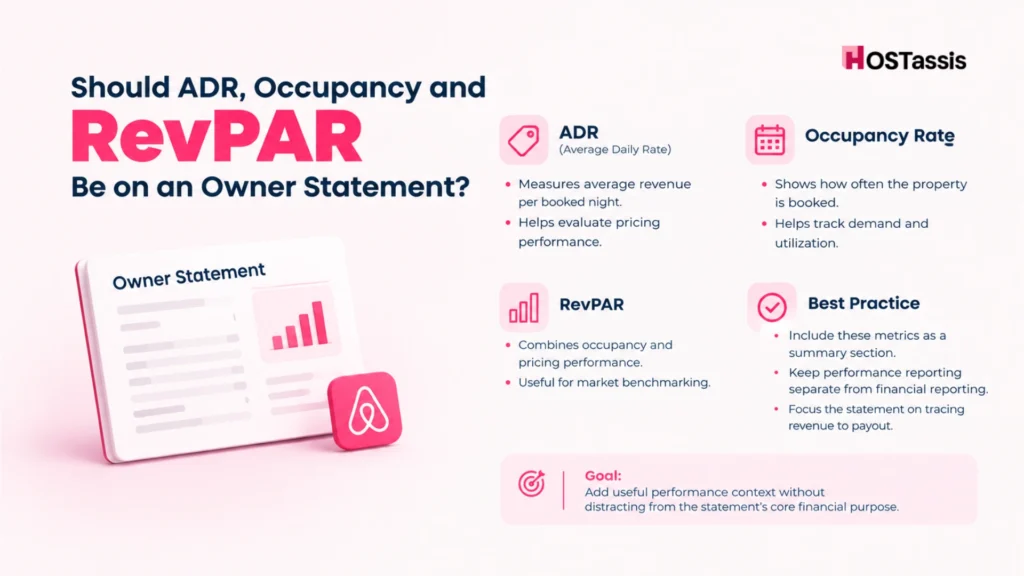
ADR, occupancy, and RevPAR are worth including as a summary reference, since they give useful context on performance, even though the statement’s core job is tracing revenue to payout.
These performance metrics can be useful as a summary reference, but they aren’t the core job of an owner statement. The statement exists to trace booking revenue through to payout, not to serve as a performance dashboard.
- Average daily rate and occupancy percentage measure how a property is performing
- RevPAR can be compared against relevant market benchmarks when that context is available
- A detailed breakdown of these numbers belongs in a separate performance report, not squeezed into a financial statement that’s already doing a different job
How Often Should Vacation Rental Owner Statements Be Sent?
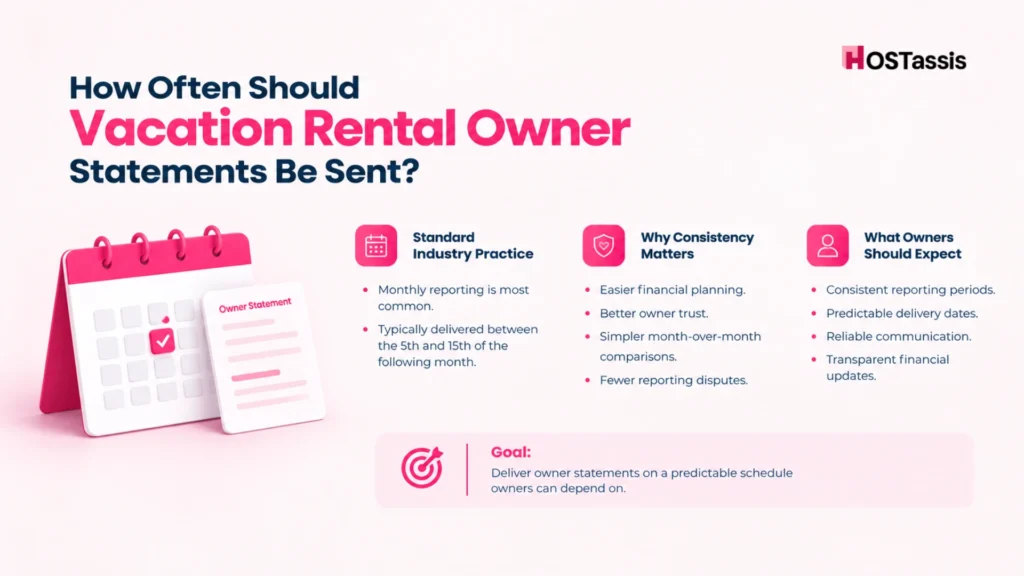
Owner statements are typically sent monthly, usually between the 5th and 15th of the following month, with timeliness and a predictable date mattering more than extra detail for building owner trust
A monthly owner statement is the standard cadence for most property managers, though some offer weekly or on demand reporting on top of it. What matters more than the frequency itself is a predictable, consistent delivery schedule.
An owner who knows their statement arrives on the same date every month, covering the same cutoff period every time, can plan around it. Irregular delivery timing is often a bigger source of frustration than the reporting frequency itself.
How Detailed Should an Owner Statement Be?
An owner statement should be fully itemized, breaking down exact dates, vendors, and amounts so every dollar of income and expense can be independently verified.. The goal is:
- Reservation level revenue
- Meaningful expense categories
- References an owner can actually follow up on
Not a wall of undifferentiated line items. If a questioned charge can be traced back to the transaction that created it, the statement has done its job. If it can’t, more detail is needed, not less.
A Simple Vacation Rental Owner Statement Structure
A vacation rental owner statement template can follow a simple, repeatable structure: property details, reservations, revenue, fees, expenses, adjustments, and final owner distribution, in that order. The numbers below are illustrative only, meant to show the flow of a typical statement rather than represent a real property.
| Line Item | Amount |
| Opening Balance | $0 |
| Reservation Revenue | $4,800 |
| OTA Commissions | ($480) |
| Operating Expenses | ($650) |
| Management Fee | ($720) |
| Adjustments | ($150) |
| Owner Distribution | ($2,800) |
| Closing Balance | $0 |
Read top to bottom, the sequence follows the same chain this whole article is built around: accommodation revenue, then OTA fees, then operating expenses, then the management fee, then adjustments, then the owner distribution. Each deduction has a clear place in that order, and the final distribution figure is simply what’s left once every step has been applied, not a number that appears out of nowhere.
7 Red Flags in a Poor Owner Statement
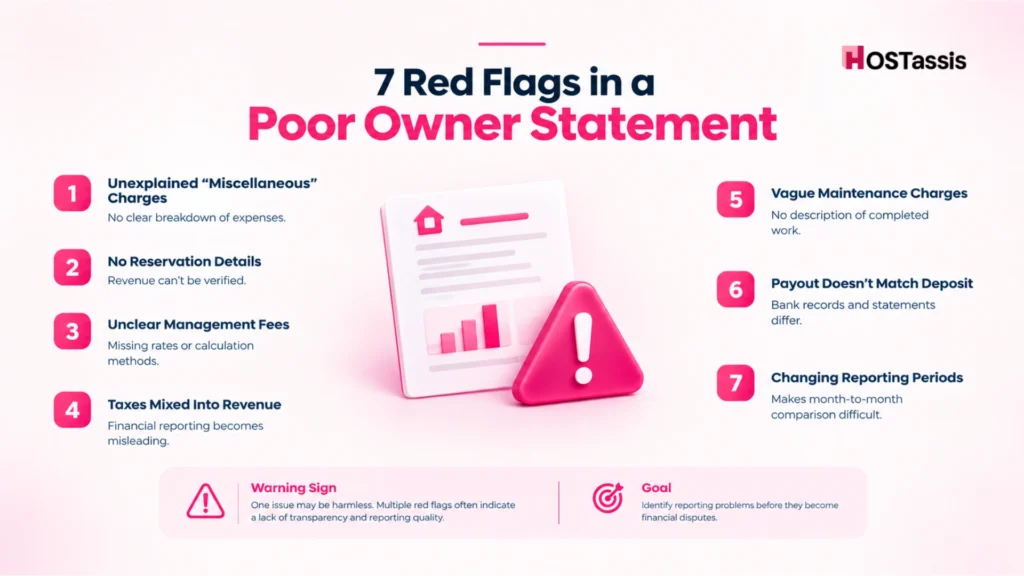
A clear owner statement reveals your investment’s true financial health, while hidden fees, poor bookkeeping, or mismanagement usually show up as red flags right on the page itself.
- A catch-all “miscellaneous” charge with no further explanation
- No reservation level detail behind the total revenue figure
- A management fee with no stated rate or calculation base
- Taxes folded into revenue instead of shown separately
- Maintenance charges with no description of the work done
- A payout that doesn’t match the actual bank deposit
- A reporting period that shifts from one statement to the next
Any single item on this list might have an innocent explanation. Several of them showing up together, month after month, is usually a sign the statement needs to be rebuilt with more transparency, not just a quick clarifying phone call.
Vacation Rental Owner Statement FAQ
What is the difference between an owner statement and a profit and loss statement?
An owner statement explains what happened to one specific property and how the current payout was calculated. A profit and loss statement is a broader accounting report covering revenue and expenses across a wider view of the business.
How often should property managers send owner statements?
Monthly is the most common cadence, though weekly or on demand reporting exists too. A predictable cutoff and delivery date matters more than the exact frequency chosen.
Should every Airbnb or Vrbo reservation appear on the owner statement?
Usually yes, if it contributed financially during that reporting period. Reservation level detail is what lets an owner check the statement against their own booking calendar.
Should cleaning fees be shown separately on an owner statement?
Yes. The cleaning fee a guest pays and the actual cost of cleaning the property are two different transactions, and combining them into one unexplained number hides more than it shows.
Should maintenance invoices be attached to owner statements?
Not every small invoice needs to appear on the statement itself, but any material expense should be clearly identifiable and, ideally, linked back to supporting documentation.
What if the owner statement does not match the bank payout?
That gap should be investigated before the statement is treated as final. Common causes include:
- Reserves held back
- Timing differences between periods
- Late adjustments or refunds
- An expense posted incorrectly
Do taxes count as vacation rental revenue?
Not automatically. Some taxes are collected and remitted directly by a booking platform, while others are passed through for the owner to handle. A clear statement shows which is which instead of counting every tax dollar as income.
Conclusion
A good owner statement isn’t complicated. It’s traceable, consistent, and clear enough that nothing on it needs a follow up call to explain. Every dollar should fit somewhere in the chain from reservation to revenue to deductions to final payout, with nothing left unlabeled.
If your current statements leave you guessing more often than not, that’s usually a reporting problem, not a property problem. HOSTassis’s STR focused accounting service builds monthly statements around exactly this kind of transparency: itemized, audit ready, and built for how short term rentals actually operate. Get in touch to see what a clearer statement looks like for your property.