Airbnb security deposits used to be common for hosts who wanted to protect their property from damage caused by guests. However, Airbnb’s policies have changed over time. Most hosts can no longer request a security deposit when guests make a reservation or ask guests to pay one outside the Airbnb platform. Airbnb now has specific rules about which hosts can collect these deposits and how they must be collected.
According to Airbnb’s latest policy, only specific hosts, including some software-connected hosts, may charge a security deposit. When a host receives a security deposit, they must enter it in the correct field in this way guests clearly see the additional amount before confirming their booking. Hosts must understand these rules to avoid problems or policy violations before asking guests to pay a deposit.
This article will give clear detail about what hosts need to know about Airbnb security deposits, including who can collect them, what to do if guests damage the property, and how to request deposits while following Airbnb’s policies. If a host understands the deposit rules, it can protect their property, clarify their rights, and help them handle security deposits correctly.
Does Airbnb Require or Allow Security Deposits in 2026?
In 2026, Airbnb hosts cannot collect a security deposit from their guests through Airbnb’s Resolution Center or otherwise.
They do not have this right, with few exceptions. The exception is for software-connected hosts and hotels, but even then, it has to be disclosed in the fees section during checkout. If a guest damages the property, the host can try to collect this amount through Resolution Center claims within 14 days after checkout, but they are not guaranteed to succeed. If a host is not successful, they should file their claim with AirCover.
Who Can Charge an Airbnb Security Deposits?
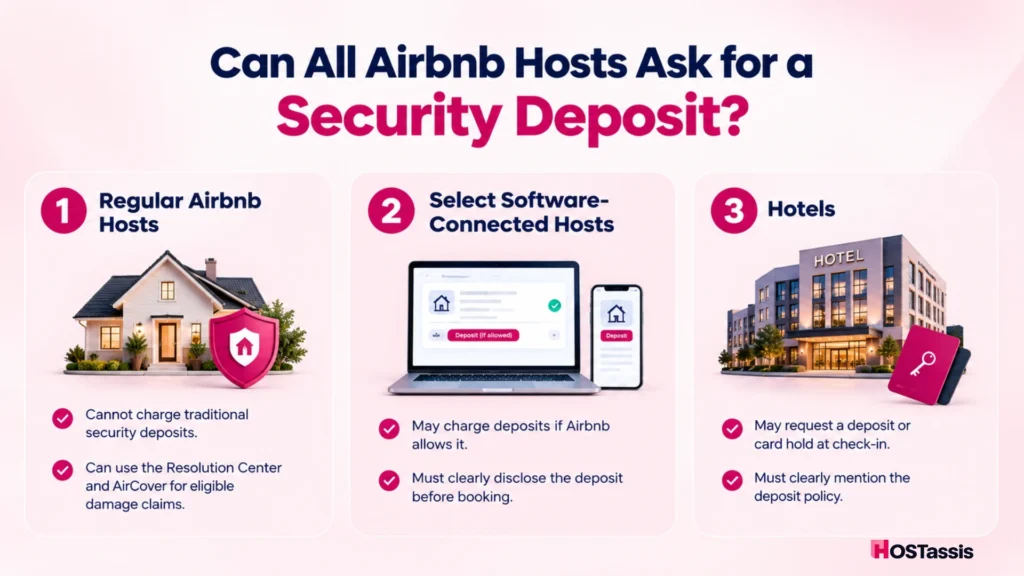
Only a limited set of hosts can charge a security deposit on Airbnb. Most regular hosts cannot. However, certain software-connected hosts and hotels may charge one if they clearly mention it in the listing before booking.
Regular Airbnb Hosts
Most regular Airbnb hosts cannot ask guests for a traditional security deposit, either through the Resolution Center or outside Airbnb. Instead, hosts can handle damage claims through the Resolution Center and AirCover for Hosts.
Select Software-Connected Hosts
Hosts using approved API-connected property management software may collect a security deposit outside Airbnb’s process.
To do this, hosts must disclose the deposit in their listing’s fee breakdown to ensure it is shown to guests during the checkout process. The deposit is usually a refundable hold or a separate payment handled outside Airbnb by the property management software.
Hotels
Airbnb allows hotels to request a security deposit or temporary hold during check-in. The hotel must disclose this information in its listing or price breakdown so guests are aware of the policy when making a reservation. The hotel returns the money to the guest at or shortly after checkout, except when charges apply under the hotel’s policy.
Airbnb Security Deposit Rules at a Glance
This table shows which hosts can charge a security deposit, when it is allowed, and how it must be handled under Airbnb’s rules.
| Host Type | Can Charge Deposit? | Where/How |
| Regular Airbnb host | Usually no | Use Airbnb damage-reimbursement process instead |
| Select software-connected host | Sometimes | Must be properly disclosed |
| Hotel | Yes, in permitted cases | Can collect under normal hotel procedures if disclosed |
| Host asking unexpectedly after booking | Generally, not allowed | May violate Airbnb payment rules |
Can a Host Ask for a Security Deposit After the Guest Books?
Usually, no. A host cannot ask a guest for a new mandatory security deposit after booking if it was not mentioned in the listing. Airbnb requires any allowed deposit to be clearly shown in the listing’s fee section, so guests know about it before they book. If a host asks for an unexpected deposit outside Airbnb or after booking, it may go against Airbnb’s payment and fee rules, and guests can report it.
Can Airbnb Hosts Collect Security Deposits Off-Platform?
In most cases, no. Airbnb doesn’t allow you to accept payments for bookings outside the platform. Some owners connected to software that allows processing deposits can receive some deposits before guests book their stay, but the deposit should be indicated in advance in the listing description. Requiring a security deposit outside Airbnb after booking violates Airbnb’s payment policy.
Security Deposit vs AirCover for Hosts: What’s the Difference?
A security deposit is a sum of money that is withheld for a particular booking. Only eligible hosts can collect a security deposit from the guest, which must be disclosed to the guest at the time of booking. AirCover for Hosts provides coverage for qualifying losses that may be claimed against the host by a guest, up to $3 million, without a security deposit, so it should not be collected from the guest. AirCover is not insurance, and there are a few exclusions.
| Security Deposit | AirCover Host Damage Protection |
| Money/hold associated with guest booking | Airbnb protection program |
| Only available to limited host types | Included for Airbnb home hosts |
| Intended to cover potential guest liability | Can reimburse eligible guest-caused damage |
| Has to be properly disclosed | No separate guest deposit required |
| Amount may be limited to deposit held | Host Damage Protection currently offers up to $3M, subject to terms |
What Happens if a Guest Damages the Property and There Is No Deposit?
Even if you don’t charge for a security deposit, you may still be able to claim reimbursement for damages caused by a guest. Take pictures and videos of the damaged items, keep any receipts for damaged items or repairs, and request reimbursement through Airbnb’s Resolution Center within 14 days of checkout.
The guest then has 24 hours to respond. If they do not pay you back, you can ask Airbnb to review the claim. If the claim meets AirCover for Hosts’ requirements and the guest still refuses to pay, Airbnb may reimburse you for eligible property damage covered under the program.
What Can a Security Deposit Be Used For?
For the limited number of hosts who are allowed to collect a security deposit, the money is meant to cover costs caused by guest damage. It should not be treated as an extra source of income. The deposit may cover :
- Repairing damage caused by a guest
- Replacing lost or damaged items
- Covering theft or missing items
- Paying for excessive cleaning when both sides agree
- Covering other costs clearly stated in the rental agreement or listing
How Much Should an Airbnb Security Deposit Be?
Airbnb doesn’t set a single standard security deposit amount for all eligible hosts. If you are a software-connected host or a hotel allowed to take a deposit, choose an amount based on your property, the types of guests you usually host, and local rules.
Experienced hosts often look at the property’s size, the value of furniture and other items, how long guests will stay, and the chances of damage when deciding on an amount. They also make sure it follows the software’s limits, Airbnb’s rules, and local laws.
How Should an Allowed Security Deposit Be Disclosed?
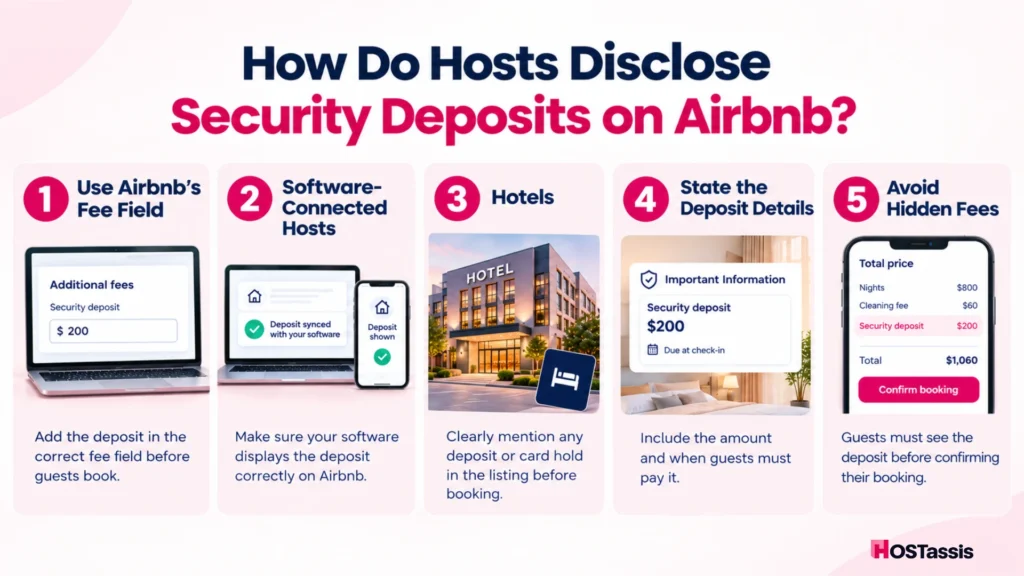
A security deposit must be clearly shown to guests as a mandatory fee before they confirm a booking. It should not be mentioned only in the listing description or after the booking is made.
Use Airbnb’s fee field (where applicable)
If Airbnb provides a fee field for your listing type and location, use it to list the security deposit as a required fee.
When available, Airbnb requires mandatory charges, including security deposits, to be disclosed in the appropriate fee field. Mentioning the deposit in the listing description alone may not meet this requirement.
The security deposit should be visible in the price breakdown at checkout so guests know what they are paying for their stay.
Listing descriptions, house rules, or messages sent after booking cannot replace the proper disclosure of mandatory fees during checkout.
Software‑connected hosts: make sure it syncs
Only software‑connected (API/PMS) hosts can collect security deposits outside Airbnb. However, they must still disclose the deposit in the appropriate fee field so guests can see it in the checkout price breakdown.
Make sure the security deposit is set as an offline or mandatory fee in your PMS and correctly linked to the relevant Airbnb fee field. Test this by making a dummy booking and checking the price breakdown at checkout.
Hotels: Disclose the deposit in the listing or at checkout
Hotels may ask guests to provide a card at check-in for incidentals or a security deposit. However, the listing or the price breakdown at checkout must clearly disclose this requirement.
A clear statement, such as “A refundable security deposit of $X is required at check-in,” can help guests understand the requirement before they arrive. Where possible, the deposit should also appear in the checkout fees if the PMS supports this.
Security Deposit vs Damage Waiver vs Insurance
A security deposit is refundable and covers property damage. A damage waiver is a non-refundable fee covering minor damage. Property/STR insurance covers larger losses and liabilities. AirCover is Airbnb’s built-in protection for hosts but does not replace their own insurance. These four terms solve different problems. Think of them as layers, not replacements.
| Feature | Security deposit | Damage wavier | Property / STR insurance | AirCover |
| What it is | Refundable amount tied to the guest to cover potential damage, loss, or extra cleaning. | Non‑refundable fee/product that covers limited accidental damage under specific terms. | External insurance policy you buy to protect your property and liability | Airbnb’s built‑in protection layer for eligible stays. |
| Who Pays | Guest (refundable). | Guest (non‑refundable fee). | Host (premium to insurer). | No direct charge to host or guest; included with eligible Airbnb bookings |
| Typical use | Larger, variable guest‑caused damage; held or authorized before/during stay. | Minor, accidental breakage up to a set cap; reduces friction for small claims. | Major damage, disasters, theft, liability claims, and other covered losses. | Host damage protection (up to $3M) and host liability insurance (up to $1M) on Airbnb. |
| Refundable? | Yes, if no valid claim is made. | No | Not applicable (coverage, not a deposit). | Not applicable (reimbursement/insurance program). |
| Who manages claims | Host initiates via platform Resolution Center or direct agreement (where allowed). | Administered by the waiver provider under its terms and caps | Host files claim with their insurer; insurer handles assessment and payout. | Host files through Airbnb’s Resolution Center within required deadlines. |
| Availability | Only for select software‑connected hosts; must be disclosed in the proper fee field. | Administered by the waiver provider under its terms and caps. | Host files claim with their insurer; insurer handles assessment and payout | Host files through Airbnb’s Resolution Center within required deadlines. |
6 Common Airbnb Security Deposit Mistakes
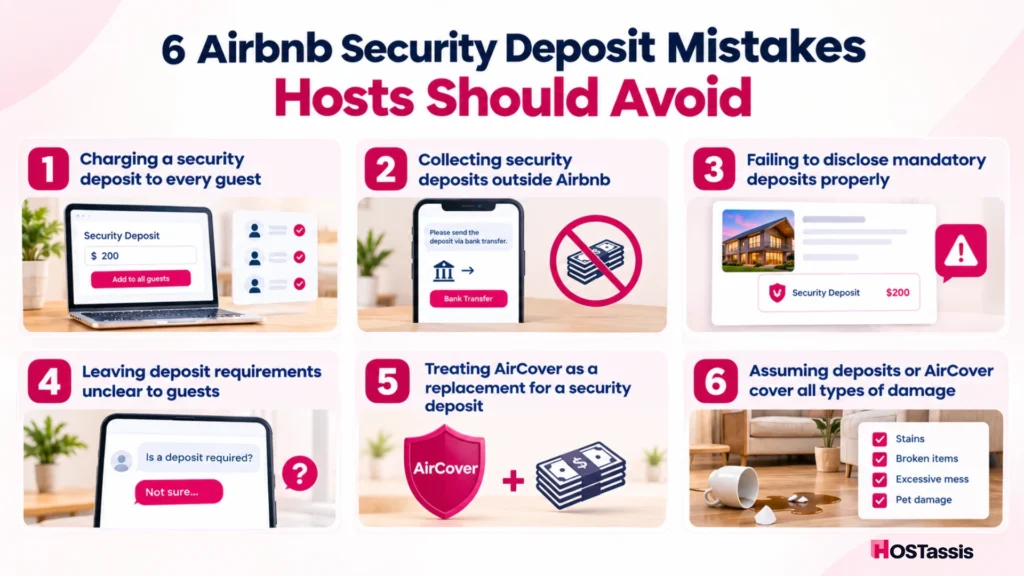
Hosts often break Airbnb’s rules or lose protection by handling security deposits incorrectly, such as charging every guest, collecting deposits outside Airbnb, or hiding fees. Here are the six most common mistakes and why they can put hosts at risk.
1.Asking every guest for a deposit
Most Airbnb hosts can’t request security deposits through the platform. Only certain software-connected hosts can. You may face policy violations or guest complaints if you charge every guest a security deposit.
2. Collecting a deposit outside Airbnb
Hosts who accept security deposits in cash, via bank transfer, or through payment methods outside Airbnb may violate the platform’s fee policy. Also, if a host asks guests to pay through another method, such as a payment link, Airbnb may deactivate their account, and the host may lose the protection Airbnb provides under its policies.
3. Hiding a mandatory deposit in the requirements
If you want to charge guests an extra fee, it must be clearly disclosed during the booking process. Hiding a mandatory deposit in messages or house rules is not enough. If Airbnb provides an appropriate fee field, you must use it.
4. Hiding deposit requirements from guests
Clearly explain any deposit requirements to guests before they book. If the deposit isn’t clearly disclosed in the checkout price breakdown, guests may not understand the charge, which can lead to confusion or disputes.
5. Confusing AirCover with a security deposit
AirCover provides additional protection for hosts, but it is not the same as a security deposit. Relying on it as automatic coverage for every type of damage may leave hosts responsible for losses that are not covered.
6. Assuming a security deposit or AirCover covers everything
Both security deposits and AirCover have specific limits, conditions, and exclusions. Assuming they cover every possible expense can lead to disappointment when a claim is made.
Do You Actually Need to Think About a Security Deposit?
For most homeowners who host on Airbnb, the answer is usually no, as they cannot collect a security deposit from guests. Instead, they must rely on guests to take care of the property or file a claim through Airbnb’s AirCover program. Only certain software-connected hosts and hotels can collect security deposits, and they must follow the rules and clearly disclose all deposit terms.
- Are you a normal Airbnb host?
If you list your property on Airbnb without a qualifying PMS/API setup, you can no longer charge a security deposit. Instead, rely on AirCover for host damage protection and liability coverage, and report any damage through the Resolution Center on time.
- Are you using qualifying software?
If you use qualifying PMS or API software, you may be allowed to collect security deposits outside Airbnb. Make sure your settings are correct and the fee appears clearly in the guest’s checkout summary.
- Are you operating a hotel?
Some hotels may ask guests to provide a credit card at check-in for incidentals or a security deposit. This information should be disclosed to guests during the booking process. Ensure all additional fees are disclosed during booking and that guests understand the terms and conditions stated on Airbnb and by the hotel. This will prevent misunderstandings and checkout complaints if the hotel charges the card.
- Are you managing multiple channels?
If guests want to book your property on different booking sites, keep in mind that each site may have different rules regarding security deposits and damage waivers. For Airbnb rentals, you can request reimbursement for covered damages through Airbnb’s AirCover program.
For rentals on other platforms, you’ll need to set up alternate protection programs for your property. Always make sure guests understand and agree to any additional fees associated with protecting their rental property, and follow the booking platform’s specific instructions.
Frequently Asked Questions
These questions and answers will help you better understand this important topic.
Does Airbnb hold a security deposit from guests?
Not for most normal Airbnb listings. Traditional host-set security deposits are generally not available, although select software-connected hosts and hotels may have permitted deposit arrangements.
Can an Airbnb host ask me for a security deposit?
Only in permitted circumstances. Most hosts cannot require one, while certain software-connected hosts and hotels may do so if properly disclosed before booking.
Can Airbnb hosts collect a cash deposit at check-in?
Ordinary hosts generally cannot introduce off-platform reservation fees. Hotels and some authorized software-connected hosts can have specific exceptions.
Is AirCover the same as a security deposit?
No. AirCover Host Damage Protection is Airbnb’s protection program, while a security deposit is money or a financial hold associated with a guest booking.
What happens if an Airbnb guest damages something?
The host can document the damage and request reimbursement through the Resolution Center. If the guest does not pay, eligible cases may be considered under Host Damage Protection.
How long does a host have to report Airbnb damage?
Airbnb’s current Host Damage Protection terms require the host to pursue the guest and notify Airbnb within 14 days of checkout for the initial damage process.
Can a co-host handle an Airbnb damage claim?
A Full Access co-host can manage certain reimbursement requests on behalf of the listing owner, though payment goes to the listing owner.
Conclusion
In 2026, most Airbnb hosts cannot charge a security deposit. Airbnb only allows it for certain hotels and software-connected hosts. For most hosts, AirCover and the Resolution Center are the main ways to request payment for guest-caused damage.
The most important thing is to be clear with guests from the start. If Airbnb allows you to charge a security deposit, guests must be able to see it in the correct fee section before they book. Adding it only to your listing description, house rules, or a message after booking isn’t enough.
To protect yourself as much as you can, set house rules, control your guests, take pictures of any damage, ask for receipts, and report any damage you find. All of these will provide the security you need and help prevent assault.