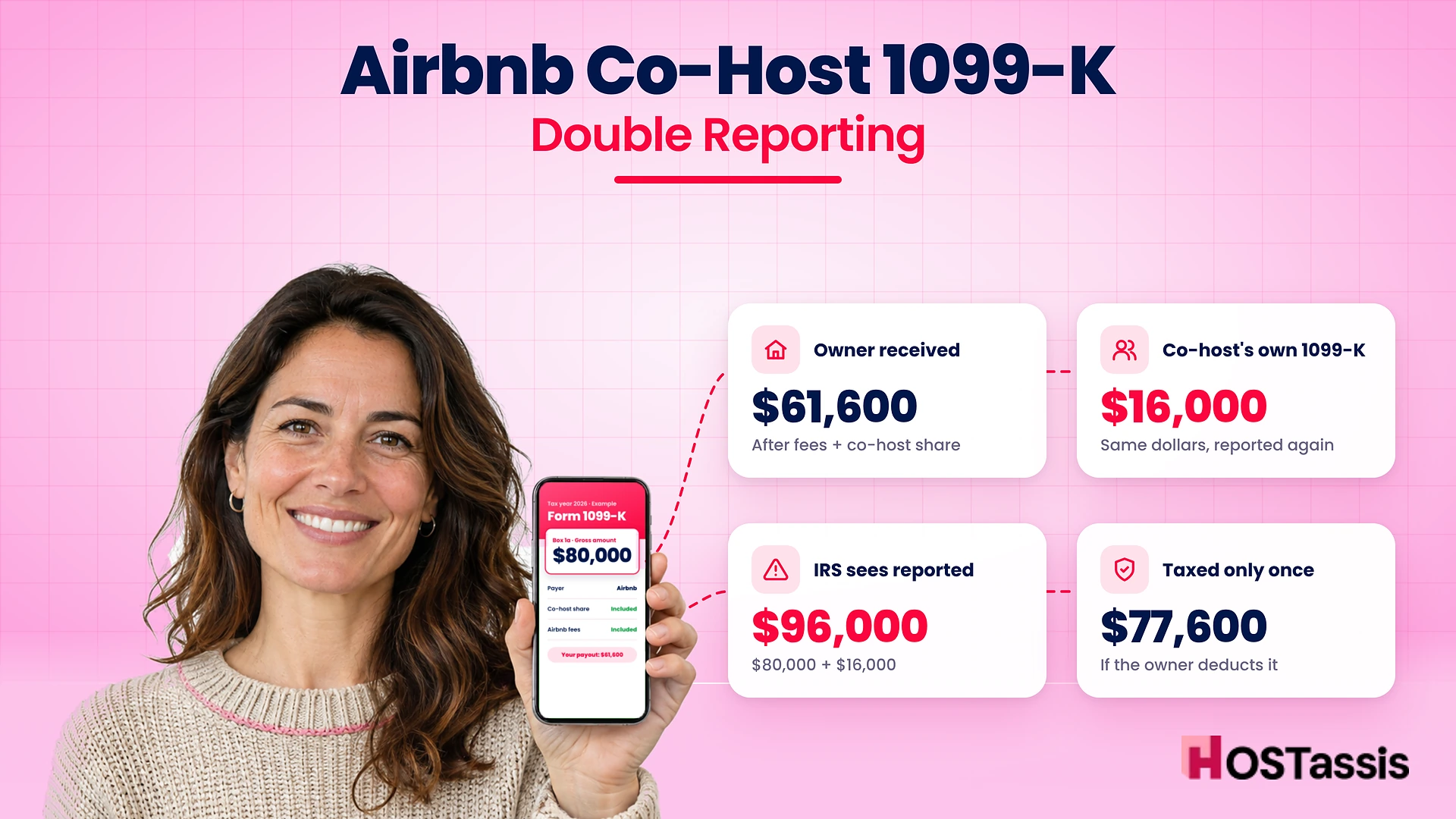
You open your Form Airbnb Co-Host 1099-K and the number is thousands of dollars higher than what landed in your bank account. Then your co-host tells you they got a 1099-K too, for money that came out of the same bookings. It looks like Airbnb reported the same income twice.
You are not the first host to ask this. One owner put it plainly in the Airbnb Community: “Is this not double taxation? Airbnb is reporting to the IRS that both the primary host and the co-host received those funds” (Airbnb Community).
Quick answer: Your 1099-K is higher than your payouts because Airbnb reports the full gross booking amount to the listing owner, including the share paid to your co-host, cleaning fees and Airbnb’s fees (Airbnb). Your co-host gets a separate 1099-K for their share. It is reported twice, but it should only be taxed once: the owner reports the gross and deducts the co-host payouts and Airbnb fees as expenses, and the co-host reports their share as income.
This guide shows exactly how that works with a worked example, how each side should report it, and what to tell your CPA before you file.
This article is general information, not tax advice. Tax treatment depends on your situation, so confirm with a qualified tax professional.
How Airbnb reports co-host payouts
When you use Airbnb’s co-host payouts feature, Airbnb splits each booking’s payout between you and your co-host. If you need a refresher on how the split is set up, see our guide to how Airbnb co-host payouts work. For tax reporting, Airbnb treats the two of you differently.
The listing owner’s 1099-K shows the full gross amount. Airbnb says payouts shared with co-hosts “will not impact the amount which will be reported to the listing owner” and that “the host’s Form 1099-K will include the full gross reservation amount” (Airbnb Help 414). Gross includes nightly rates, cleaning fees, Airbnb’s fees, pass-through taxes and any co-host payouts.
The co-host gets their own 1099. Once a co-host adds their taxpayer information, they “receive their own Form 1099 from within their own Airbnb account,” showing the amount the owner assigned to them (Airbnb Help 414).
The 2026 thresholds (and why you might not get a 1099-K at all)
| Form | Who issues it | 2026 federal threshold |
|---|---|---|
| 1099-K | Airbnb, to owners and co-hosts paid through Airbnb | More than $20,000 in gross payments and more than 200 transactions in the year (IRS) |
| 1099-NEC | An owner who pays a co-host directly, outside Airbnb | $2,000, up from $600, starting with the 2026 tax year (Airbnb Help 3165) |
Both tests must be met for a federal 1099-K. A single listing with mostly 3–5 night stays may have fewer than 200 bookings a year, so many owners will not get a federal form. However, Airbnb says it may still issue one if your state has a lower threshold. Its list currently includes Arkansas, the District of Columbia, Illinois, New Jersey, Maryland, Massachusetts, Montana, Vermont and Virginia, and it may change (Airbnb Help 414).
No form does not mean no tax. Rental income is taxable whether or not you receive a 1099-K, so the reconciliation below still applies. Airbnb issues 1099-Ks by January 31 for the previous year.
Worked example: $80,000 in bookings, $16,000 to the co-host
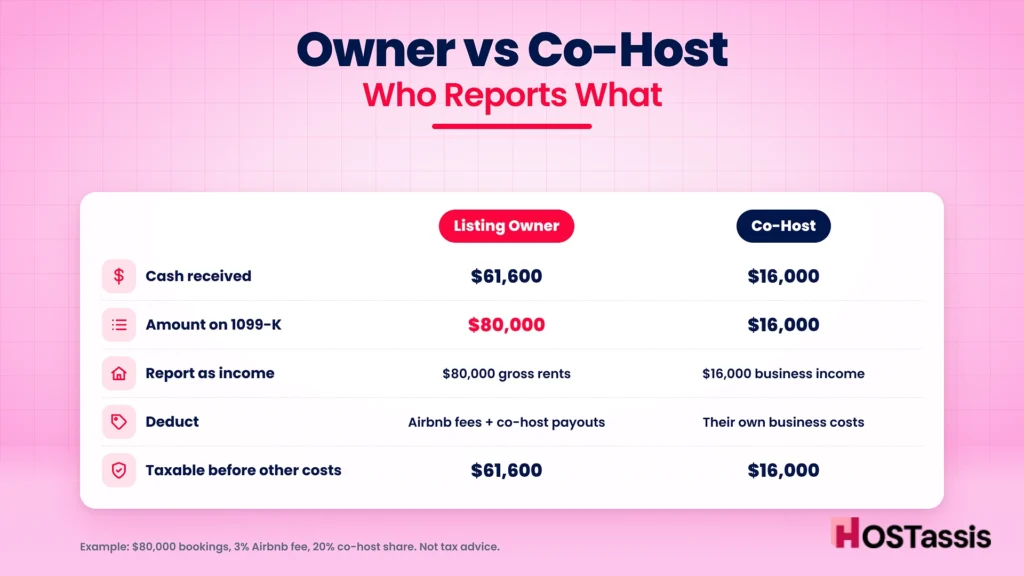
Here is one year for a single listing. Numbers are rounded to keep the math easy to follow.
- Gross bookings (nightly rates + cleaning fees): $80,000
- Airbnb host service fee at 3%: $2,400 (your fee may be different; see what Airbnb charges hosts)
- Co-host payout, 20% of gross as set by the owner: $16,000
- What the owner actually receives: $80,000 − $2,400 − $16,000 = $61,600
| Listing owner | Co-host | |
|---|---|---|
| Cash actually received | $61,600 | $16,000 |
| Amount on their 1099-K | $80,000 | $16,000 |
| Why it differs | Includes the co-host’s $16,000 and Airbnb’s $2,400 fee | Matches what they received |
| Report as income | $80,000 gross rents | $16,000 business income |
| Deduct | $2,400 Airbnb fees + $16,000 co-host fees (plus your normal rental expenses) | Their own business expenses |
| Taxable before other expenses | $61,600 | $16,000 minus their expenses |
how one year of bookings lands on two 1099-K forms
Add the two forms together and the IRS sees $96,000 of reported payments, even though guests only paid $80,000. That is the “double reporting”. But follow the table across: the owner is taxed on $61,600 and the co-host on $16,000. Together that is $77,600, which is exactly the $80,000 guests paid minus Airbnb’s $2,400 fee. Nothing is taxed twice, as long as the owner deducts the co-host payouts.
If Airbnb collected and remitted occupancy taxes for you, check whether any pass-through taxes appear in your gross. Those are not your income, and your tax professional can show how to back them out.
How listing owners reconcile the 1099-K, step by step
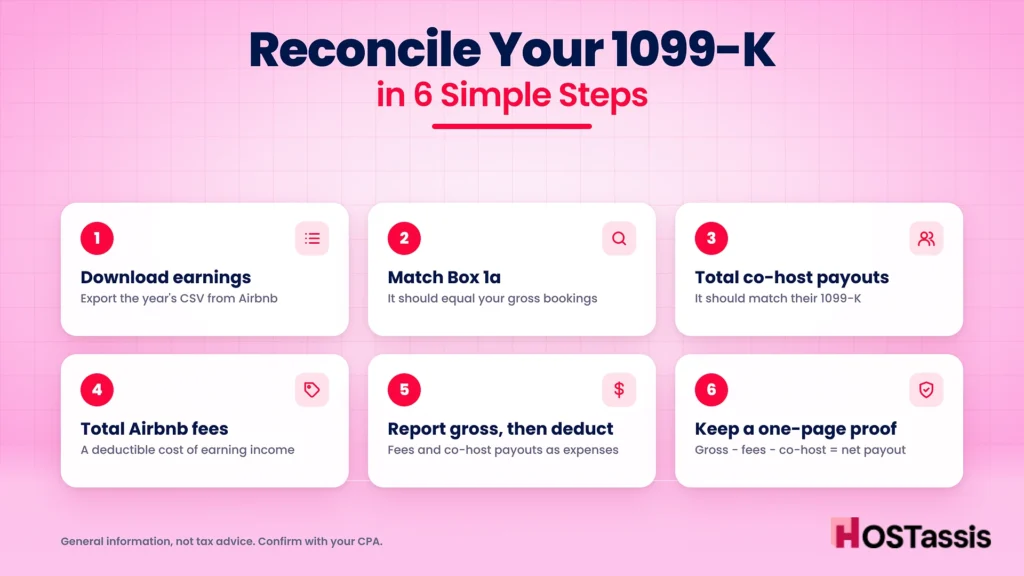
Do this in January, as soon as your form arrives. It takes under an hour if your books are clean.
- Download your Airbnb earnings. In your Airbnb account, open Earnings and export your gross earnings and transaction history for the year as a CSV. Airbnb says the Gross Earnings total corresponds to Box 1a on your Form 1099-K (Airbnb Help 414).
- Match Box 1a to your gross. Box 1a should equal your total bookings, including cleaning fees and co-host payouts. If it does not match, look for resolution adjustments, refunds or a second listing under the same tax ID.
- Total your co-host payouts. Add up every co-host payout from the transaction history. This should match the 1099-K your co-host received. Ask them to confirm their Box 1a.
- Total Airbnb’s fees. Host service fees are a deductible cost of earning the income.
- Report gross, then deduct. Report the full Box 1a amount as rental income, then deduct Airbnb fees and co-host payouts as expenses. Many tax professionals put co-host payouts under management fees (line 11 on Schedule E), but where it goes depends on your setup, so confirm with your preparer.
- Keep a one-page reconciliation. Gross on the 1099-K, minus Airbnb fees, minus co-host payouts, equals net payouts in your bank. Save it with your co-host agreement and the CSV.
If you list on more than one platform, run the same check for Vrbo and Booking.com. Our guide to OTA reconciliation walks through it. Setting up a separate “co-host fees” account in your chart of accounts makes step 3 automatic next year.
A quick note on schedules: most owners who simply rent out a property report on Schedule E. If you provide hotel-like services, your activity may belong on Schedule C instead. That choice affects self-employment tax, so it is worth a direct conversation with your CPA.
What Airbnb co-hosts should do with their 1099-K
If you are the co-host, your form is simpler: the 1099-K shows only the payouts the owner assigned to you, so it should match what you received.
- Report it as business income. Co-hosting is a service you provide, so most co-hosts report it on Schedule C and may owe self-employment tax on the profit.
- Deduct your own costs. Mileage to properties, software, supplies you paid for, phone and contractor fees are common examples. Keep receipts.
- Check the owner is not also sending a 1099-NEC for the same dollars. If Airbnb already paid you through the co-host payouts feature, the owner should not issue a second form for that money.
- Set aside tax money monthly. No tax is withheld on 1099-K income, so plan for estimated payments.
Co-hosts paid outside Airbnb (by bank transfer, Zelle or check) will not get a 1099-K from Airbnb for that money. That is where the 1099-NEC rules below come in.
Whichever side you are on, put the payout split, payment method and who handles tax forms in writing. Our guide to the legal and operational considerations of using a co-host covers what that agreement should include.
What to tell your CPA (copy and paste)
Most of the confusion disappears when your preparer has the full picture on day one. Send this message with your documents.
Hi [CPA name],
For [tax year], I received a Form 1099-K from Airbnb showing $[Box 1a] for my rental at [address].
This amount is gross. It includes:
– $[amount] paid directly to my co-host, [name], through Airbnb’s co-host payouts feature (they received their own 1099-K for this)
– $[amount] in Airbnb host service fees
– $[amount] in cleaning fees collected from guests
My actual net payouts were $[amount]. I’ve attached:
1. My Airbnb 1099-K
2. Airbnb earnings CSV for the year
3. A one-page reconciliation (gross – fees – co-host payouts = net)
4. My co-host agreement showing their percentage
Please confirm how to report the gross and where to deduct the co-host payouts, and whether this should be Schedule E or C.
Thanks,
[Your name]
Records to keep for at least three years
- Airbnb 1099-K and annual earnings CSV
- Your monthly owner statement or payout report
- Your signed co-host contract showing the split
- The one-page reconciliation from the steps above
- Receipts for every other rental expense
Common mistakes that cause trouble
- Reporting only your net payouts. If your return shows $61,600 but Airbnb reported $80,000, the mismatch can trigger an IRS letter. Report the gross and show the deductions.
- Forgetting to deduct the co-host share. This is the mistake that actually creates double taxation. The co-host pays tax on it, so the owner should not.
- Sending a 1099-NEC for money Airbnb already reported. If the co-host was paid through Airbnb’s co-host payouts, a second form double-reports it again.
- Mixing on-platform and off-platform payments. Some owners pay part of the co-host fee through Airbnb and part by bank transfer. Track them separately: only the off-platform part may need a 1099-NEC.
- Wrong taxpayer details. Airbnb sends the form to whoever’s W-9 is on the payout method. If a co-host is set up under the owner’s tax info, all income lands on one form (Airbnb Help 3165). Check this with your co-host permissions and payout setup now, not in April.
More traps like these are in our post on common STR bookkeeping mistakes.
Paying a co-host outside Airbnb? The 1099-NEC rule
If you pay your co-host directly, not through Airbnb, you may need to send them a Form 1099-NEC. Starting with the 2026 tax year, the threshold rises to $2,000, up from $600 (Airbnb Help 3165). Collect a W-9 from your co-host before you pay them, and confirm the filing deadline with your preparer.
Frequently asked questions
Why is my Airbnb 1099-K higher than my payouts?
Because it shows gross bookings, not net payouts. It includes cleaning fees, Airbnb’s host service fees, pass-through taxes and any money paid to your co-host. You deduct the fees and co-host payouts on your return.
Does a co-host get a 1099-K from Airbnb?
Yes, if they are paid through Airbnb’s co-host payouts feature, have added their taxpayer information and meet the reporting threshold. Their form shows only the share the owner assigned to them.
Am I taxed twice on my co-host’s share?
No, not if you report it correctly. The amount is reported twice, once on each form, but the owner deducts it and the co-host pays tax on it. Double taxation only happens if the owner forgets the deduction.
I didn’t get a 1099-K this year. Do I still report my Airbnb income?
Yes. The federal form is only required above $20,000 and 200 transactions, but rental income is taxable either way. Use your Airbnb earnings report instead.
Should I send my co-host a 1099-NEC?
Only for payments you made directly, outside Airbnb, that reach the threshold ($2,000 starting with the 2026 tax year). Do not issue one for money Airbnb already paid them through co-host payouts.
My 1099-K looks wrong. What should I do?
First reconcile it against your Airbnb earnings CSV using the steps above. If it still does not match, contact Airbnb through the Resolution Center or your tax documents page and ask about a corrected form, and tell your CPA before filing.
The bottom line
Your Airbnb 1099-K is not wrong just because it is higher than your payouts. It shows gross bookings, including your co-host’s share. Report the gross, deduct Airbnb’s fees and your co-host payouts, keep a one-page reconciliation, and your co-host’s share is taxed once, on their return.
The owners who struggle in tax season are usually the ones whose books were never reconciled during the year. As we explain in revenue doesn’t equal profit, clean monthly numbers make January easy.
HOSTassis helps short-term rental owners with exactly this: monthly owner statements, payout reconciliation and year-end reports your CPA can use, alongside our Airbnb virtual assistant and co-hosting services.
Want your 2026 books ready before January? Contact us for a free bookkeeping and operations review.