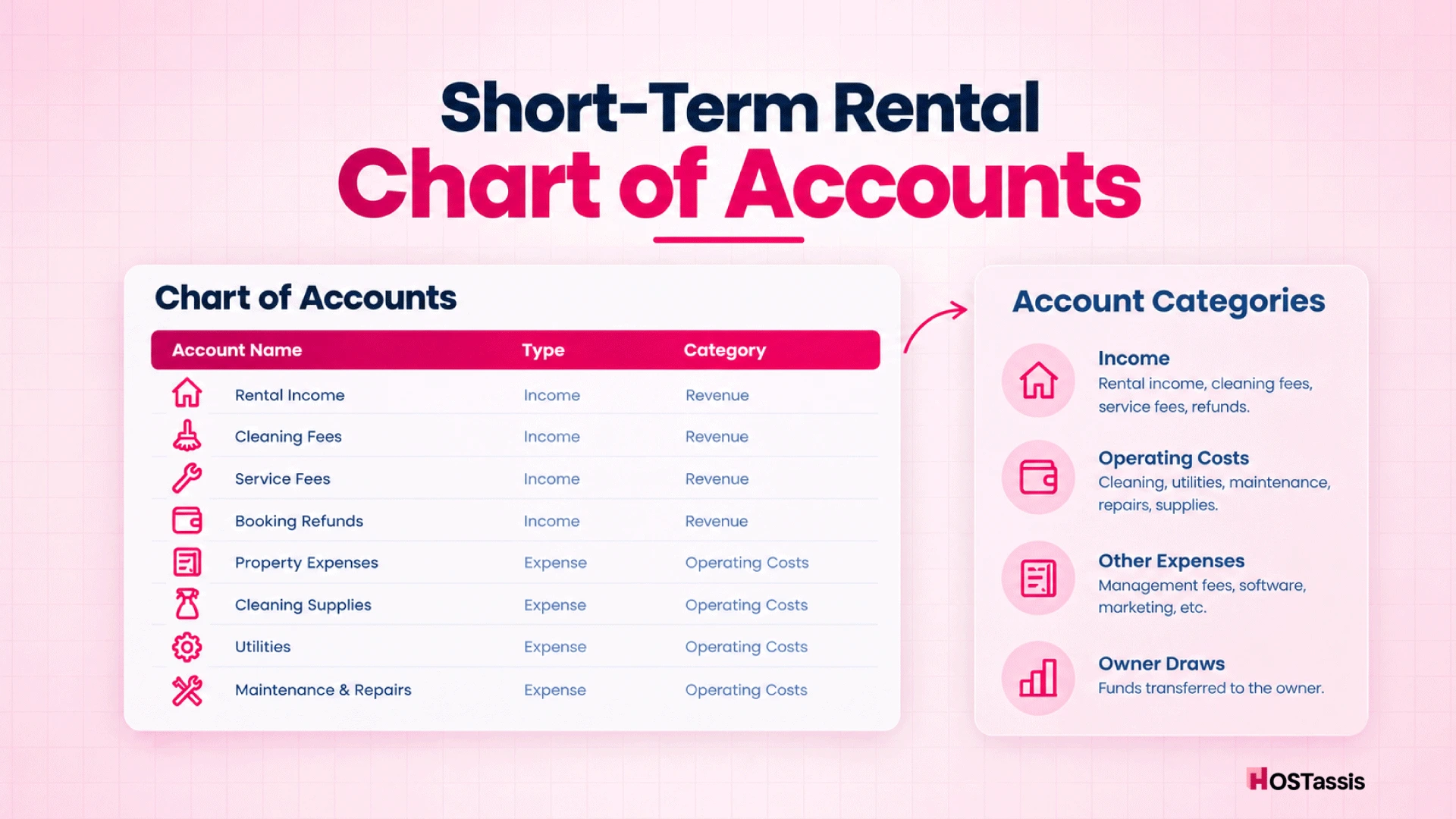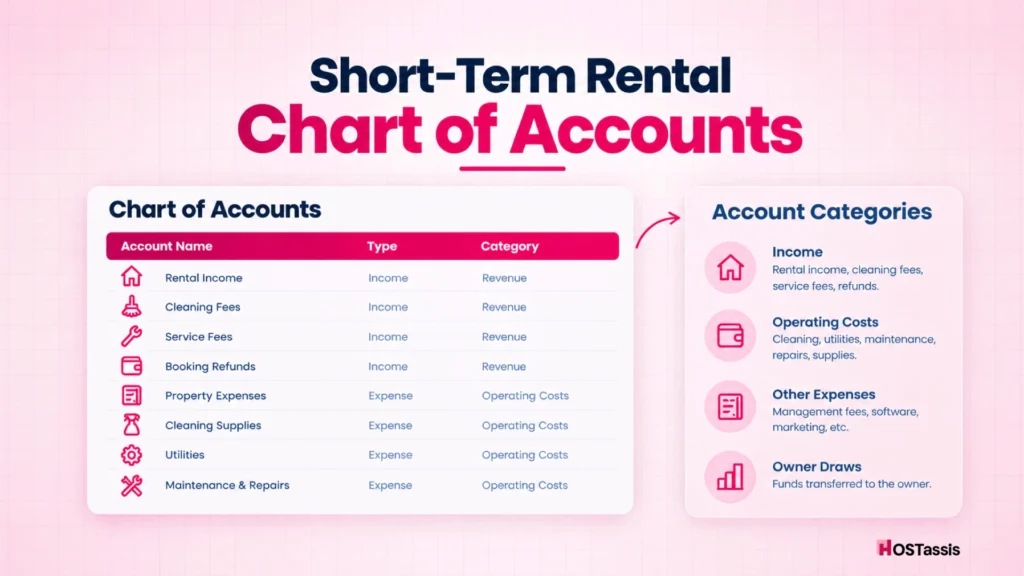
A short‑term rental chart of accounts is a list of categories that separate the income, expenses, assets and liabilities of your STR business. It covers bookings, guest fees, commissions and cleaning costs.
A short-term rental chart of accounts is a set of control accounts that help organize a business’s bookkeeping. It stores each transaction in relevant accounts that show where the organization’s revenues come from and where all its expenses are paid. Several journal entries may concern one booking, for example, a nightly rate, cleaning fee, commission, lodging tax, and refund. The gross amount of nightly rate is recorded first, and other expenses are separated as commission, cleaning fee, and taxes. Cleaning income is kept apart from cleaning expenses, and a lodging tax and refundable deposit are liabilities because they do not belong to the company.
What Is a Short-Term Rental Chart of Accounts?
A short-term rental chart of accounts is a list of categories that sorts everything your STR business earns, spends, owns, owes and invests. It separates bookings, guest fees, platform commissions, cleaning, operating costs, assets, liabilities and owner activity.
Think of the chart of accounts, or COA, as the filing system behind your bookkeeping. Every transaction needs a home, and the COA decides where it goes. It isn’t the same thing as an Airbnb or Vrbo payout report, which only shows what landed in your bank. A profit and loss report isn’t a COA either. The P&L is the result, while the COA is the structure that produces it. Most accounting setups start with five top-level types: assets, liabilities, equity, income and expenses. For a vacation rental, you add STR-specific subaccounts underneath.
Why a Generic Chart of Accounts Is Not Enough for an STR Business
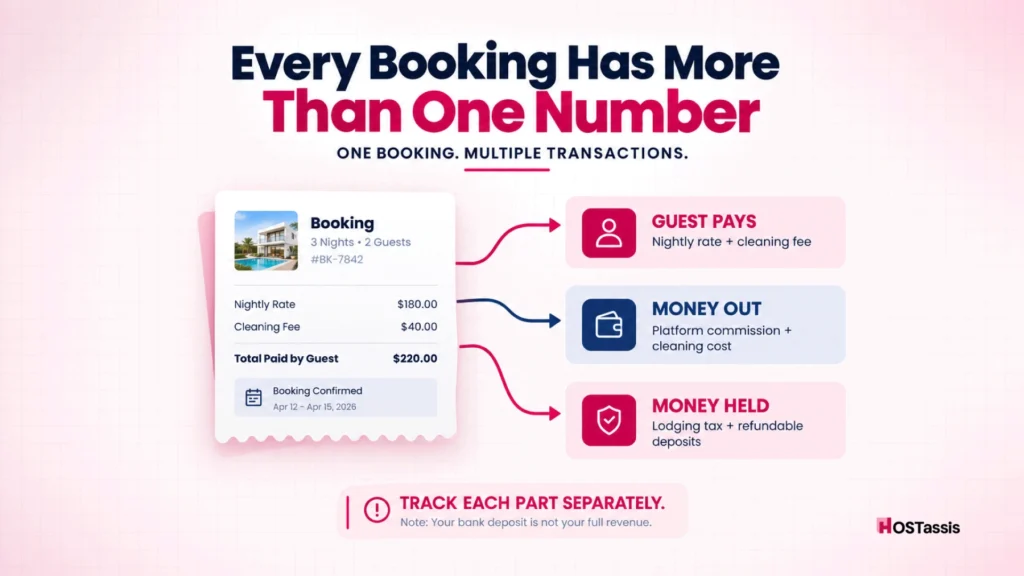
Quick answer: One reservation creates many transactions: nightly revenue, cleaning fee, commission, tax, maybe a refund. A generic chart lumps these together, so you can’t see which part of a booking makes money and which costs it.
Breakdown:
- Accommodation revenue, cleaning fee and pet fee all come from one booking.
- The OTA commission and lodging tax come out of the same booking.
- Refunds and turnover costs follow later.
One Airbnb payout is not one accounting category. Every account in your chart should answer a business question. How much is Airbnb or Vrbo taking? Does the cleaning fee cover the real cleaning bill? Which costs eat the most of each property’s income? If an account can’t answer a question like that, it probably doesn’t need to exist.
The 5 Main Sections of an STR Chart of Accounts
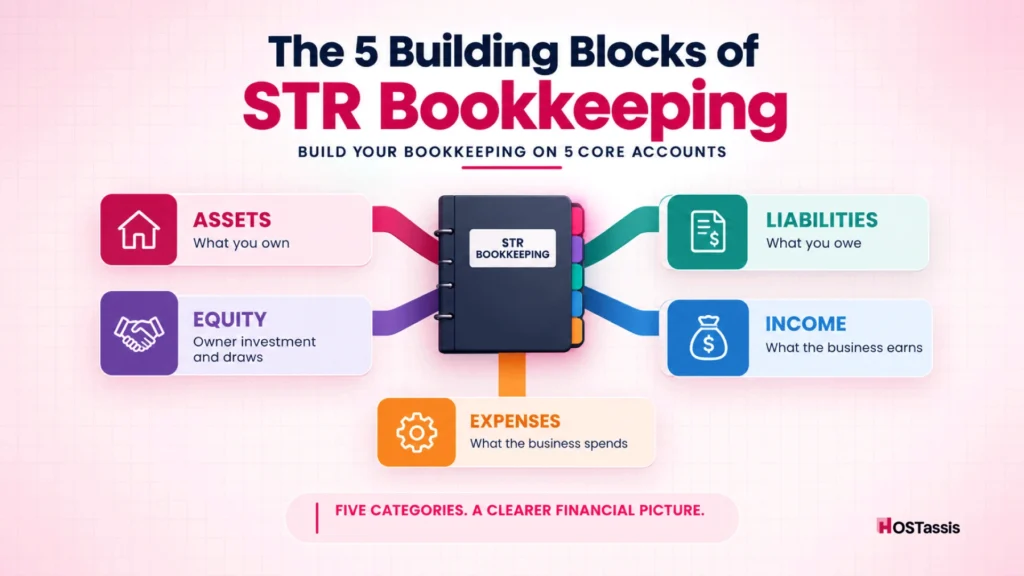
Quick answer: Every chart is built on five account types: assets, liabilities, equity, income and expenses. STR-specific categories sit underneath them. Learn these five first, and the rest of the chart makes sense quickly.
Breakdown:
- Assets: what the business owns or controls.
- Liabilities: what the business owes to others.
- Equity: the owner’s investment and withdrawals.
- Income: guest bookings and related revenue.
- Expenses: what it costs to operate the property.
Most of your day-to-day work will happen in income and expenses. The other three sections change less often, but they keep your numbers honest.
Income Accounts Every Vacation Rental Business Should Consider
Quick answer: Income accounts track what guests pay you. Keep nightly accommodation revenue separate from fees like cleaning, pets and extra guests, and record the gross amount, never just the bank deposit Airbnb sends you.
Breakdown:
- Accommodation revenue: the nightly rate, recorded gross.
- Cleaning fee income: what the guest is charged for cleaning.
- Pet fee income: useful to track on its own.
- Extra guest fee income: if you charge for additional guests.
- Early check-in and late check-out income: optional add-ons.
- Other guest services: equipment rentals, concierge extras and similar.
You don’t need a new account for every $10 service. If the amounts are small and similar, one “Other Guest Fees” account does the job. Keep revenue categories useful, not excessive.
Platform and Booking Cost Accounts
Quick answer: Platform costs are the fees Airbnb, Vrbo, Booking.com and payment processors take. Record gross booking revenue first, then log these fees as separate expenses, so your reports show what each channel truly costs.
Breakdown:
- Airbnb service fees
- Vrbo commissions
- Booking.com commissions
- Payment processing fees on direct bookings
- Other channel or booking fees
This is the most STR-specific part of the chart, and the one generic templates usually miss. If you only record the net payout, the fees disappear and you can’t compare channels. Matching payouts to individual reservations is a separate job, covered in our guide: OTA Reconciliation: Match Airbnb, Vrbo and Booking.com Payouts to Reservations.
Cleaning and Turnover Expense Accounts

Quick answer: Cleaning income and cleaning cost belong in different accounts. The fee a guest pays is income, while the cleaner’s invoice is an expense. Mixing them hides whether turnovers actually make or lose money.
Breakdown:
- Cleaning labor: cleaner or vendor invoices.
- Laundry and linen service: outside laundry costs per turnover.
- Turnover supplies: consumables used between guests.
- Linen and towel replacement: worth its own line if the cost adds up.
Here’s why separation matters. Say you collected $4,000 in cleaning fees and paid cleaners $5,000. Put both in one account and you’ll see a $1,000 expense, which looks harmless. Keep them apart and the real picture shows up: you charged guests less than turnovers cost you. That’s a pricing decision waiting to be made.
Property Operating Expense Accounts
Quick answer: Operating expense accounts cover the ongoing cost of running each property. Group them by how they behave: utilities, supplies, repairs, insurance, fees and software each move differently, so each deserves its own line.
Breakdown:
- Utilities: electricity, gas, water
- Internet and TV
- Guest supplies and consumables: toiletries, coffee, paper products
- Repairs and maintenance (routine only)
- Pest control
- Landscaping, pool or exterior services
- Insurance
- Property taxes and permits
- HOA or condo fees
- Management fees, including co-host fees
- Software: PMS, dynamic pricing, smart locks, accounting, guest messaging
Splitting these out makes patterns obvious. A jump in utilities points to one problem, a jump in repairs to another. One lump called “Property Expenses” tells you neither.
Professional and Administrative Expense Accounts
Quick answer: Professional and admin accounts hold the business side of hosting: accounting, legal, marketing, website, bank fees and office costs. Keep this list short, because a handful of clear accounts beats dozens nobody uses properly.
Breakdown:
- Accounting and bookkeeping
- Legal fees
- Marketing and advertising
- Website and direct booking costs
- Bank and merchant fees
- Office and administrative costs
Only split these further if you actually report on them. If you never look at the difference between two admin accounts, merge them.
Assets: What Should Not Be Recorded as a Normal Expense?
Quick answer: Bigger purchases like furniture, major appliances and renovations may need to be tracked as assets, not ordinary expenses. Treatment varies by country and situation, so your accountant should make the final call.
Breakdown:
- Furniture
- Major appliances
- Property improvements
- Significant renovations
- Equipment
A new sofa and a plumber’s call-out fee are very different purchases. When both land in “Repairs and Maintenance,” your costs look inflated and your chart gets misleading. There’s no single dollar amount that separates the two, because rules depend on where you operate and your circumstances. Ask your accountant or CPA how your larger purchases should be treated.
Liabilities Every STR Operator Should Understand
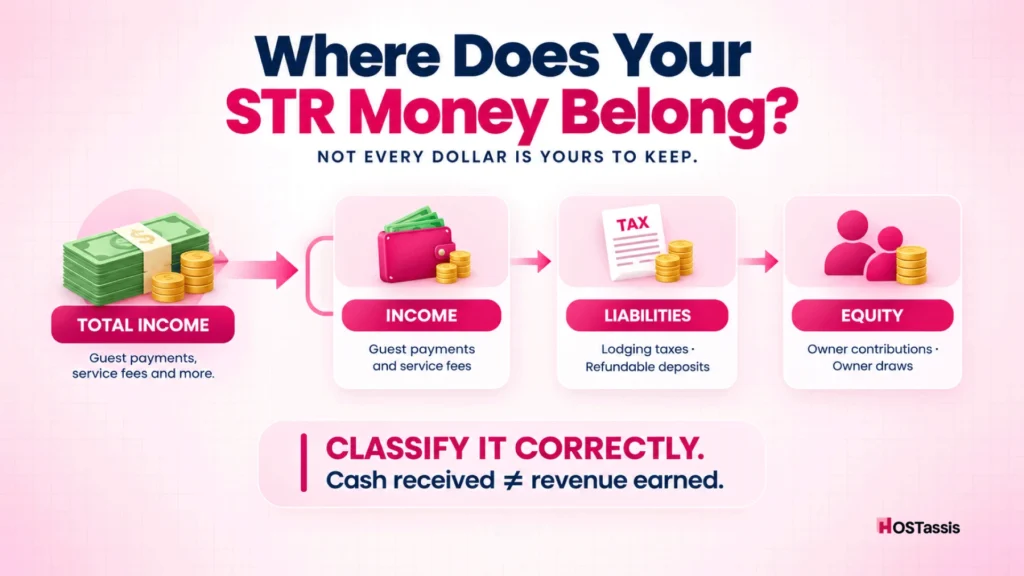
Quick answer: Liabilities are amounts you owe, not money you earned. Lodging taxes you collect for a government, refundable deposits, cards, loans and owner funds all belong here instead of in your revenue.
Breakdown:
- Occupancy or lodging tax payable: tax collected is not revenue. If Airbnb or Vrbo collects and remits it directly, the treatment can differ.
- Security or damage deposits: refundable deposits shouldn’t automatically count as revenue.
- Credit cards and loans: outstanding business debts.
- Owner funds payable: for managers holding money that belongs to property owners.
Taxes and deposits are the two amounts most often mixed into revenue by mistake. If the money isn’t yours to keep, it shouldn’t inflate your income.
Equity Accounts for Owners
Quick answer: Equity tracks the owner’s money going in and out of the business. Contributions are what you put in, draws are what you take out. Neither one is income or an expense.
Breakdown:
- Owner contributions: money you add to the business.
- Owner draws or distributions: money you take out.
Not every transfer between your personal and business accounts is a sale or a cost. Move money in, it’s a contribution. Move money out, it’s a draw. Keeping that straight stops your profit from looking better or worse than it really is.
Should You Create Separate Accounts for Every Property?

Quick answer: Usually no. Keep one consistent chart of accounts and tag each transaction by property using classes, locations or tags. It scales far better than building a separate set of accounts for every listing.
Breakdown:
- Avoid: Cleaning Expense – Property 1, Cleaning Expense – Property 2, Cleaning Expense – Property 3.
- Use: one Cleaning Expense account, then tag the property: Lisbon 01, Manchester 06, San Jose 03.
Add a fourth property and you only add a new tag, not a whole new set of accounts. Reports stay consistent, and you can still filter by property whenever you need to.
Should Airbnb, Vrbo and Booking.com Have Separate Revenue Accounts?
Quick answer: Not necessarily. One rental revenue account plus a channel tag is often cleaner than separate revenue accounts per platform. Separate fee accounts still help when you want to compare what each channel costs.
Breakdown:
- Simple setup: one Rental Revenue account with a channel tag.
- Detailed setup: Airbnb Revenue, Vrbo Revenue and Booking.com Revenue as separate accounts.
Both work. Pick the one that gives you useful reports without extra complexity. If you can’t explain why you need the detailed version, start with the simple one.
How Detailed Should an STR Chart of Accounts Be?
Quick answer: Detailed enough to answer real management questions, simple enough that every transaction gets categorized the same way each time. If the extra detail won’t change a decision, you probably don’t need it.
Breakdown:
- Too simple: “Expenses: $80,000.” Tell you nothing.
- Too detailed: separate accounts for toilet paper, shampoo, coffee, tea, dish soap and sponges.
- Just right: one “Guest Supplies & Consumables” account.
Too much detail creates clutter, and clutter leads to inconsistent bookkeeping. A lean chart that gets used the same way every month beats a perfect one that doesn’t.
A Simple STR Chart of Accounts Example
Quick answer: Here’s a lean starter chart. Use it as a model and adjust it to your business. The account numbers are illustrative only, and you can use any numbering system that suits you.
Breakdown:
- 1000 – Assets: Bank Account, Accounts Receivable, Furniture & Equipment, Property Improvements
- 2000 – Liabilities: Credit Card, Loans Payable, Occupancy Tax Payable, Refundable Deposits
- 3000 – Equity: Owner Contributions, Owner Draws
- 4000 – Income: Accommodation Revenue, Cleaning Fee Income, Pet Fee Income, Other Guest Fees
- 5000 – Direct Booking / Turnover Costs: OTA Commissions, Payment Processing Fees, Cleaning Labor, Laundry, Turnover Supplies
- 6000 – Operating Expenses: Utilities, Internet, Guest Supplies, Repairs & Maintenance, Insurance, Property Taxes, Management Fees, Software, Professional Fees, Marketing
Treat this as a starting point, not a rulebook. Remove what you don’t use and add what your business genuinely needs.
7 Common STR Chart of Accounts Mistakes
Quick answer: Most chart problems come from seven repeat mistakes, such as booking net payouts as revenue or mixing cleaning income with cleaning cost. All seven are easy to fix once you spot them.
Breakdown:
- Recording net Airbnb deposits as revenue
- Combining cleaning income with cleaning expense
- Treating occupancy taxes as normal income
- Putting every purchase under “Miscellaneous”
- Creating too many tiny categories
- Mixing capital purchases with routine repairs
- Using a different category structure for every property
If you recognize two or three of these, don’t panic. They’re common, and cleaning them up usually takes an afternoon, not a full rebuild.
How to Set Up Your Chart of Accounts Without Overcomplicating It
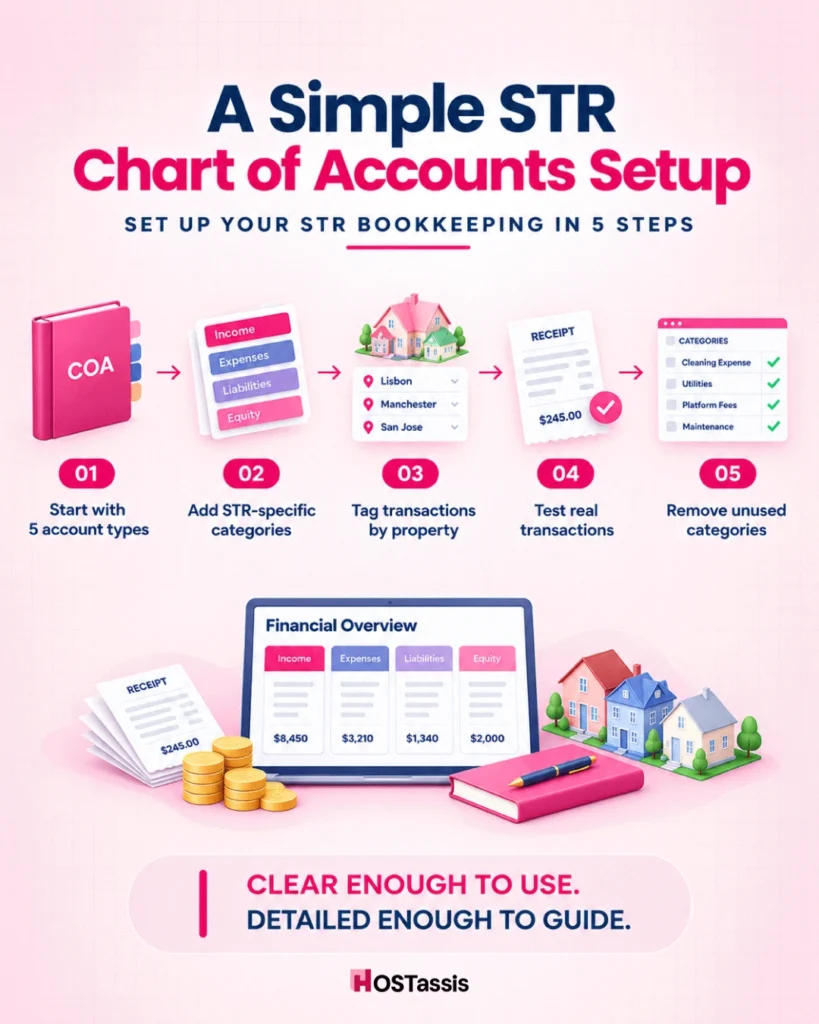
Quick answer: Start with the five main account types, add STR categories, set up property tracking, test the chart against recent transactions, then delete whatever you never use. Five steps, no need to overcomplicate it.
Breakdown:
- Start with the five main account types: assets, liabilities, equity, income, expenses.
- Add STR-specific categories: booking revenue, guest fees, platform costs, turnover expenses.
- Add property tracking: use a class, location or tag.
- Review real transactions: check the last 60 to 90 days.
- Remove categories you’ll never use.
Step four is the one people skip. Running real transactions through the chart shows you quickly where it breaks. A chart should match the business you actually run, not an ideal version of it.
Short-Term Rental Chart of Accounts FAQs
What accounts should an Airbnb host have?
At minimum: rental revenue, guest fees, platform fees, cleaning and turnover, supplies, utilities, maintenance, insurance, taxes, software and owner activity.
Is an Airbnb payout considered revenue?
Not by itself. A payout is the net cash after Airbnb’s deductions. Record gross booking revenue and the fees separately.
Is an Airbnb cleaning fee income or an expense?
The fee charged to the guest is generally income. What you pay the cleaner is a separate expense.
Are lodging taxes income?
Generally no. Money collected for a government and owed for remittance is tracked separately from ordinary rental revenue.
Do I need a separate chart of accounts for each property?
Usually not. One consistent chart with property tags, classes or locations works for most operators.
Should Airbnb fees be deducted from rental income?
For clear gross reporting, record platform commissions as separate expenses instead of only the net bank deposit.
How many accounts should an STR business have?
There’s no ideal number. Use enough to see revenue and major costs, but not so many that consistent bookkeeping gets hard.
Final STR Chart of Accounts Framework
Quick answer: A good chart shows where revenue comes from, what each booking and property costs, and which money belongs to the business. This simple hierarchy sums it all up in one clear view.
Breakdown:
- Income: accommodation, cleaning fees, guest fees
- Direct/booking costs: OTA fees, cleaning, laundry and turnover
- Operating expenses: utilities, maintenance, supplies, software, management
- Assets: furniture and improvements
- Liabilities: taxes, deposits, payables
- Equity: owner contributions and draws
A good short-term rental chart of accounts doesn’t try to track every tiny purchase separately. It creates enough separation to show where revenue comes from, what each booking and property costs to operate, and which money actually belongs to the business. If you’d rather not build and maintain it yourself, HOSTassis offers STR-focused accounting built around exactly this kind of structure.