
Airbnb co-host payouts let a listing owner share part of booking income with a co-host who helps manage the property. The owner can choose how to pay the co-host, such as a percentage of the booking income, the cleaning fee, a fixed amount, or a combination of these options. Once both sides accept the arrangement, Airbnb automatically calculates the agreed payout and sends it to the co-host’s chosen payout account based on Airbnb’s payment schedule.
Only the listing owner can create or change a co-host payout arrangement. A co-host cannot set up or change the payout split on their own. After the owner sends a payout proposal, the co-host has 14 days to accept or decline it. Both the listing owner and co-host must verify their identities and add valid payout methods before they can receive payments.
How Airbnb Calculates a Co-Host Payout
Airbnb first calculates the booking subtotal, which usually includes the nightly rate and eligible host-set fees, such as cleaning, pet, and extra-guest fees. Airbnb then deducts its host service fee and other applicable charges. Under the single-fee structure, many hosts pay around 15.5%, although the exact rate can vary.
The co-host’s payment depends on the arrangement the listing owner sets. A co-host may receive the cleaning fee, a percentage of earnings, the cleaning fee plus a percentage, or a fixed amount per booking. Percentage-based fees commonly range from 10% to 30%, depending on the agreement.
Basic Calculation
Booking subtotal = (Nightly rate × Nights) + Cleaning fee + Other eligible fees
Host earnings = Booking subtotal − Airbnb service fee − Other charges
Co-host payout = Agreed percentage, cleaning fee, fixed amount, or combination
Host final payout = Host earnings − Co-host payout
The host and co-host should agree on whether the percentage is calculated before or after Airbnb’s service fee and which fees are included.
Example
Nightly rate: $100 × 3 nights = $300
Cleaning fee: $60
Extra guest fee: $40
Booking subtotal: $400
With a 15.5% Airbnb service fee:
Service fee: $62
Host earnings: $338
Co-host payout (20%): $67.60
Host final payout: $270.40
This example calculates the co-host’s 20% share after Airbnb deducts its service fee.
When Does the Co-Host Get Paid?
For many standard stays, Airbnb may start the payout process by the end of the business day after the guest’s scheduled check-in. However, timing can vary by listing, payout method, and financial institution.
Cancellations, refunds, payment issues, or account verification can also affect the payout amount or timing.
How Hosts Get Paid: The 4 Main Co-Host Payout Models

Airbnb supports four main ways to pay a co-host: cleaning fee only, cleaning fee plus a percentage, a percentage of each booking, and a fixed amount per booking. Here’s a simple explanation :
1. Cleaning Fee Only
With this option, the co-host receives the full cleaning fee from each booking. This works well when the co-host mainly handles cleaning-related tasks, such as arranging cleaners, restocking supplies, handling keys, and checking the property after cleaning.
It can be a simple choice when the co-host helps with turnovers but is not responsible for things like pricing or guest communication.
Direct answer: If you choose “cleaning fee only,” Airbnb pays the full cleaning fee to the co-host for eligible bookings.
Example:
- Cleaning fee: $100
- Booking: 3 nights × $120 = $360
- Co-host receives: $100 cleaning fee
- The host receives the remaining earnings after Airbnb fees and any required taxes.
This option works well when the co-host mainly handles the property turnover. Their payment is based on the cleaning fee for each stay rather than the nightly rate.
2. Cleaning Fee Plus a Percentage
This is a hybrid model: the co-host gets the full cleaning fee plus a percentage of the booking revenue, but the percentage is calculated excluding the cleaning fee.
This can work well when the co-host handles both property tasks, such as cleaning, maintenance, and check-in, and management tasks like guest messages, calendar updates, or pricing support.
Example:
- Booking earnings: $500
- Cleaning fee: $100
- Co-host percentage: 15%
Calculation:
- 15% of $500 = $75
- Cleaning fee = $100
- Co-host receives = $175
- The remaining eligible earnings go to the host.
This way, the co-host is paid for both managing the property turnover and helping with the overall booking.
3. Percentage of Each Booking
With this option, the co-host receives a set percentage from each booking. You can choose whether the cleaning fee is included in that calculation or not, which can significantly change the co-host’s earnings. This option makes sense when your co-host is involved in overall property management, not just cleaning.
Example:
- Booking earnings: $500
- Cleaning fee: $100
- Co-host rate: 20%
A) If the cleaning fee is included
The percentage is calculated using both the booking earnings and cleaning fee.
$500 + $100 = $600
20% of $600 = $120
So, the co-host would receive about $120 in this simple example.
B) If the cleaning fee is excluded
The percentage is calculated only on the $500 booking earnings.
20% of $500 = $100
So, the co-host would receive about $100.
Why does this matter?
Even though the co-host rate is 20% in both cases, including the cleaning fee gives them a higher payout. That’s why hosts should be clear about whether the cleaning fee is included when setting up a percentage-based payout.
4. Fixed Amount Per Booking
With this option, the co-host receives the same fixed amount for every booking, no matter how short the stay is or how much the guest pays. This is a per-booking payout set up directly through Airbnb, rather than a monthly payment arranged outside the platform.
This option works well when the co-host does similar work for each reservation, such as handling check-in and check-out or basic guest communication. It also makes co-host costs easier for the host to predict.
Example:
- Fixed co-host payout: $70 per booking
Short, lower-value booking:
- Accommodation: $200
- Cleaning fee: $60
- Co-host payout: $70
Here, the $70 payout takes up a bigger part of the booking earnings.
Long, higher-value booking:
- Accommodation: $1,000
- Cleaning fee: $120
- Co-host payout: still $70
In this case, the same $70 is a much smaller part of the total booking earnings.
Does Airbnb Calculate the Co-Host Percentage Before or After Its Service Fee?
No. Airbnb does not calculate the co-host percentage before taking out its service fee.
Airbnb first deducts the host service fee and any other applicable fees or taxes to determine the host’s potential earnings. Airbnb then applies the co-host’s agreed percentage to that amount.
In simple terms: Airbnb’s service fee comes out first, and the co-host’s share is calculated from what remains.
Simple formula:
Host potential earnings
= (Nightly rate × Number of nights) + Eligible extra charges − Host service fee − Applicable taxes/fees
Co-host payout
= Host potential earnings × Agreed co-host percentage
Example:
If the host’s potential earnings after the relevant deductions are $500 and the co-host receives 20%, the co-host payout would be:
$500 × 20% = $100
So, a 20% co-host payout does not necessarily mean 20% of the total amount the guest pays. It is based on the host’s eligible potential earnings for that booking.
What Percentage Do Airbnb Co-Hosts Usually Charge?
Airbnb does not set a standard percentage for co-hosts. The property owner and co-host agree on the final rate based on the services provided, the property’s location, and the level of responsibility involved. Airbnb lets hosts set a percentage-based payout and choose whether to include the cleaning fee in the calculation, but it does not require a specific commission rate.
Airbnb Rule vs. Market Pricing :
Airbnb rule: Airbnb does not require hosts to pay co-hosts a fixed percentage. It provides the tools to share payouts, while the host and co-host decide the payment amount or structure. The payout terms should be clearly agreed upon before the co-host starts managing the property.
Market Pricing : Airbnb does not require hosts to pay co-hosts a fixed percentage. It provides the tools to share payouts, while the host and co-host decide the payment amount or structure. The payout terms should be clearly agreed upon before the co-host starts managing the property.
| Service level | Common benchmark | Typical responsibilities |
|---|---|---|
| Basic support | 10%–15% | Guest messaging, inquiry responses, check-in instructions, and review support |
| Standard co-hosting | 15%–20% | Guest communication, booking management, calendar updates, and cleaning coordination |
| Full-service management | 20%–30% | Pricing support, guest communication, turnovers, maintenance coordination, issue handling, and daily operations |
Airbnb Co-Host Payout Examples: What the Host and Co-Host Actually Receive
Let’s look at three simple examples using the same booking: an $800 stay with a $100 cleaning fee. We’ll compare how the payout changes when the co-host gets 20% excluding the cleaning fee, 20% including the cleaning fee, or the full cleaning fee plus 10% of the booking earnings. This makes it easier to see what the co-host receives and what the host keeps under each option.
Example A: 20% Cleaning Fee Excluded
Here, the co-host receives 20% of the $800 accommodation amount, and the $100 cleaning fee is excluded from the percentage calculation.
$800 × 20% = $160
The co-host receives $160, leaving $740 of the $900 total before other Airbnb deductions.
Example B: 20% Cleaning Fee Included
Now, calculate the same 20% using both the accommodation amount and the cleaning fee.
$800 + $100 = $900
$900 × 20% = $180
The co-host receives $180, while the host keeps $720 before other applicable deductions.
This shows why the cleaning-fee setting matters. The percentage is still 20%, but including the cleaning fee increases the co-host’s share.
Example C: $100 Cleaning Fee + 10%
With this setup, the co-host receives the full $100 cleaning fee, plus 10% of the $800 accommodation amount.
10% of $800 = $80
$100 cleaning fee + $80 = $180
The co-host therefore receives $180, leaving $720 before other applicable deductions.
Percentage vs Cleaning Fee vs Fixed Amount: Which Payout Model Makes Sense?
The right payout model depends on what your co-host actually does and how your Airbnb operates. A percentage can make sense when the co-host manages revenue-related work, while a cleaning-fee payout fits a turnover-focused role. If they handle both, a cleaning fee plus a percentage can cover the wider workload. A fixed amount is easier when the work stays about the same for every reservation.
Use this decision table to match your situation to a payout model:
| Payout Model | Best Fit When | How Pay Moves with Your Business | Things to Watch |
| Percentage of booking | Co-host handles guest communication, pricing, calendar, and overall operations. | Pay goes up and down with nightly rate, occupancy, and booking value. | Decide if cleaning fee is included or excluded; higher revenue = higher co-host cost. |
| Cleaning fee only | Co-host mainly handles turnover: cleaning coordination, restocking, check-in/out. | Pay is tied to the number of stays; not how expensive they are. | Pay is tied to the number of stays; not how expensive they are. |
| Cleaning fee + percentage | Co-host do both turnover tasks and broader operations (messaging, pricing, maintenance). | Part of pay is stable (cleaning), part scales with revenue. | Good balance if workload has a fixed part (turnover) and a variable part (guest management). |
| Fixed amount per booking | Work per reservation is fairly consistent (standard check-in/out, basic support). | Pay per booking stays the same regardless of stay length or price. | Pay per booking stays the same regardless of stay length or price. |
How to Decide Based on Your Listing?
Choose a co-host payout model based on their responsibilities, workload, and booking value. If they mainly handle cleaning, a cleaning fee or a cleaning fee plus a small percentage may work well. For full management, a percentage of earnings is usually more suitable.
A fixed amount works well when the workload is similar for every booking, while a percentage is better when booking values and workload vary. For frequent, low-value bookings, make sure a fixed fee does not become too expensive.
1. What does your co-host actually handle?
- Mostly cleaning and turnovers: a cleaning fee only, or a cleaning fee plus a small percentage, makes more sense.
- Full management, including guest communication, pricing, and calendar updates: a percentage of booking earnings, or a cleaning fee plus a percentage, can better match the wider role.
2. How much do your booking values change?
- If you have a mix of cheaper and more expensive stays, a percentage model lets the co-host’s pay move with your booking earnings.
- If most bookings bring in a similar amount, a fixed amount per booking can keep costs simple and predictable.
3. Does the workload stay the same for every booking?
- If each reservation requires roughly the same amount of work, a fixed amount or cleaning fee only can be a practical choice.
- If some stays need much more support because of longer stays, larger groups, busy seasons, or extra guest requests, a percentage or cleaning fee + percentage gives you more flexibility as the workload changes.
4. How frequently does your property get booked?
- Many short or lower-value bookings: watch the fixed amount per booking carefully. A fee that looks reasonable once can add up quickly when you have frequent turnovers.
- Fewer but higher-value bookings: a percentage payout keeps the co-host’s earnings connected to the income each reservation brings in.
Instead of simply asking, “Which payout model is best?”, think about which model fits the co-host’s responsibilities and your normal booking pattern. A good payout structure should make sense during both busy and quiet periods, while keeping the arrangement clear and fair for both the host and co-host.
When Does Airbnb Pay a Co-Host?
Airbnb usually releases a co-host’s payment by the end of the next business day after the guest’s scheduled check-in. For example, if the guest checks in on Monday, Airbnb usually releases the payout by Tuesday. However, it may take a little longer for the money to reach the account, depending on the bank or payout method.
Standard Stays (Under 28 Nights)
For most stays under 28 nights, the co-host payout follows the host’s payout schedule. Airbnb usually releases the payment by the end of the next business day after check-in, not after checkout. If a co-host payout is set up, Airbnb releases their share with the host’s payout.
For new hosts or listings, Airbnb may hold the first payout a little longer, which can also delay the co-host’s payment.
Long-Term Stays (28 Nights or More)
For stays of 28 nights or longer, Airbnb usually sends payouts monthly. Airbnb generally releases the first payment after check-in, and releases the remaining payments each month during the stay.
If the co-host has a percentage or another payout arrangement, Airbnb takes their share from each applicable payout.
How the Payout Method Affects Timing
Airbnb releasing the payout doesn’t always mean the money will appear in the account right away. Banks may take a few business days to process it, while some digital or instant payout methods can be faster. Weekends and bank holidays may also cause delays.
What Should Co-Hosts Check?
Co-hosts should make sure their payout method is added and verified and that the correct payout arrangement is set up. They should also keep in mind that the first payout for a new host or listing may take longer. For stays of 28 nights or more, payouts are usually made monthly rather than all at once.
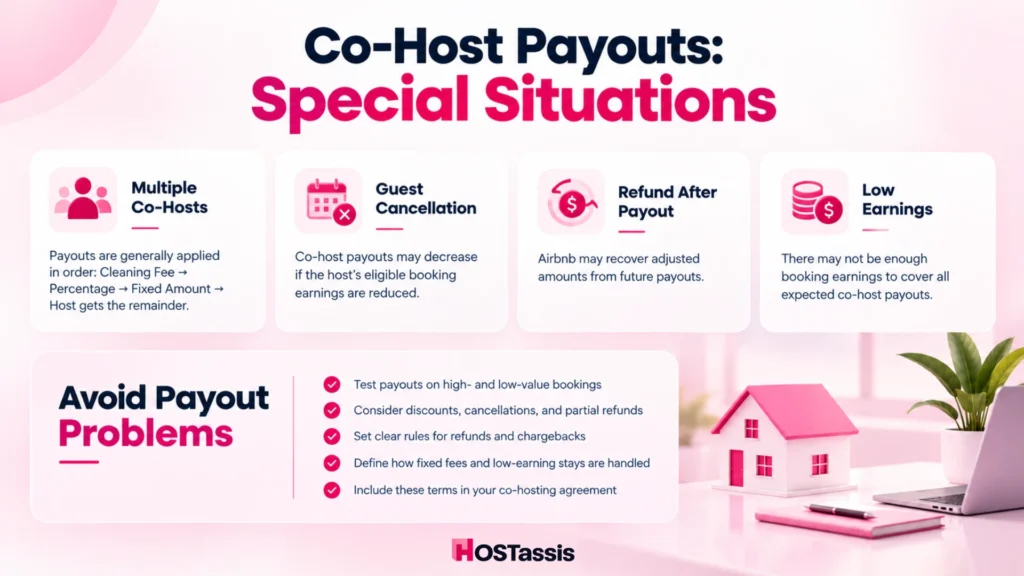
What Happens With Multiple Co-Hosts, Cancellations or Insufficient Earnings?
Airbnb payouts can change when multiple co-hosts are involved, a reservation is canceled, or available earnings are too low. Knowing how these situations work can help you avoid unexpected payout issues.
Multiple Co-Hosts: Who Gets Paid First?
When several co-host payouts are set up, Airbnb generally applies them in this order:
- Cleaning-fee payouts
- Percentage-based payouts
- Fixed-amount payouts
- Primary host receives what remains
Co-host payments come from the host’s available earnings. So, if you add several payout rules to one booking, the amount left for the primary host can become quite small, especially on lower-priced stays.
What Happens if a Guest Cancels?
A cancellation can reduce both the host’s and co-host’s payout. Airbnb first adjusts the reservation earnings based on the cancellation policy and timing, then calculates the co-host payout from the updated amount.
If the host receives a smaller payout, a percentage-based co-host payment will usually be smaller too. If the canceled reservation generates no eligible earnings, the co-host may receive nothing.
What if the Payout Has Already Been Sent?
Airbnb may recover refunded or adjusted amounts from future payouts. This can happen when a refund, cancellation, or other adjustment is made after the original payout has already been released.
For this reason, your co-hosting agreement should clearly explain who is responsible for refunds, chargebacks, cancellation costs, and similar adjustments.
What Happens When Earnings Are Too Low?
There may not be enough earnings to cover every expected payout. This is more likely with multiple co-host splits, fixed fees on low-value bookings, discounted stays, or refunds that reduce reservation earnings.
For example, a fixed co-host fee that works well on a $1,000 booking may take up a much larger share of a $300 booking.
How Can Hosts Avoid Payout Problems?
Check how your payout structure performs in both good and bad scenarios. Calculate the numbers for normal bookings, low-season rates, discounted long stays, and bookings with partial refunds.
It is also helpful to include clear rules for cancellations, refunds, chargebacks, fixed fees, and low-earning bookings in your co-hosting agreement. This makes payout responsibilities much clearer for everyone.
Are Damage and Resolution Center Payments Shared With Co-Hosts?
No, not automatically. Airbnb’s co-host payout system mainly applies to earnings from home reservations. Damage reimbursements and Resolution Center payments are usually handled separately.
What Does the Co-Host Payout Cover?
Airbnb’s co-host payout feature divides eligible earnings from a reservation. Depending on the setup, this may include the booking earnings and cleaning fee. The co-host receives their agreed percentage or fixed amount based on the normal payout schedule.
What Is Not Automatically Shared?
Damage reimbursements and Resolution Center payments are not automatically shared with co-hosts. This can include payments for guest-caused damage, missing items, or extra cleaning after a guest issue.
Even if the co-host helps collect evidence, communicate with the guest, or manage the claim, they do not automatically receive a share of that payment.
Why Does This Matter?
For example, if a co-host earns 20% of booking earnings and the host receives a $1,000 damage reimbursement, the co-host does not automatically receive $200.
This matters when the co-host also manages damage claims, since their regular management fee may not cover that extra work.
How Should Hosts Handle It?
The host can keep the full reimbursement, share an agreed percentage with the co-host, or pay a separate fee for handling claims. It’s best to include this in the co-hosting agreement so both sides know who handles claims, who receives the reimbursement, and whether any amount will be shared.
How Are Airbnb Co-Host Payouts Reported for Taxes?
Airbnb generally reports payouts based on gross earnings, so paying a co-host does not automatically reduce the amount reported for the listing owner. A co-host may also receive their own tax document, depending on the country and local tax rules.
This explains how Airbnb reports co-host payouts, not how you should file your taxes. Tax rules are different in each country, so it’s always best to check with a local tax professional.
Does a Co-Host Payout Reduce the Owner’s Reported Amount?
No. Using Airbnb’s built-in co-host payout system does not automatically reduce the owner’s reported gross earnings.
For example, if a reservation earns $1,000 and the co-host receives 20% ($200), the owner’s tax records may still show the full $1,000 rather than only the $800 they keep.
Can Co-Hosts Receive Their Own Tax Documents?
Yes. Eligible co-hosts may receive their own tax documents for payments received through Airbnb. The document type depends on the country, earnings amount, and local tax rules.
In the U.S., Airbnb may issue Form 1099-K to hosts and co-hosts when the reporting requirements are met. Both should keep their own payout records.
What if You Pay a Co-Host Outside Airbnb?
Payments made outside Airbnb, such as bank transfers, are separate from Airbnb’s payout system. Depending on the country and working relationship, these payments may have their own tax-reporting requirements.
Why Doesn’t the Owner’s Reported Amount Go Down?
Airbnb may report the owner’s gross earnings, even when part of those earnings goes to a co-host. The owner receives less after the split, but the reported gross amount may stay the same.
Based on local tax rules, co-host payments may be treated as business expenses or management costs.
What Should Hosts Keep Track Of?
- Gross Airbnb earnings
- Co-host payouts made through Airbnb
- Payments made directly to co-hosts
- Property expenses, such as cleaning, maintenance, and supplies
What Should Co-Hosts Keep Track Of?
- Payments received through Airbnb
- Extra payments received directly from the owner
- Airbnb tax documents
- Co-hosting-related expenses
Both the host and co-host should keep copies of their co-hosting agreement, payout summaries, invoices, and payment records.
How to Set Up a Co-Host Payout on Airbnb
You can set up automatic co-host payouts directly from your Airbnb listing. Once the payout is active, Airbnb automatically sends the co-host their agreed share, so you don’t need to pay them manually after every booking.
Step 1: Open Your Listing
Log in to Airbnb, go to Listings, and choose the property where you want to set up the co-host payout.
Step 2: Open the Co-Hosts Section
From your listing settings, find Co-hosts. Depending on your Airbnb view, you may first need to open Your space or Manage listing.
Step 3: Select or Invite Your Co-Host
If the person is already a co-host, select their name from the list. If not, choose Invite a co-host, enter their details, select the permissions you want to give them, and send the invitation. They will need to accept the invitation before you can complete the payout setup.
Step 4: Choose the Payout
Open the co-host’s payout settings and choose how you want to pay them. Depending on the options available, you may be able to select:
- A percentage of the booking
- A percentage plus the cleaning fee
- A fixed amount per booking
- Cleaning fee only
Enter the percentage or amount carefully and review the payout before continuing.
Step 5: Send the Payout Offer
Once everything looks correct, confirm and send the payout proposal. The co-host will receive a notification and must accept the payout setup before it becomes active.
Airbnb generally gives the co-host 14 days to respond. If they decline or do not accept within the required time, the payout setup will not take effect.
What Happens After the Co-Host Accepts?
Once accepted, Airbnb can automatically calculate and send the co-host’s share for eligible reservations based on the payout arrangement you selected.
Before finishing the setup, double-check the payout amount, cleaning-fee arrangement, and co-host details. Also, make sure the payout setup matches your written co-hosting agreement, especially for refunds, cancellations, and other adjustments.
This makes co-host payments much easier to manage because Airbnb handles the split automatically instead of you calculating and sending each payment yourself.
Frequently Asked Questions About Airbnb Co-Host Payouts
Here are some key questions that will help you understand it more clearly.
1. Can a co-host set up their own Airbnb payout?
No. Only the listing owner can set up or edit co-host payouts.
2. Can Airbnb pay more than one co-host?
Yes, multiple co-host payouts can be configured, but Airbnb applies them in a defined payout order, and available host earnings may limit what each co-host receives.
3. Can a co-host receive 100% of the cleaning fee?
Yes. “Cleaning fee” is one of Airbnb’s supported co-host payout options.
4. Can you change a co-host payout after bookings are confirmed?
Explain that payout-setting changes apply to bookings beginning after the co-host confirms the updated proposal; do not imply every existing reservation is retroactively recalculated.
5. What happens if the booking earnings are too low to cover all co-host payouts?
Airbnb notes that a co-host may receive less than expected or no payout, and the host can also end up with no payout.
6. Does the listing owner see the co-host’s full transaction history?
No. Both can see their own earnings information, but Airbnb says the listing owner does not have access to the co-host’s transaction history
Conclusion
A clear payout model helps Airbnb hosts understand how compensation is calculated and what each service includes. When the scope includes guest communication, booking management, and daily operations, it becomes easier to create a fair, practical payment structure for everyone involved.
Payout isn’t just about calculating money; it is also about valuing the work behind a smooth hosting experience.
With HOSTassis, you can clearly define responsibilities, manage key hosting tasks, and build a compensation plan that matches the real work being done.