No listing on Airbnb comes up just because of proximity. A certain ranking system works behind it. Among the 800+ factors, booking probability, guest satisfaction, click and conversion rates are the most important. Also, accurate pricing, quick replies and Guest Favorite badges play a big role in keeping listings ahead in 2026.
What Is the Airbnb Search Algorithm?
Ask ten hosts what the Airbnb algorithm is and you’ll get ten different answers, most of them wrong. It’s not a secret formula you can hack with one trick. It’s a live scoring system that ranks your listing against every other option in your area, and it reshuffles that ranking constantly based on what guests do.
Two people can search the exact same location and dates and see completely different results. That’s by design. Airbnb isn’t just showing “available properties”, it’s predicting which properties each specific guest is most likely to actually book.
Why Does Airbnb Use a Search Ranking System?
Airbnb only makes money when a booking happens, and the stay goes well. A listing that gets clicks but never converts is worthless to the platform, so the system is built around protecting that outcome, not around being fair to every host equally.
In practice, this means Airbnb:
- A listing won’t stay at the top just because more people click on it. Airbnb may lower its ranking if it doesn’t get booked after a few views.
- A good guest experience, fewer issues, fewer cancellations, and consistent successful bookings are all important to Airbnb.
- Not all guests will see the same search results for the same home and dates. Airbnb will show different listings based on family size, travel purpose, and needs.
How Airbnb Matches Guests With Listings?
The matching process starts with the basics: location, dates, and guest count, but it doesn’t stop there. Airbnb also factors in what the guest typed, their device, their past bookings, and how long they hover over a listing before clicking away.
- Relevance filters (location, dates, headcount) create the initial pool of eligible listings
- Personal history then reshuffles that pool for each individual guest
- Real-time behavior, saves, clicks, and time on page can shift rankings within hours, not weeks
What Changed in Recent Algorithm Updates?
The biggest shift in 2026 came in April, when Airbnb updated its Terms of Service and, for the first time, formally acknowledged in writing how its recommendation system actually works. A few things changed alongside that:
- The visibility boost new listings used to get has been scaled back significantly
- Guest Favorites has quietly become a stronger quality signal than Superhost
- The 24-hour free cancellation window is now standard on stays under 28 nights, and the old Strict cancellation policy was retired — a change that affects booking friction, which in turn affects conversion and ranking
How Airbnb Ranks Listings (Step-by-Step)
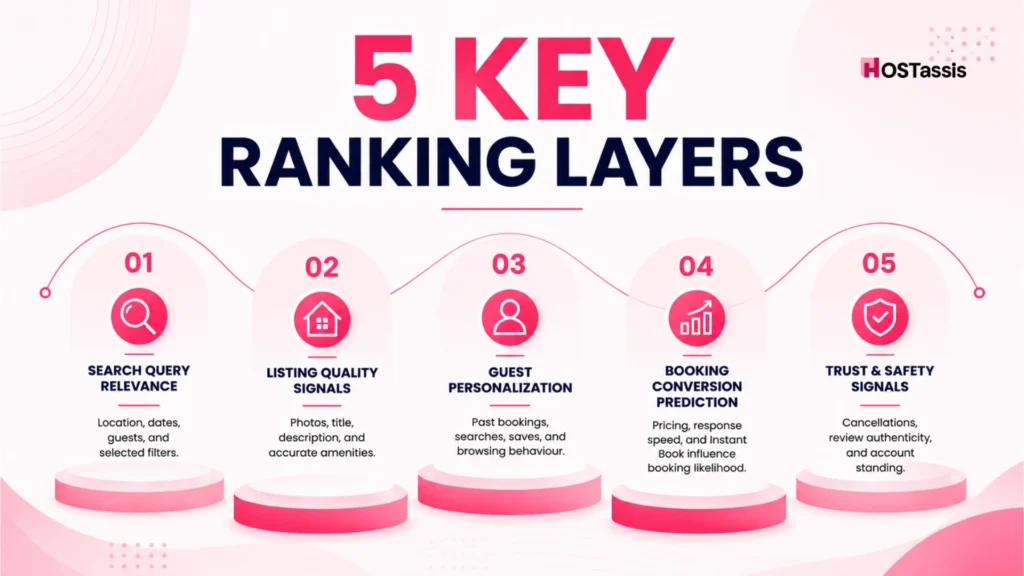
There isn’t one ranking formula. There are five layers, and a listing has to clear each one before it earns a top spot in front of the right guest.
Search Query Relevance
This is the first gate. Location, dates, headcount, and any filters the guest turns on, pool, pet-friendly, a price ceiling, determine. Which listings are even in the running before quality gets factored in at all.
Listing Quality Signals
Once a listing clears that first gate, Airbnb starts scoring it on photos, title clarity. How complete the description is, and whether the listed amenities actually match reality. Vague or outdated listings tend to lose ground here, even with good reviews.
Guest Personalization
From here, results get reordered per guest. Device type, saved listings, past bookings, even browsing patterns all nudge what that specific person sees first. Which is why comparing rankings with another host is often a waste of time.
Booking Conversion Prediction
This stage is where pricing, response speed, and Instant Book carry the most weight. Airbnb is essentially trying to answer one question: will this specific guest book this specific listing, or bounce to a competitor?
Trust & Safety Signals
Finally, cancellation history, review authenticity, and account standing feed into a trust score. A host who cancels often or has unresolved complaints gets pushed down here, no matter how good the earlier stages looked.
Top 15 Airbnb Ranking Factors That Matter Most
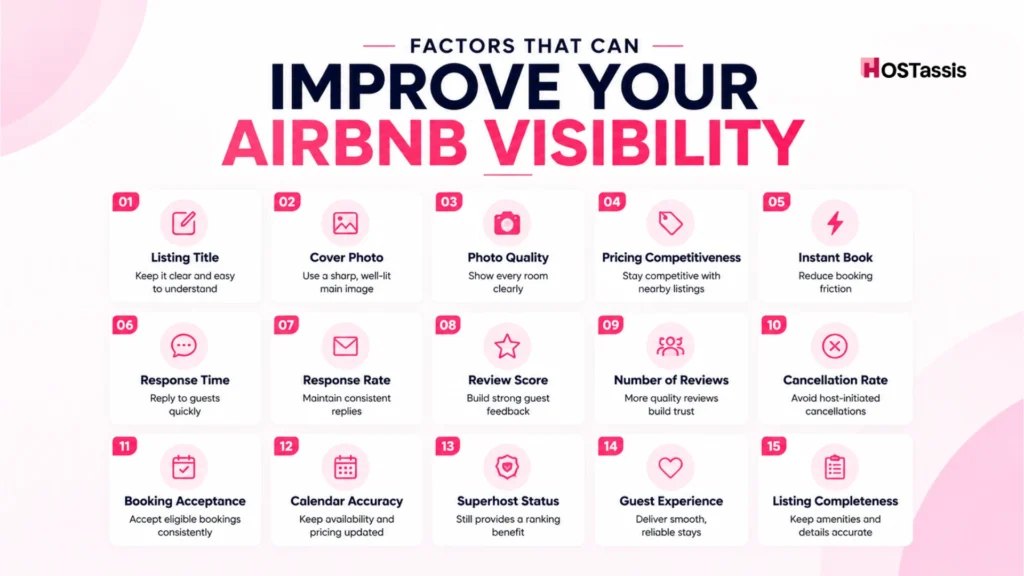
These are the factors that consistently show up across host data and Airbnb’s own disclosures as having a real, measurable pull on visibility. Not the ones hosts just assume matter.
Listing Title
A title that clearly says what the space is beats a clever one every time. Clarity drives click-through rate. Cramming in extra keywords doesn’t help and often just makes the title harder to read.
Cover Photo
This single image decides whether someone taps your card in the first place. A sharp, well-lit, honestly framed cover photo consistently pulls a higher click rate than one that’s dark, cluttered, or misleading.
Photo Quality
The rest of the gallery matters too, because it affects how long a guest lingers on your page, and dwell time itself feeds back into ranking.
- Shoot in natural light, use wide angles where you can
- Photograph every room you mention in the listing text
- Swap in new photos each season so the listing feels current, not stale
Pricing Competitiveness
Pricing isn’t just about revenue anymore, it’s a ranking input. Price too far above the market and you’ll get fewer clicks and worse conversion, and Airbnb responds by simply showing you less often.
- Aim to stay within about 10–15% of comparable listings nearby on peak dates
- Adjust rates regularly instead of setting one price and forgetting it
- Treat a dropping conversion rate as an early warning sign, not just a slow week
Instant Book
Turn it on and your listing tends to sit noticeably higher in search, because it removes a step of friction between “interested” and “booked.”
- You can now require verified ID and a minimum review history from guests
- That gives you screening power without losing the ranking boost
- Leaving it off in 2026 puts you at a real disadvantage against hosts who don’t
Response Time
How fast you reply feeds directly into Airbnb’s conversion prediction. A guest who doesn’t hear back quickly often just books somewhere else before your reply even lands.
Response Rate
Speed isn’t enough on its own, consistency matters just as much. A host who answers nearly every inquiry reads as more reliable than one who replies fast sometimes and disappears other times.
Review Score
Airbnb doesn’t just look at your star average. It reads the actual review text and weighs specific mentions of cleanliness, communication, and accuracy. A vague five-star review carries less signal than a detailed four-star one.
Number of Reviews
Volume builds trust over time. A listing with fifty solid reviews will generally outperform one with five, even when both average the same rating.
Cancellation Rate
Cancelling on a guest, especially last-minute, is one of the fastest ways to undo months of good ranking. Airbnb treats host-initiated cancellations as one of the strongest negative trust signals it has.
Booking Acceptance
Declining requests too often reads as unreliability to the algorithm. Accepting the bookings you’re eligible for keeps you in good standing.
Calendar Accuracy
Airbnb tracks two things about your calendar: how much you’re actually offering, and how recently you touched it. A calendar that’s stale or overly blocked quietly limits how often you show up in search.
- Keep a rolling 60–90 day window open where possible
- Update pricing and availability weekly rather than monthly
- Avoid heavy owner-use blocks during your local high season
Superhost Status
It still helps, but it’s earned quarterly and no longer carries the weight it used to. Guest Favorites, which updates far more often, has become the bigger signal.
Guest Experience
Everything that happens during a stay, how smooth check-in was, how a problem got handled eventually shows up in reviews and repeat bookings, both of which the algorithm is watching closely.
Listing Completeness
Skip or mislabel an amenity and you might simply disappear from searches that filter for it. It has nothing to do with review scores or photos — it’s a visibility issue, not a quality one.
Ranking Factors You Can’t Control
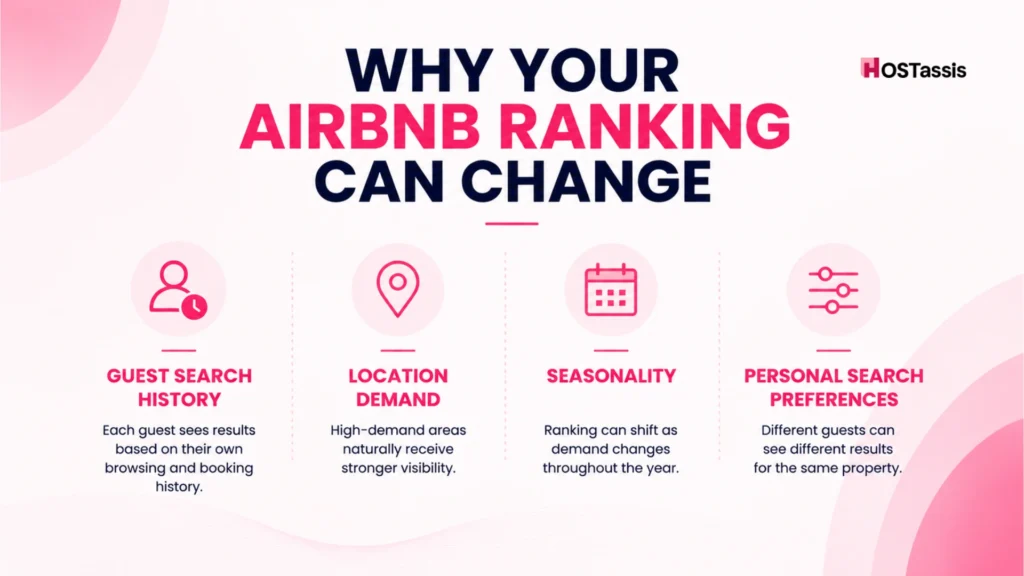
Not everything about your ranking comes down to effort. Some of it is entirely about who’s on the other end of the search.
Guest Search History
A guest’s own past bookings and browsing shape what they see. Two people searching identical dates can get different results because Airbnb is reading their individual history, not just the search terms.
Location Demand
A property in a high-demand neighborhood will naturally out-rank an identical one somewhere quieter. That’s about the market, not the listing.
Seasonality
Demand swings change how aggressively certain listing types get promoted. A dip in visibility during your off-season doesn’t necessarily mean something’s wrong with your listing.
Personal Search Preferences
A family of four, a couple, and a solo traveler each trigger different ranking logic. So when a host asks “where do I rank on Airbnb,” the honest answer is: it depends who’s looking.
How to Improve Your Airbnb Ranking?
There’s no single switch to flip here. Ranking improvement comes from doing a handful of small things consistently, week after week, rather than one big overhaul.
Weekly Optimization Checklist
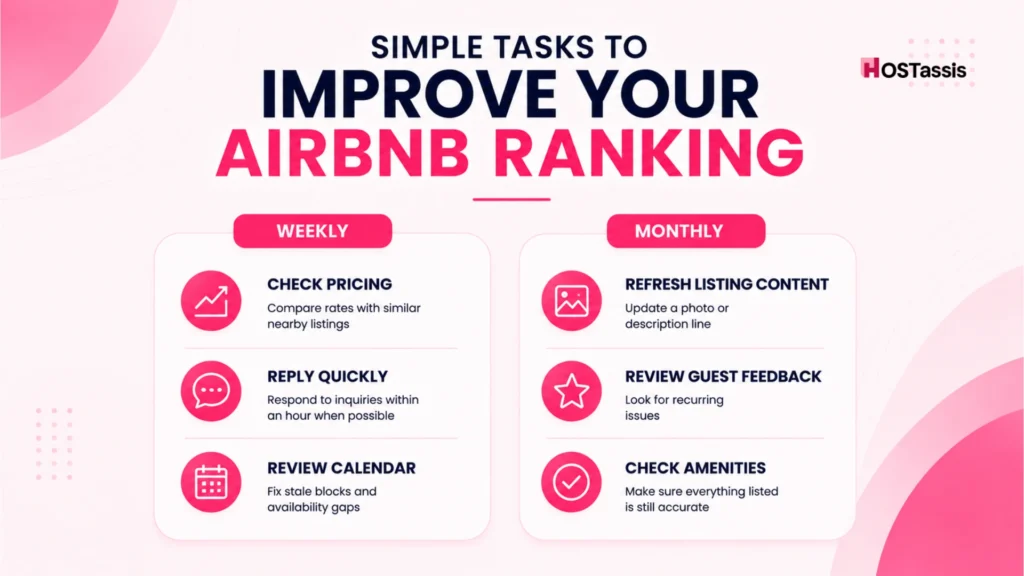
- Compare your pricing against similar listings nearby and adjust if needed
- Reply to inquiries within an hour whenever you can manage it
- Scan your calendar for stale blocks or gaps that shouldn’t be there
Monthly SEO Tasks
- Refresh a photo or a line of description so the listing looks actively managed
- Read through recent reviews for patterns worth fixing operationally
- Double-check that your listed amenities still match what you actually offer
Mistakes That Hurt Rankings
- Keeping Instant Book off without a real reason to
- Letting the calendar sit untouched for weeks at a stretch
- Writing keyword-stuffed titles instead of clear, honest ones
Common Airbnb SEO Myths
Some advice that circulates among hosts was never quite true, and some of it just hasn’t kept up with how the algorithm works now.
- “Lower prices always rank higher.” Not really. Underpricing can hurt perceived value, and it won’t fix a weak conversion rate caused by something else.
- “More amenities automatically help.” Only if they’re accurate and correctly tagged. Listing amenities you don’t have can actually work against you.
- “Superhost guarantees top placement.” It helps, but it’s one signal among hundreds and Guest Favorites currently outweighs it.
Frequently Asked Questions
Q. Does Airbnb use keywords?
A. Clear titles and descriptions help with click-through rate, but stuffing them with keywords doesn’t improve ranking — it usually just hurts readability.
Q. Does Superhost increase rankings?
A.“It helps, yeah, but no longer carries as much weight as it once did for us. Guest Favorites updates far more regularly.”
Q. Does lowering the price help?
A. Only if a truly competitive pricing structure is the actual cause you aren’t getting conversion.
Q. Do reviews matter?
A. Yes, and more specifically than most hosts assume Airbnb reads what reviews actually say about cleanliness, communication, and accuracy, not just the star average.
Q. How long does ranking improvement take?
A. Most hosts notice movement within two to four weeks of making consistent changes. Deeper trust signals, like review history and cancellation records, build up over months, not days.
Final Thoughts
Nothing on this list is a secret. Accurate pricing, fast responses, a clean calendar, reviews that reflect a genuinely good stay none of it is complicated on paper. What’s hard is keeping up with all of it, every week, especially once you’re managing more than one property.
That’s the part HOSTassis handles. Our co-hosts take care of guest communication, calendar upkeep, listing updates, and review follow-up, so the ranking factors that actually move the needle stay covered without eating into your time. Talk to us if you’d rather spend your hours growing your portfolio than chasing algorithm updates.