Airbnb only removes reviews when they break a specific section of its Authentic and Trustworthy Reviews Policy, and being unfair or factually incorrect on its own is never enough to guarantee removal.
A one star review can ruin your week. But before you spend hours drafting an angry dispute, it helps to know something most hosts don’t. A “bad” review and a “removable” review are two very different things. Airbnb doesn’t take a review down just because it hurt your rating or felt unfair. It takes a review down when that review breaks a specific rule. This guide walks through exactly which reviews qualify, which ones almost never do, and how to build a request that actually gets read instead of rejected.
Quick Answer: Can Airbnb Reviews Be Removed?
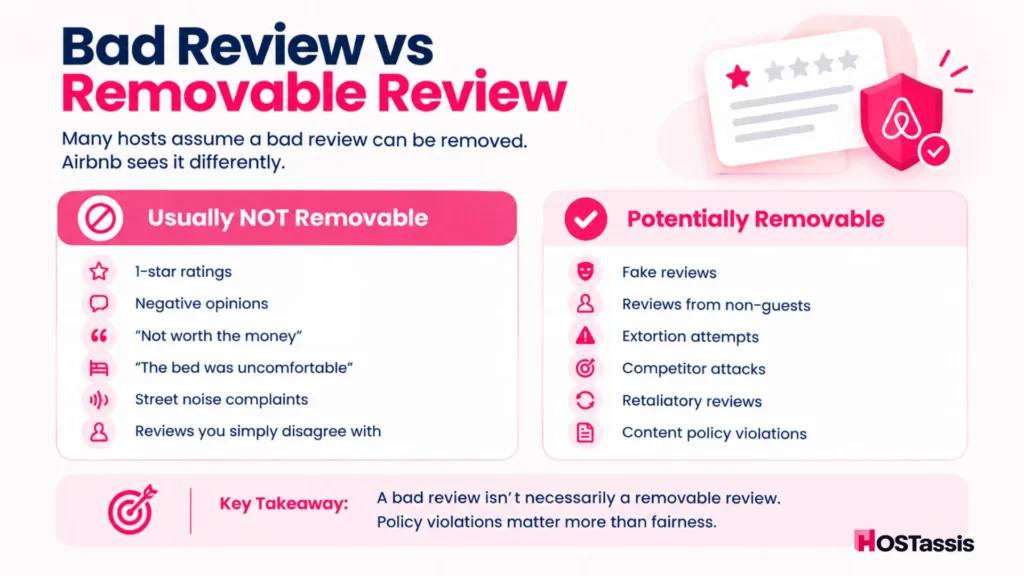
Yes, but only when a review breaks Airbnb’s Reviews Policy or Content Policy, not simply because a host disagrees with it or finds it unflattering.
Airbnb will consider removing a review if it’s irrelevant to the stay, fake, manipulated, tied to extortion, aimed at hurting a competitor, retaliatory under Airbnb’s own definition, or if it violates the Content Policy. What Airbnb generally won’t do is referee a disagreement. A guest calling your place “not worth the money” isn’t a violation. It’s an opinion, and opinions are allowed to sting.
Can an Airbnb Host Delete a Guest Review?
No. Hosts can’t personally delete a review they’ve received. Only Airbnb can remove it, and only after a formal request proves a policy was broken.
There’s no delete button sitting on a host’s dashboard next to a bad review. What you can do instead:
- Submit a review removal request through Airbnb’s official process, if you or an eligible co-host believe a specific policy was violated
- Respond publicly to the review instead, which is often the faster, more realistic option
- Wait it out, since one bad review rarely wrecks an otherwise solid rating history
The one exception runs the other way. If you wrote a review, you have 30 days after it is published to remove it yourself. Guests have that same right over reviews they’ve written about your listing.
Which Airbnb Reviews Can Actually Be Removed?
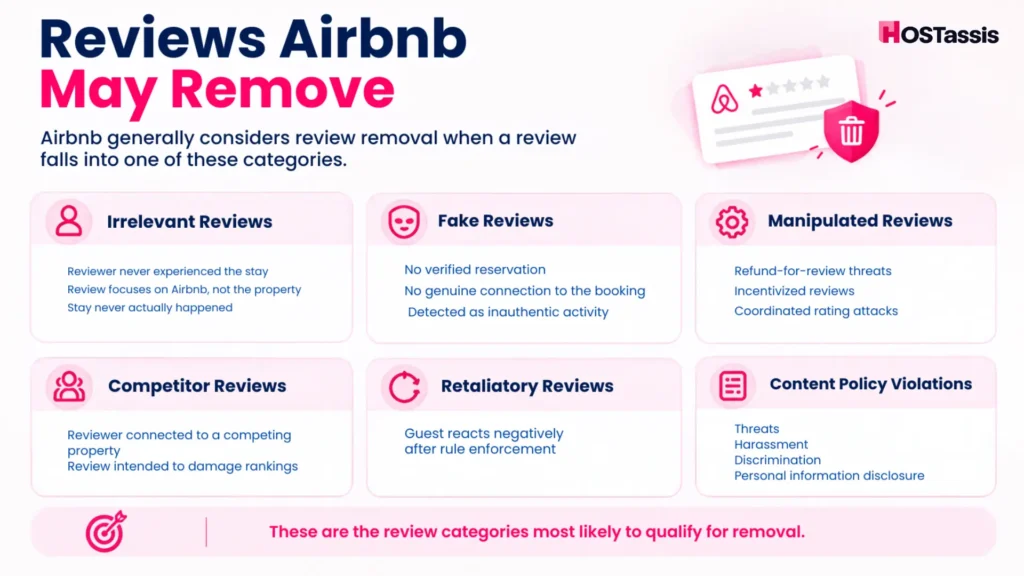
Airbnb recognizes six categories where a review may qualify for removal: irrelevance, fakeness, manipulation, competitor sabotage, retaliation, and Content Policy breaches.
Here’s a quick way to see how this plays out in practice.
| Review Situation | Removable? | Why |
| Guest gives 1 star | Usually not | Rating disagreement, not a violation |
| Guest says the bed was uncomfortable | Usually not | Subjective opinion |
| Guest complains the street was noisy | Not automatically | May still be relevant to future guests |
| Reviewer never actually stayed | Potentially | Lacks first-hand experience |
| Guest threatens a bad review unless refunded | Potentially | Extortion or pressure |
| Review traded for money or a discount | Potentially | Incentivized review |
| A direct competitor leaves a damaging review | Potentially | Competition manipulation |
| Guest retaliates after a documented rule enforcement | Potentially | Retaliation policy |
| Review reveals private or identifying information | Potentially | Content Policy |
| Review contains discriminatory or threatening language | Potentially | Content Policy |
| Host insists the whole review is a lie | Not enough alone | Accuracy disputes aren’t typically mediated |
1. Reviews That Are Irrelevant to the Stay
A review can be flagged as irrelevant if it has nothing to do with the actual listing or stay, or if the reviewer never genuinely experienced it first hand.
- Written by someone who wasn’t part of the reservation
- Focused on something entirely unrelated to your property, such as a dispute with Airbnb itself
- Left despite a cancelled or never completed stay, with no real experience to review
One caution here. Neighborhood noise or a long walk to the nearest cafe isn’t automatically “irrelevant” just because it’s outside your control. If it’s genuinely something future guests should know, Airbnb tends to treat it as fair game, even if it wasn’t your fault.
2. Fake or Inauthentic Reviews
A review is considered fake when it isn’t based on a real reservation or a real stay, and Airbnb runs automated systems specifically built to catch this pattern.
- Not tied to an actual, verified booking
- Written by someone with no genuine connection to the reservation
- Flagged by Airbnb’s own fake review detection tools
Keep the distinction sharp. A guest who lied about something in their review isn’t automatically the same as a fake review. Lying about the mattress firmness is a dispute over accuracy. A review with no real stay behind it is fabrication, and that’s the category Airbnb actually acts on.
3. Reviews Involving Extortion, Pressure, or Manipulation
Reviews used as leverage, where a guest threatens a bad rating unless they get something in return, cross directly into policy violation territory, and message history is your strongest evidence.
- “Refund me, or I’ll leave a one-star review”
- A review offered, withheld, or changed in exchange for money, free nights, or upgrades
- Coordinated efforts by multiple accounts to manipulate a listing’s rating
- Any review clearly incentivized by a side deal outside the platform
Save every message. A single screenshot of a guest threatening you over refund terms is often the single most persuasive piece of evidence you can submit.
4. Reviews Left to Harm a Competitor
Airbnb prohibits reviews written by people connected to a competing listing or business, since these aren’t genuine guest feedback at all.
- The reviewer runs, works for, or is affiliated with a rival property
- The review appears designed to damage your ranking rather than inform future guests
Evidence here usually means linking the reviewer’s profile to a competing listing, business page, or social account. Proof of the relationship, not just suspicion of one.
5. Retaliatory Reviews
A review counts as retaliatory only under a fairly narrow definition. The guest broke a rule, was told about it, and then left a biased review connected to that specific enforcement.
That sequence matters. A guest disputing a charge through the Resolution Center or an AirCover claim and then leaving a critical review isn’t automatically retaliation. Disagreement over money isn’t proof of bad faith. If this is the exact situation you’re facing, our full guide on documenting and disputing retaliatory Airbnb reviews walks through the evidence standard in detail.
6. Reviews That Violate Airbnb’s Content Policy
Airbnb prohibits reviews that contain harmful, abusive, or illegal content, along with reviews that break specific platform rules around extortion, discrimination, irrelevance, or manipulation for competitive gain.
- Threatening or harassing language directed at the host
- Discriminatory remarks based on race, religion, gender, or similar characteristics
- Sexually explicit or graphically violent content
- Impersonation of another person
- Details specific enough to identify your home’s exact address or location
This category tends to be the clearest cut of the six. The language itself is usually the evidence.
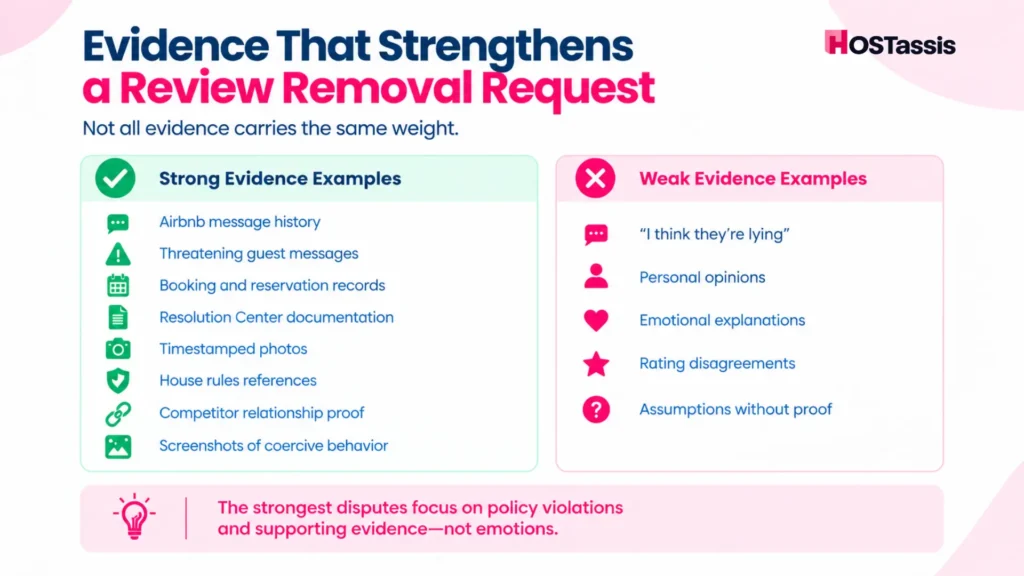
Which Bad Airbnb Reviews Usually Cannot Be Removed?
Bad Airbnb reviews reflecting honest experiences, opinions, or lawful critique generally can’t be removed. Airbnb protects genuine feedback, so support rejects removal requests unless a specific policy rule was actually broken. You can review Airbnb’s official Reviews Policy for more details.
“The guest gave me an unfair star rating.” Disagreeing with a rating isn’t grounds for removal. Airbnb doesn’t judge whether four stars was fair for a stay with one small hiccup.
“The guest mentioned something outside my control.” Traffic noise, a construction project down the street, unseasonable weather- these can still be genuinely useful to a future guest, even though none of it was your fault.
“The review is just their opinion.” “The bed was too firm,” “the room felt small,” “not worth the price,” these are subjective impressions, and subjective impressions are exactly what reviews are supposed to capture. They stay up.
“The guest’s review is factually wrong.” This is the big one. Airbnb generally does not mediate disputes over whether a review’s claims are accurate. Saying “they lied” isn’t enough on its own. You need to connect the false-seeming statement to an actual policy violation, not just assert that it’s untrue.
How to Request Airbnb Review Removal in 2026
To request review removal, log into your account, find the review in your dashboard or the Airbnb Help Center, and submit a formal report citing the specific policy violated. Airbnb also provides official guidance on how to report and request removal of a review.
- Go to Airbnb’s Help Center and start a review removal request
- Select the specific review you’re disputing
- Choose the policy category it violates, not “I don’t like it,” but the actual rule
- Write a short, factual explanation connecting the review to that rule
- Attach supporting documents
- Submit and wait for a decision
Write this like you’re building a case, not venting frustration. A request that says “this policy was clearly broken, here’s the proof” gets taken far more seriously than one that says “this isn’t fair.”
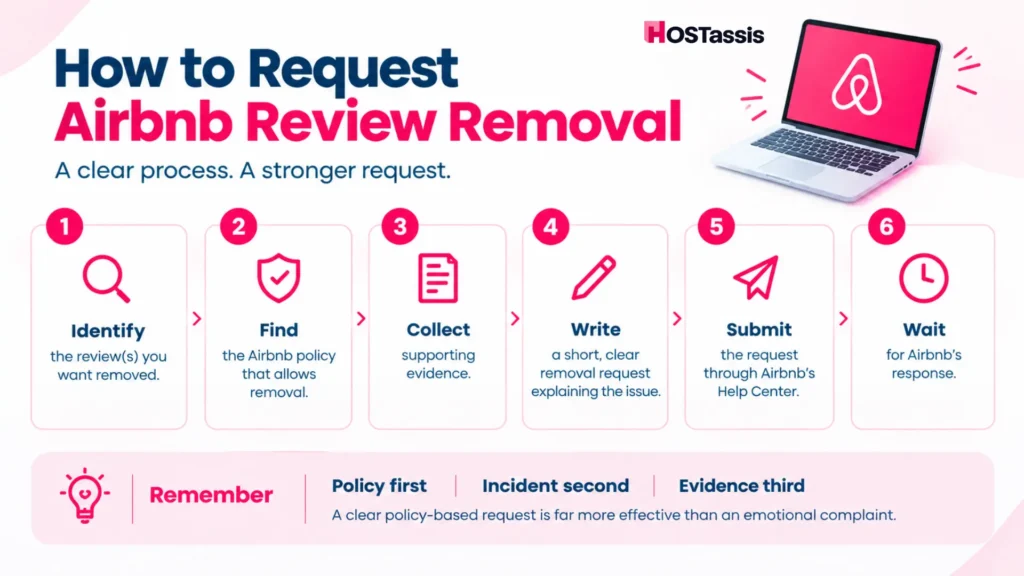
What Evidence Should You Include in an Airbnb Review Dispute?
To successfully dispute an unfair Airbnb review, you need concrete, on-platform evidence proving a direct policy violation; simply arguing the review is unfair or inaccurate won’t be enough.
Strong evidence proves the specific rule violation, not just that you’re upset, and the clearer the paper trail, the stronger your case.
- Message threads showing threats, incentive offers, or coordination
- Reservation and booking details confirming or disproving a genuine stay
- Timestamped photos, when relevant to the claim
- Records from an existing Airbnb case or Resolution Center thread
- House rules or listing details that support your position
- Screenshots of any coercive or threatening messages
- Documentation linking a reviewer to a competing listing, if that’s the claim
One important caution. Don’t upload sensitive personal information such as IDs, medical details, anything involving children, or criminal history records. It’s unnecessary and Airbnb specifically warns against it.
How Long Does Airbnb Take to Decide a Review Removal Request?
Airbnb usually resolves straightforward review removal requests within 48 hours, though more complex disputes reviewed manually by support agents can take 3 to 14 business days, occasionally stretching up to 30 days.
- Busier periods or more complicated cases can stretch the timeline a bit further
- If the review is removed, the guest who wrote it gets notified too
- New information from either side, even after the decision, can still cause things to shift
So while 48 hours is the standard, it’s not always the final word on the matter.
How Many Times Can You Dispute the Same Airbnb Review?
You can dispute the same Airbnb review up to two times. Once both attempts have been submitted and denied, Airbnb’s system blocks any further removal requests for that specific review.
You get two attempts to dispute the same review, and that limit is exactly why rushing your first submission is such a costly move. A weak or emotional first try can quietly cost you your best shot. Before filing, make sure you’ve covered the basics:
- Reference the exact policy the review violates
- Back it up with real, solid evidence
- Cut the filler and emotional venting entirely
Treat that first attempt like it’s your only real chance, because functionally, it pretty much is.
Who Can Request Removal of an Airbnb Review?
Eligibility here goes beyond just the listing owner. Airbnb extends this right to a few different roles, including:
- The listing owner themselves
- A full access co-host managing that specific property
- Certain professional host or team account roles with the right permission
- The guest, but only for a review they personally wrote
If you work with a co-host or a host assist service, it’s worth confirming this access upfront. A full access co-host can often handle the entire dispute process on your behalf, saving you the back-and-forth with support.
Can a Guest or Host Remove a Review They Wrote?
Yes, both guests and hosts can remove a review they personally wrote on Airbnb, but only within 30 days of the date it was originally published.:
- Before publication, there’s a 14-day window where limited edits are possible
- Once the review is live, editing generally isn’t an option anymore
- Removal within that 30-day window becomes the only real lever left
So if second thoughts show up, it’s better to act sooner rather than let that window close.
What Happens to the Rating When Airbnb Removes a Review?
When a policy-violating review is removed, its associated star rating and related content may also be removed along with it. Airbnb’s own language here is careful, and worth paying attention to. The Airbnb Reviews Policy provides the platform’s official guidance on how reviews are handled.
- It says “may remove,” not “will always remove”
- This means removal isn’t guaranteed to wipe out every trace of the review’s impact instantly
- In most cases, though, the rating tied to it does end up going too
Basically, don’t overpromise this outcome to yourself before the decision actually comes through.
What Happens to Airbnb’s AI Review Highlights After a Review Is Removed?
Airbnb’s AI-generated review highlights are built automatically from your overall review history, and Airbnb says these should refresh within 48 hours of a policy-violating review being removed. A few things worth knowing:
- This is a detail most guides skip entirely
- If a removed review had shaped a negative-sounding highlight, that summary is expected to update on its own
- No separate request is needed for this to happen
It’s a small detail, but genuinely useful if you’re watching your listing’s public-facing summary closely.
Airbnb Review Removal Checklist Before You Submit
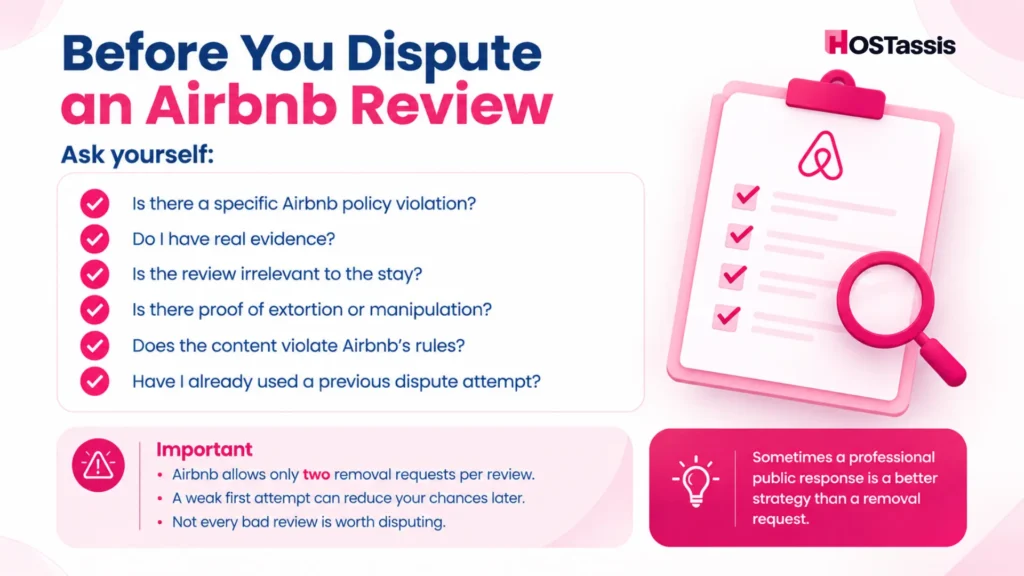
You can submit a removal request through the Airbnb Support Center or directly from your hosting dashboard, keeping in mind you’re limited to a maximum of two attempts per review.
Before you file a request, it helps to run through a quick checklist. Ask yourself the following:
- Is there an exact, nameable policy the review violates
- Do you have real evidence, not just your own account of events
- Is this a relevance or first-hand experience issue
- Is there proof of manipulation, extortion, or incentive
- Does the content itself violate Airbnb’s Content Policy
- Have you already used up a prior attempt on this same review
If most of these come back now, a public response to the review is probably a better use of your time than a dispute you’re likely to lose.
What Does a Strong Airbnb Review Dispute Actually Look Like?
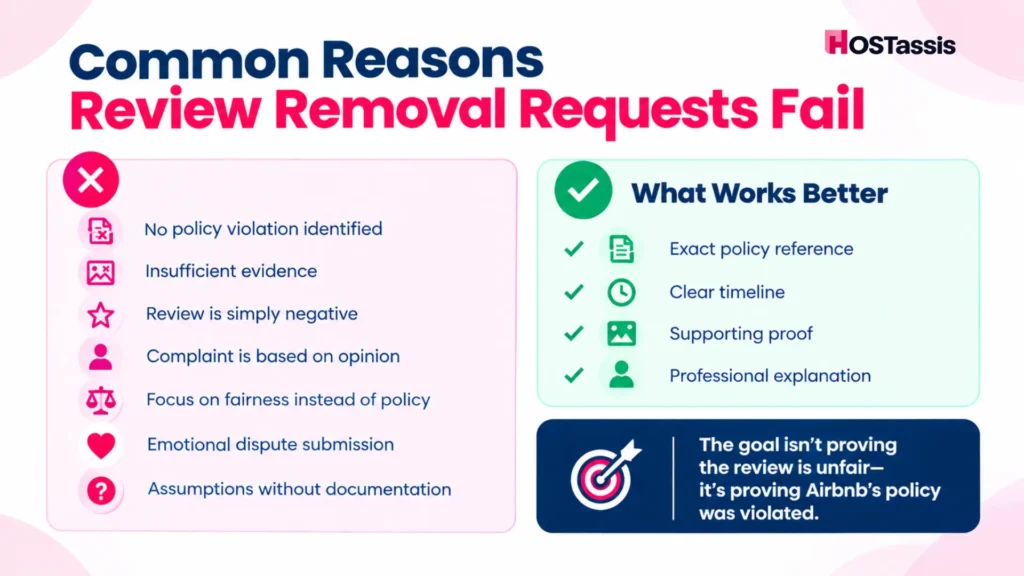
A strong Airbnb review dispute reads like a precise, factual policy brief rather than an emotional complaint. Since Airbnb’s review filters rely on clear rule violations rather than fairness arguments, winning requires laying out exact dates, timestamps, and explicit policy breaches.
- Names the exact policy violated, such as extortion or manipulation
- States the specific date and incident clearly
- References attached evidence directly, like a screenshot or message log
- Stays factual throughout, with zero emotional language
The pattern to follow: policy first, incident second, evidence third. Skip explaining how unfair it feels; that part doesn’t move the decision.
What Happens If Your First Dispute Gets Rejected?
If your first dispute or chargeback gets rejected, the provisional credit is reversed, you become liable for the charge, and the case closes in the merchant’s favor unless you choose to escalate further.
- Re-read the exact policy wording on Airbnb’s Help Center
- Check whether your evidence actually proved the violation, or just implied it
- Look for anything new since the first submission
- Rewrite the request from scratch rather than editing the old one
If the second attempt also fails, that’s usually the end of the formal process. At that point, a calm, professional public response becomes the better move.
Why Choose Us for Airbnb Cohosting?
Building a strong review dispute takes time, policy knowledge, and evidence gathering, something most hosts simply don’t have the bandwidth for while running a listing. As a full access co-host, we handle this entire process on your behalf:
- Check whether a review actually qualifies for removal before filing, so your two attempts aren’t wasted on a weak case
- Collect message logs, timestamps, and booking records as solid evidence
- Write disputes the way Airbnb’s team actually wants: policy named first, incident second, evidence third, with zero emotional language
- Strengthen a second attempt if the first gets rejected, instead of resubmitting the same denied request
Beyond review management, we also handle guest messaging and reputation, so you stay focused on growing your listings while we defend them.
Airbnb Review Removal FAQs
Can Airbnb remove a one-star review?
Not simply because it’s one star. A low rating on its own isn’t a violation. It needs an accompanying policy issue to qualify for removal.
Can Airbnb remove a false review?
Not automatically. Airbnb generally doesn’t mediate accuracy disputes. The content has to break a specific Reviews or Content Policy rule, not just be untrue in the host’s eyes.
Can Airbnb remove a review if the guest never stayed?
Potentially. A review with no genuine first-hand experience behind it can be treated as irrelevant, though cancellation and check-in circumstances matter to the outcome.
Can Airbnb remove a review after a refund dispute?
Not automatically. Disagreeing over a refund or an AirCover claim doesn’t by itself make the resulting review retaliatory.
Can a full access co-host dispute an Airbnb review?
Yes. Full access co-hosts are among the roles Airbnb currently allows to request removal on behalf of the listing.
How long does Airbnb review removal take?
Airbnb usually emails a decision within 48 hours of submission.
How many times can I ask Airbnb to remove the same review?
Up to two removal requests per review, so it’s worth making the first one count.
Does Airbnb notify the guest if their review is removed?
Yes. The reviewer gets an email notification and can reach out to Airbnb if they believe the removal was a mistake.
The Bottom Line
Not every bad review is a mistake. Most of them are just guests telling the truth about an experience you didn’t love hearing. The ones worth fighting are the ones tied to an actual policy: fake, manipulated, retaliatory, irrelevant, competitor driven, or in breach of the Content Policy. Everything else is usually better answered with a calm, professional public response than a dispute you’re likely to lose.
If chasing down evidence, drafting disputes, and managing guest communication isn’t where you want to spend your time, that’s exactly the kind of day to day work HOSTassis handles for hosts, from guest messaging to reputation management, so you can stay focused on growing your listings instead of defending them