A burst pipe in a vacation rental rarely announces itself. If you live three states away, you usually find out when the next guest walks into a flooded kitchen, or when your cleaner sends a photo you never want to see.
State Farm says it paid more than 20,000 frozen-pipe claims between 2024 and June 2025, and the average claim was over $30,000 (State Farm). For an out-of-state host, that number is not just a repair bill. It is cancelled bookings, a hit to your reviews and weeks of coordinating contractors by phone.
The good news: you do not need to live near your rental to protect it. You need the right setup, the right people and a plan written down before the first freeze.
Quick answer: To winterize a vacation rental remotely, keep the heat at 55°F or higher, install a smart thermostat plus leak and temperature sensors that alert your phone, shut off and drain outdoor water lines, give a local vendor a fixed check-in schedule, and write down exactly who does what if a pipe freezes. Then confirm every step with dated photos, not promises.
This guide walks you through each step, with a checklist for vacant and occupied weeks, a device table, a vendor schedule and a burst-pipe escalation plan you can hand to your team.
Why winterizing remotely is different
Most winterizing guides assume you can drive over, check the furnace and walk the property after a storm. Out-of-state hosts cannot. That changes three things.
- You find problems late. Without sensors, a failed furnace on Tuesday may not be noticed until Friday’s check-in. By then the pipes have frozen and thawed.
- You depend on other people. Your cleaner, handyman and plumber become your eyes and hands. If nobody knows their exact job, everybody assumes someone else checked.
- Guests change the settings. A guest who turns the heat to 50°F to save energy, or opens a window, can undo your preparation in one night.
So remote winterizing is less about a longer to-do list and more about a system: devices that tell you what is happening, people with clear roles, and proof that the work was done. If you are still deciding whether this model works for you, read our guide on whether you can run an Airbnb without being there.
The remote winterizing checklist
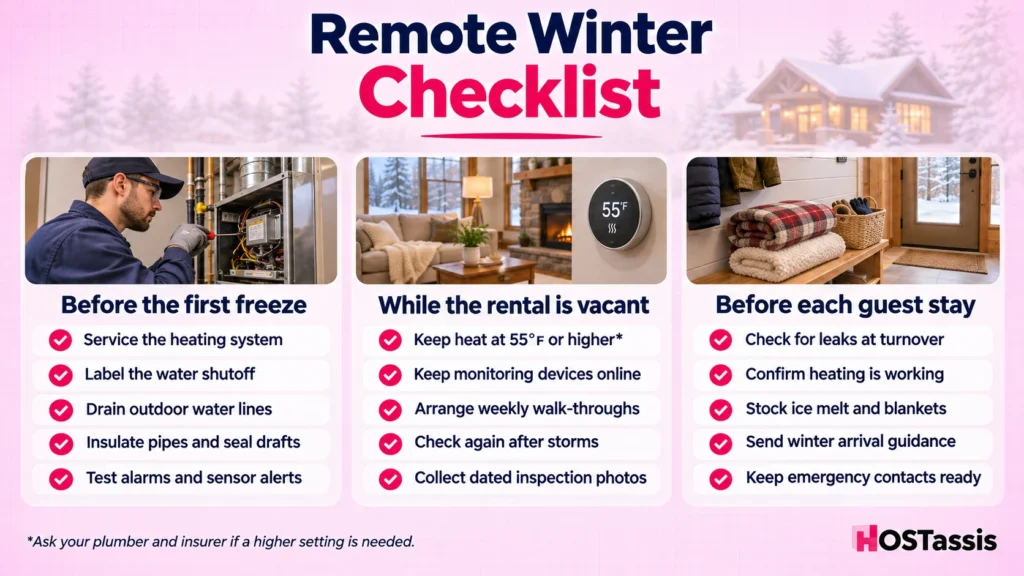
Work through this list in October or early November, before your area’s first hard freeze. Every item that needs hands on site is marked with who does it, so you can assign it from anywhere.
Before the first freeze (one-time setup)
- Book an HVAC service visit. Ask the technician to change the filter, test the furnace and send you photos of the filter and the thermostat reading. (HVAC tech)
- Find and label the main water shutoff. Get a photo of the valve with a tag on it, and save it in your shared ops folder. (Handyman or cleaner)
- Shut off and drain outdoor water. Disconnect hoses, close the inside valve to each hose bib, open the outside tap to drain, and blow out irrigation lines. (Handyman or landscaper)
- Insulate exposed pipes. Focus on crawl spaces, garages, attics and pipes along outside walls. (Handyman)
- Seal drafts around doors, windows and where pipes enter the house. (Handyman)
- Clean gutters and check the roof to reduce ice dams. (Gutter or roofing service)
- Service the fireplace or chimney, or lock it out of guest use if you cannot. (Chimney sweep)
- Test smoke and carbon monoxide alarms and replace batteries. (Cleaner at turnover)
- Winterize or protect the hot tub and pool following the manufacturer’s guide. (Pool or spa service)
- Install your monitoring devices (see the table below) and test every alert on your phone. (Handyman + you)
- Sign a snow removal contract with a clear trigger, for example “plow when snowfall reaches 2 inches, before 8 a.m. on check-in days”. (Snow contractor)
Vacant weeks (no guests booked)
- Set the thermostat to at least 55°F, the minimum State Farm recommends to prevent frozen pipes (State Farm). In very cold climates, ask your plumber and insurer if you need higher.
- Open cabinet doors under sinks on outside walls so warm air reaches the pipes.
- Set the water heater to vacation mode.
- For long gaps (several weeks), consider shutting off the main water and draining the lines. Note: this also disables fire sprinklers, so check with your plumber first.
- Keep the monitoring devices powered and online, and schedule a walk-through at least once a week.
Occupied weeks (guests in the house)
- Lock the thermostat’s minimum at 55°F so guests cannot turn the heat off.
- Ask your cleaner to check under sinks, in the utility room and at the water heater at every turnover. Our property inspection checklist covers what else to check.
- Stock ice melt, a snow shovel, extra blankets and a boot tray.
- Send the winter guest message (template below) before arrival.
- Watch the forecast. Before a cold snap, ask guests to keep the heat on and let one tap drip overnight.
Smart devices that let you monitor winter from anywhere
Sensors are what turn a remote host from “hoping” into “knowing”. You do not need everything on this list, but a smart thermostat and leak sensors are the minimum for any rental in a freezing climate.
| Device | What it tells you | Where to put it | Priority |
|---|---|---|---|
| Smart thermostat | Indoor temperature, heat on or off, lets you lock a minimum setting | Main living area | Must have |
| Water leak sensors | Water on the floor, with a phone alert | Under sinks, behind toilets, by the water heater and washer | Must have |
| Temperature and humidity sensors | Cold spots before pipes freeze | Crawl space, basement, garage, the coldest room | Must have in cold climates |
| Smart water shutoff valve | Detects unusual flow and can close the main remotely | On the main water line (plumber installs) | Strongly recommended |
| Smart lock or keypad | Lets vendors in without a key handoff and logs entry times | Front or side door | Strongly recommended |
| Noise decibel monitor | Sound levels only, no recording | Common areas only, disclosed in the listing | Optional |
| Outdoor camera | Snow on the drive, deliveries, who arrived | Exterior only, disclosed in the listing | Optional |
Two rules matter here. First, Airbnb bans indoor security cameras in all listings, and outdoor cameras and noise monitors must be disclosed before booking (Airbnb). Second, devices only help if someone reads the alert. Decide now whose phone gets each alert, and who is the backup at 2 a.m.
If you are choosing a lock, our smart lock or keypad comparison explains which suits remote hosts best.
Build a winter vendor schedule (and ask for proof)
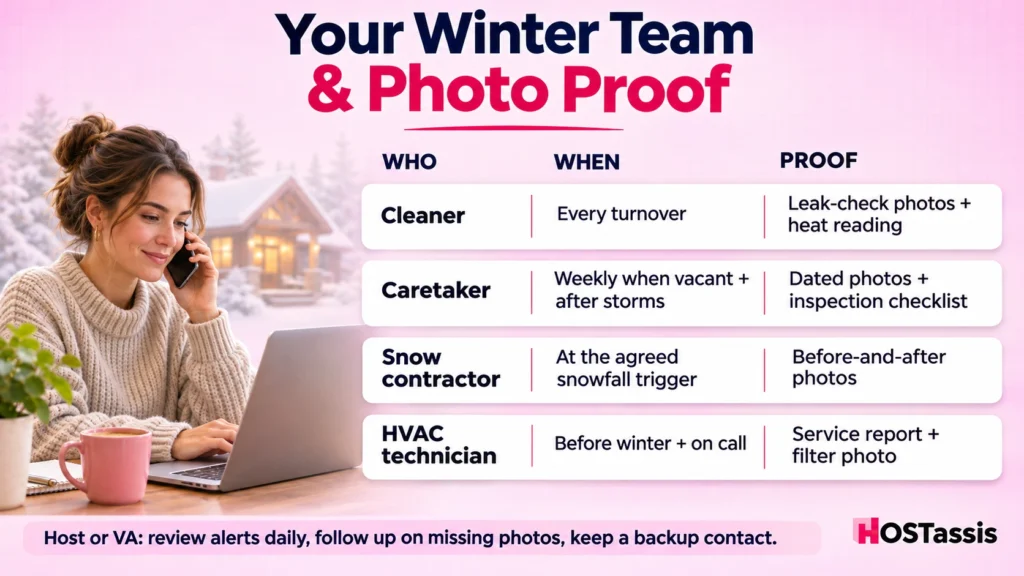
Your local team is your winter safety net. The mistake most remote hosts make is hiring good people with vague instructions. Give each person a fixed task, a fixed frequency and a fixed way to prove it was done.
| Who | Winter job | How often | Proof you should receive |
|---|---|---|---|
| Cleaner | Check under sinks, water heater area and thermostat at every turnover | Every turnover | Photos of each area + thermostat reading |
| Handyman or caretaker | Walk-through during vacant weeks: heat, water, doors, windows, snow | Weekly while vacant, and after every storm | Dated photo set + short checklist |
| Snow contractor | Plow driveway, clear paths, salt steps | When snow passes the agreed trigger | Before/after photos with time stamp |
| HVAC technician | Furnace service and filter change | Once before winter, plus on call | Service report + filter photo |
| Plumber | Emergency response for leaks and frozen pipes | On call | Invoice + photos of the repair |
| You or your virtual assistant | Read alerts, check the forecast, chase missing photos, update guests | Daily | A simple log of alerts and actions |
Keep every vendor’s number, rate and backup in one shared document, and write the steps as written SOPs so a new cleaner can follow them on day one. Give vendors their own lock codes, and give your co-host or assistant only the access they need using Airbnb’s co-host permissions.
This is the part a remote virtual assistant handles well: watching the alerts, booking vendors, collecting photos and following up when something is missed, all from a different time zone.
Tell winter guests what you need from them
Guests can protect your property or undo all your work. A short, friendly message before arrival prevents most problems. Add the same points to your house rules and digital guidebook.
Copy and adapt this template. You can also automate your guest messages so it goes out 3 days before every winter check-in.
Hi [Guest name],
We’re looking forward to hosting you! A few winter notes so your stay is cozy and safe:
– Heat: please keep the thermostat at 60°F or higher, even when you go out.
– Windows: please keep them closed while the heat is on.
– Cold nights: if the forecast drops below [X°F], please let the kitchen tap drip overnight.
– Driveway: snow is cleared by [Company] when it passes [X] inches. Ice melt is by the front door.
– Fireplace: [instructions, or “the fireplace is not available in winter”].
– Water shutoff: in case of a leak, the main valve is [location] (tagged in red).
If anything feels cold, leaks or stops working, message us right away, day or night. We respond 24/7.
Thanks, and enjoy your stay!
[Your name]
The 60°F guest setting sits above your 55°F floor, so a small dip during the day never puts your pipes at risk.
If a pipe freezes or bursts: your escalation plan
When an alert fires at 2 a.m., nobody should be deciding what to do. Agree on this plan with your team before winter, print it inside the utility closet, and save it in your ops folder.
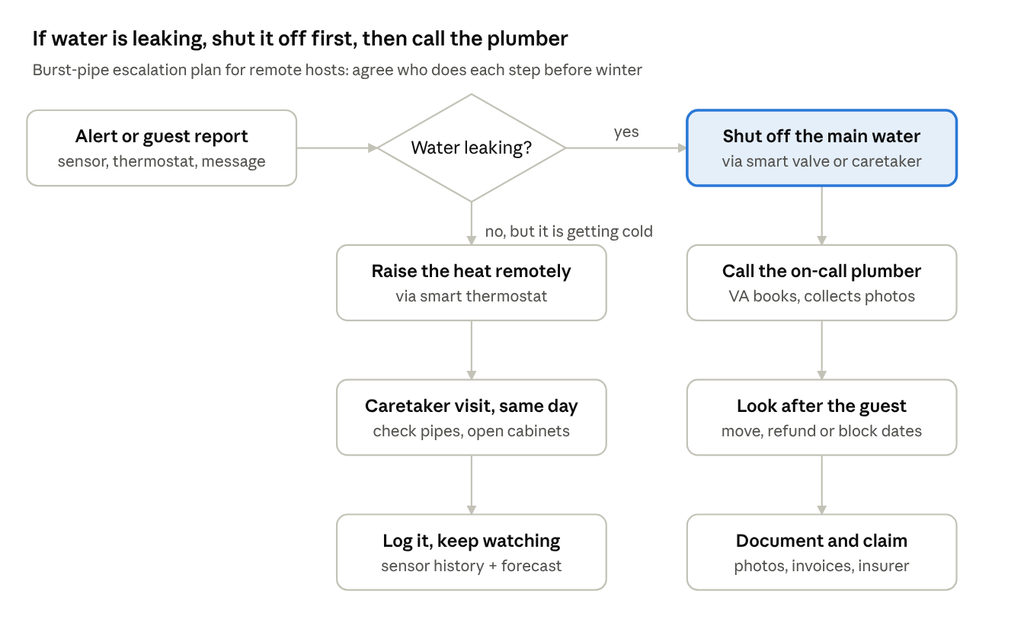
burst-pipe escalation plan · 1 decision, 7 steps
The first minutes decide the size of the bill: stopping the water comes before calling anyone. If the caretaker finds a leak on a cold-weather visit, they jump straight to shutting off the main.
- Stop the water. Close the main valve using a smart shutoff, your caretaker or, if needed, the guest.
- Get the plumber in. Use the on-call plumber from your vendor list, not a random search at midnight.
- Take care of the guest. Offer a move, a partial refund or a cancellation, and block affected dates.
- Document everything. Photos, timestamps, invoices and your thermostat log go to your insurer.
- If it is only getting cold, raise the heat remotely, send the caretaker the same day, and keep watching the sensors.
Insurance and booking notes for winter
- Read your policy’s vacancy terms. Many policies treat a home that sits empty for a long stretch differently, and some require heat to be kept on. Ask your insurer what they need to see, and keep your thermostat logs and vendor photos as proof.
- Short-term rental coverage. A standard homeowner policy may not cover a home rented to guests. Confirm you have a short-term rental or landlord policy that names winter water damage.
- Block dates for big repairs. If a freeze damages the home, block the calendar quickly and contact affected guests. Cancelling as a host has costs, so read our guide to host cancellation penalties before you act.
- Guest-caused damage. If a guest switched off the heat or left a window open, document it right away. Our guide to security deposits explains what you can and cannot charge on Airbnb.
This section is general information, not insurance or legal advice. Check your own policy terms.
Frequently asked questions
How do I winterize an Airbnb I don’t live near?
Set up remote monitoring (smart thermostat, leak and temperature sensors), hire a local handyman for the one-time outdoor shutdown and insulation, and give a caretaker a weekly check-in schedule during vacant weeks. Ask for dated photos after every visit so you can verify the work from anywhere.
What temperature should I keep a vacant rental at in winter?
Keep it at 55°F or higher. That is the minimum State Farm recommends to prevent frozen pipes. In extreme cold, or if your pipes run along outside walls, ask your plumber and insurer whether a higher setting is needed.
Who should check the property in winter?
A local caretaker, handyman or your cleaner, on a fixed schedule: every turnover when booked, weekly when vacant, and after every storm. A remote assistant can track the schedule, read sensor alerts and chase missing reports.
Should I shut off the water in a vacant vacation rental?
For long vacant periods, shutting off the main and draining the lines removes most freeze risk. It also disables fire sprinklers and means someone must restart the system before guests arrive, so plan it with your plumber.
Are noise monitors and cameras allowed on Airbnb?
Outdoor cameras and noise decibel monitors are allowed if you disclose them in the listing before booking. Indoor security cameras are banned in all Airbnb listings.
What should I do if a guest reports a frozen pipe?
Ask the guest to close the main water valve (your welcome message should say where it is), call your on-call plumber, and document everything with photos. Then follow the escalation plan above to handle the guest’s stay and future bookings.
Make winter the season you stop worrying
Winterizing remotely comes down to three things: devices that alert you, local people with clear jobs, and proof that each job was done. Set them up once this month, and every cold snap becomes a quick check of your phone instead of a crisis.
If you would rather not watch the alerts, chase vendors and message guests yourself, that is exactly what our team does. A HOSTassis Airbnb virtual assistant monitors your sensors, schedules cleaners and maintenance, collects photo proof and handles guest messages 24/7, so your rental stays protected while you stay where you are. Also see what’s new for hosts this season in Airbnb’s Fall Update, including the new multi-listing calendar.
Ready to hand off winter? Contact us for a free listing and operations review.