
Your Airbnb business may be losing time and revenue because of operational bottlenecks. Guest communication is a good place to start. Set a clear response-time goal, such as replying to guest messages within 15 minutes, and review your team’s performance every week. If replies are regularly delayed, check the process and find out what is slowing your team down.
Manual pricing can also become a bottleneck. Dynamic pricing tools can adjust nightly rates based on demand, local events, booking lead time, and market changes. This saves you from constantly updating prices by hand and helps you stay competitive.
A digital guidebook can reduce repeated guest questions as well. Guests can scan a QR code to quickly find Wi-Fi details, parking instructions, appliance guides, trash rules, and other useful information.
Let’s talk about how a host can make their Airbnb business run more smoothly and make daily hosting easier.
What Does Slowing Down Your Airbnb Business Mean?
An Airbnb bottleneck is any recurring task, process, or dependency that slows down your daily operations, delays guest service, or prevents your business from growing efficiently.
Guest messaging can become a major bottleneck when you manage 10 or more units, often taking 3–5 hours a day. Cleaning can also cause delays when there are no clear checklists, photo checks, or backup cleaners. Response speed matters too. For example, if fast replies bring 25 bookings from 100 inquiries but a six-hour delay brings only 20, that is 5 more bookings. However, results vary by property, so use a 20–30% improvement as a goal, not a guarantee.
How hidden mistakes hurt your profit
- Lost bookings: When you reply too late, guests may already move on to another property. Slow responses can make you look unreliable and cost you bookings.
- Extra costs: Bottlenecks can lead to last-minute cleaning, urgent repairs, and extra staff costs. These unexpected expenses quickly reduce your profit.
- Empty nights: Calendar errors or strict stay rules can leave empty nights between bookings. These small gaps can quickly reduce your overall income.
- Guest refunds: Problems during a guest’s stay, such as a broken appliance, missed cleaning, or an incorrect access code, can result in a refund. Even small refunds can reduce your profit.
- Lower ratings: Guests often show their disappointment through lower ratings. Too many 4-star reviews can hurt your visibility and lead to fewer bookings over time.
How operational issues hurt guest satisfaction
- Late check-in messages: Late instructions can leave guests confused and worried about how they will access the property.
- Slow replies: When guests wait too long for a reply, they may feel that their questions or concerns are not important.
- Inconsistent cleaning: When a property is not properly cleaned, guests may feel disappointed and question the overall quality of your service.
- Maintenance delays: When AC, Wi-Fi, or other essentials fail, and repairs take too long, guests can quickly become frustrated and uncomfortable.
- Poor team coordination: When your team is not well coordinated, guests may have to report the same issue repeatedly, which can quickly become frustrating.
- Unresolved complaints: A small issue can become a big problem when it is not solved quickly, leaving guests frustrated and more likely to leave a poor review.
How Do Operational Issues Affect Your Airbnb Business?
Operational bottlenecks make it harder to run an Airbnb business smoothly. Slow guest replies, cleaning issues, maintenance delays, and last-minute problems waste time and create extra stress.
As you add more properties, these problems can grow and become harder to manage. Without clear systems and the right support, you may end up working more while your service quality and profit suffer.
- Daily operational issues turn simple tasks into recurring problems, wasting your time and energy instead of helping you grow.
- They slow down daily operations, such as cleaning, maintenance, check-in, and other important tasks.
- Guest messages take longer to answer, which can make guests feel ignored or less important.
- Slow replies and complicated processes can cause you to lose bookings to faster and better-managed competitors.
- Poor cleaning and check-in coordination can make your Airbnb look disorganized, even if the property itself is nice.
- Guests face more problems, such as late access or unresolved issues, which can lower their overall satisfaction.
- These problems can show up in reviews through lower ratings for cleanliness, communication, and the overall stay.
- Poor reviews and slow response times can hurt your Airbnb visibility and make it harder to maintain Superhost status.
- The host becomes responsible for fixing every small problem, leaving less time to focus on business growth.
- As you add more properties, these weak spots also grow. Instead of earning more with less stress, you may end up with more work and more problems.
And this is exactly how bottlenecks hold your Airbnb business back.
14 Airbnb Issues That Can Hurt Your Business
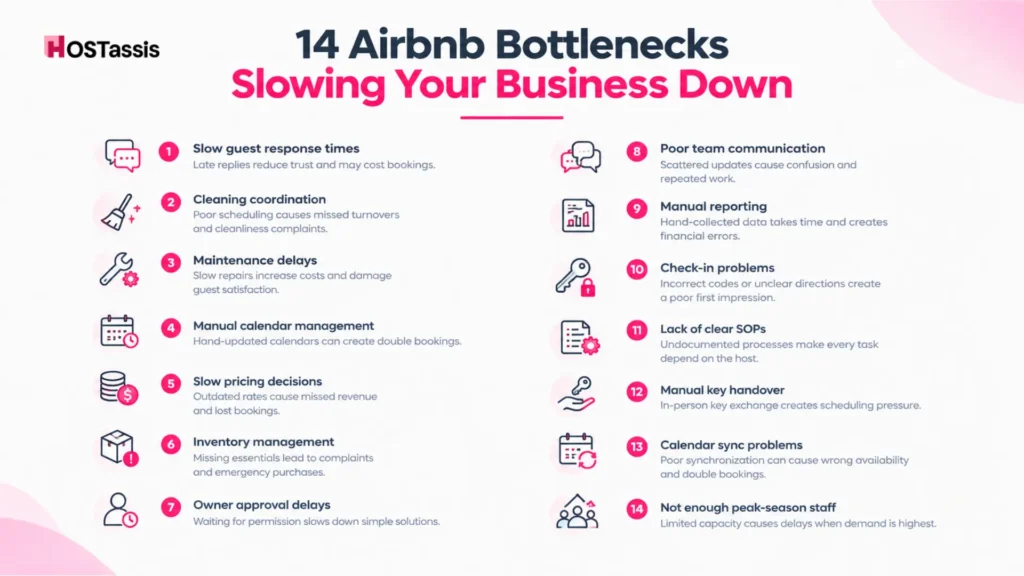
Most Airbnb businesses face similar operational problems. Let’s look at some of the most common ones so you can identify them early and take the right steps to fix them.
1. Slow Guest Response Times
Slow replies will definitely cause you to lose bookings and guest trust. Just put yourself in a guest’s position and think: you are trying to communicate with an Airbnb team, but they are not responding. Would you feel comfortable choosing or booking this Airbnb? It can also make your listing less visible in search.
Moreover, late replies make guests feel unvalued. Using simple message templates for common questions helps you reply quickly, stay consistent, and avoid missing booking opportunities.
2. Cleaning Coordination
Poor coordination in cleaning leads to lower guest satisfaction. Loss of guest satisfaction leads to fewer reservations and lower ratings. It also causes last-minute scheduling, missed turnovers, and late check-ins.
When cleaners, hosts, and guests are not on the same page, a simple stay can become stressful. Inconsistent cleaning quality can also lead to lower cleanliness scores in reviews, which may reduce bookings and search visibility.
3. Maintenance Delays
Maintenance delays can lead to unhappy guests, extra costs, poor reviews, and even lost bookings. Poor maintenance can quickly become a bottleneck when contractors are unavailable, urgent issues are not prioritized, or recurring problems persist. Emergency repairs, such as water leaks, broken locks, or no hot water, can take even longer to address. Because of this bottleneck, guests may have a stressful stay and feel unhappy with the service.
4. Manual Calendar Management
Manual calendar management means the host or team updates booking dates and availability by hand rather than using a system that updates everything automatically.
Manual calendar management is a serious bottleneck, leading to double bookings, blocked dates, channel synchronization issues, and incorrect availability. These mistakes can waste time, cause lost bookings, and create extra work for the host.
5. Pricing Decisions
Airbnb prices often need to change based on demand, season, weekends, local events, and how soon the booking date is. You can’t compete in the market with the same pricing all the time. If you miss changes in demand, pricing decisions can quickly become a bottleneck. As a result, your competitors can easily attract your guests, even your previous guests.
6. Inventory Management
Inventory management can easily become a bottleneck if you are not informed about which supplies your property needs before check-in and which need to be restocked. Some guests will not think twice before complaining or leaving a poor review if they cannot find small but essential things like toilet paper, towels, coffee, soap, or cleaning supplies.
Without regular inventory checks, you should not wait until the check-in date or time to find out what is missing. If you handle everything at the last minute, it will cost you more, and the stress comes for free.
At the same time, you cannot simply overstock everything, as that can create problems such as expired products, limited storage space, and unnecessary costs.
In short, you have to track every single thing that helps your Airbnb business run smoothly and keeps your guests satisfied.
7. Owner Approvals
Guests may encounter various problems during their stay, but if your team needs your approval for every issue, it can cause delays. If you are busy or unavailable, the guest may have to wait longer for a solution, which can lead to frustration and poor reviews.
Small decisions should not always be left to the owner. Delays in refunds, compensation, or repairs can create trust issues and make simple problems worse. Your team should have clear rules for handling common issues without waiting for approval every time.
Your team needs to know exactly what to do when an emergency knocks at the door.
8. Team Communication
Poor team communication becomes a bottleneck when cleaners, maintenance staff, co-hosts, and guest support lack the same information.
When updates are scattered across Airbnb, WhatsApp, email, and other apps, important details can easily get lost. As a result, the team wastes time searching for information instead of solving problems. Unclear communication can also cause duplicate work, such as two team members contacting the same plumber. Even a small misunderstanding, like sharing the wrong check-out time or unit details, can create bigger problems.
In short, poor communication leads to confusion, repeated work, missed updates, and unnecessary delays.
9. Manual Reporting
Manual reporting becomes a bottleneck when you have to collect booking, expense, revenue, and property data by hand. It may work when you manage one or two properties, but it becomes difficult when you manage multiple properties.
You have to log into platforms like Airbnb and Booking.com, collect data, and put everything together. This takes hours and leaves more room for mistakes. Even one wrong number or date can affect the whole report and lead to poor decisions about pricing, expenses, or profit.
Manual reports can also become messy and unorganized, making it difficult to understand how much profit you actually make and where your money goes.
10. Check-In Problems
Check-in gives guests their first impression of the stay, so even a small problem at the door can set their experience off on the wrong foot.
An incorrect code, a hard-to-find lockbox, or a missing key can leave guests standing outside with their luggage and frustrated. Smart locks make check-in easier, but dead batteries, Wi-Fi issues, or incorrect codes can make it difficult. Your team must provide clear instructions about where to go, how to enter, and everything guests need for check-in.
This is especially important for first-time guests, who can easily get confused. To reduce confusion and make check-in smooth, clear instructions are a must.
11. Lack of Clear SOPs
If your team depends on you for instructions every time, daily operations will slow down. Simple written SOPs for guest messages, cleaning, check-in, maintenance, and emergencies help cleaners, VAs, and vendors know what to do without repeatedly asking you.
12. Manual Key Handover
Meeting every guest to hand over keys takes time and can make check-in stressful. Late flights or changing arrival times can make it even harder. Smart locks, lockboxes, or a reliable self-check-in process can make arrivals much easier to manage.
13. Calendar Sync Problems
Listing the same property on Airbnb, Vrbo, and Booking.com means you need to keep availability updated everywhere. Doing this manually can lead to missed updates, wrong availability, or even double bookings. A channel manager keeps your calendars connected and reduces manual work.
14. Not Enough Staff During Peak Season
Busy seasons mean more bookings, turnovers, and maintenance requests. If you depend only on your regular team, they may struggle to keep up. Having backup cleaners and maintenance vendors ready can help you handle busy periods without unnecessary delays.
How to Identify What’s Slowing Down Your Airbnb Business
The easiest way to identify common mistakes is to map every recurring process and look for tasks that repeatedly cause delays, errors, or unnecessary manual work.
Let’s go through step by step:
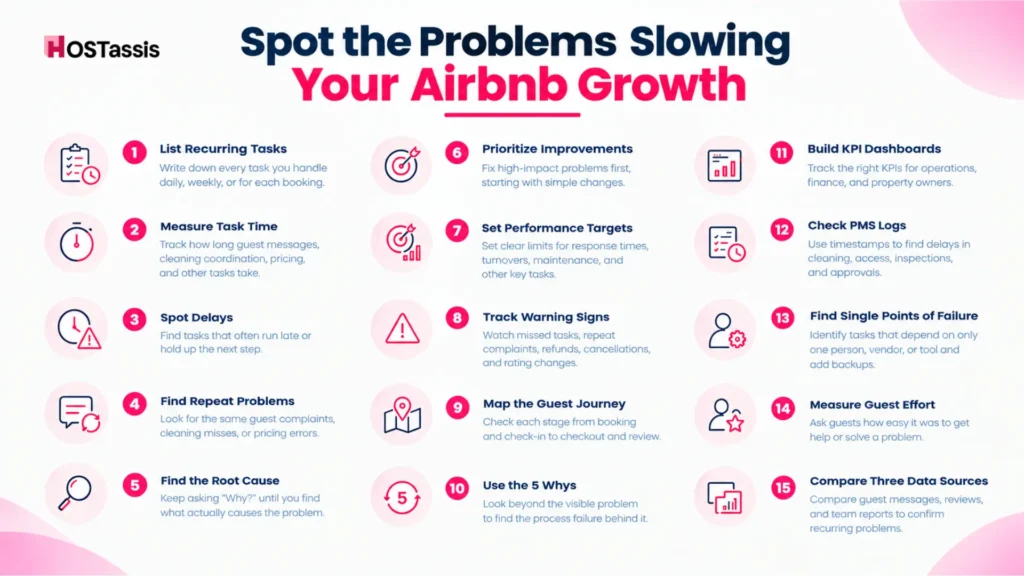
Step 1: List every recurring task
Make a list of every task you handle regularly, such as guest messages, price updates, cleaner coordination, supply restocking, maintenance, calendar updates, and review requests. If the same task comes up with every booking or every week, add it to the list.
Step 2: Measure how long each task takes
For one week, note how much time you spend on each task. You can use a simple timer or write it down as you work. After a few days, it becomes much easier to see which tasks take up most of your time, such as guest messages, coordinating with cleaners, or urgent last-minute problems.
Step 3: Identify delays
Look for tasks that often run late or hold up other work. For example, cleaners may arrive late, maintenance may take too long, or guests may wait too long for a reply. These delays often lead to rushed work, missed tasks, and guest complaints.
Step 4: Find recurring problems
Check your messages, reviews, and team notes to see which problems happen repeatedly. It could be guests asking the same questions about Wi-Fi or parking, cleaners missing the same tasks, or pricing errors on busy dates. When the same issue keeps coming back, it usually means the process needs to be fixed, not just the single problem.
Step 5: Determine root causes
Keep asking “why” until you find the real reason behind the problem. For example: “Why do guests keep asking about check-in?” “Because the instructions are not clear.” “Why are they not clear?” “Because the important details are hidden inside long messages.” The real cause is often something simple, such as unclear instructions or no backup person for urgent issues.
Step 6: Prioritize improvements
Solve each bottleneck based on its priority. Start with simple changes like message templates, a digital welcome guide, check-in reminders, or a shared cleaning checklist with photos. Work on one bottleneck at a time so your team can follow the new process easily and make it part of the daily routine.
Step 7: Set Clear Performance Thresholds
Set a clear target for each important task. For example, flag guest replies that take more than 1 hour, turnovers that take longer than 12 hours, or urgent maintenance issues that are not fixed within 4 hours. These are your own management targets, not Airbnb rules, so adjust them based on your property and the level of service you want to provide. Airbnb also tracks response time and response rate, so quick, consistent replies matter.
Step 8: Track Leading and Lagging Indicators
Problems such as lower ratings, cancellations, refunds, or negative reviews show that something has already gone wrong. Leading indicators help you spot issues before they become serious. Track missed cleaning tasks, common guest complaints, uncovered turnovers, and maintenance requests. For example, several comments about weak Wi-Fi can warn you about a problem before your overall rating drops.
Step 9: Map the Guest Journey
Look at every stage of the guest journey: booking, pre-arrival, check-in, stay, checkout, and review. At each stage, check how long tasks take, what problems occur, and how easy the process is for guests. Pay extra attention when work passes from one person to another, such as from a cleaner to an inspector or from a host to a maintenance vendor. Delays often happen during these handoffs.
Step 10: Use Structured Root-Cause Analysis
When a problem happens, use the 5 Whys to find the real cause. Do not stop at “the cleaner forgot.” Ask why it happened. Was the checklist clear? Did the cleaner have access? Did anyone check the task? Was there a backup plan? This helps you find and fix the actual problem behind the guest complaint.
Step 11: Build Role-Based KPI Dashboards
Create separate dashboards for operations, finance, and property owners. Operations can track response time, turnovers, inspections, and maintenance. Finance can track costs, refunds, and RevPAR, while owners can see occupancy, revenue, ratings, and major risks. Real-time dashboards make it easier to spot problems quickly.
Step 12: Use PMS and Channel-Manager Logs
Your PMS or channel manager can help you find where delays happen. Check times for cleaner assignments, property access, cleaning, inspections, and completed tasks. This makes it easier to see whether the delay comes from access, cleaning, inspection, or approval.
Step 13: Audit Single Points of Failure
Check what could go wrong if a key person, vendor, or tool is unavailable. For example, relying on only one cleaner or one person for all guest messages can cause problems. Have backup staff, shared access, clear procedures, and alternative tools ready.
Step 14: Measure Guest Effort
Ask guests a simple question after their stay: “How easy was it to solve your issue?” They can rate their experience from 1 to 5. If the score starts to drop, it may point to problems in your guest support process that don’t show up in public reviews. This gives you another way to understand how easy or difficult the stay was for your guests.
Step 15: Triangulate Three Data Sources
Do not rely on just one source to understand a problem. Compare guest messages, reviews, and cleaner or maintenance reports. For example, if guests often complain about Wi-Fi, maintenance reports show problems with the same router, and reviews mention it too, you likely have a bigger issue that needs a proper fix.
Signs Your Airbnb Management System Isn’t Working Efficiently
If your business becomes harder to manage as bookings increase, operational issues may be holding back your growth. The sooner you notice the signs, the sooner you can fix the problems. So, let’s look at the most common signs of the Airbnb bottleneck.
- You work longer hours every month.
- Guest messages pile up, and replies get late.
- Cleaning schedules feel stressful and rushed.
- Maintenance issues get missed or fixed too late.
- Reviews mention check-in, cleaning, or supply problems.
- Revenue grows, but your workload grows even faster.
- You cannot take a few days off without problems.
- Your team keeps asking the same questions.
- Small mistakes happen because you are always rushing.
- You keep delaying system improvements.
- More bookings feel stressful instead of exciting.
- You rely on memory instead of checklists.
- Guests keep asking the same basic questions.
- Turnover days feel messy and unorganized.
- Looking at your calendar or numbers feels stressful.
The Airbnb Operations Audit Checklist
Use this checklist to evaluate whether your current operations can support sustainable growth.
Guest Communication
- Response time: Keep the average guest reply time under 15 minutes and reply to at least 90% of messages within 1 hour.
- First-contact resolution: Try to solve at least 70% of guest issues in the first reply, with minimal back-and-forth.
- Guest effort score: After the stay, ask guests, “How easy was it to solve your issue?” Aim for an average score of 4.5/5 or higher.
Cleaning and Turnovers
- Turnover time: Aim to complete most turnovers within 12 hours.
- Photo verification: Ask cleaners to submit the required photos before they mark a cleaning task as complete.
- Inventory levels: Set a minimum stock level for essentials and check supplies before each arrival. Avoid running out of important guest items.
- Operations failure rate: Keep problems such as missed cleaning, late access codes, or maintenance delays below 10% of stays.
Maintenance and Vendors
- Maintenance response: Fix urgent safety issues within 4 hours, comfort-related problems within 48 hours, and small cosmetic issues by the next turnover.
- Backup vendors: Have at least two backup cleaners and two maintenance vendors available for each property.
- Vendor response time: Ask backup cleaners and maintenance vendors to respond to requests within 2 hours.
- Maintenance proof: Ask for before-and-after photos and track how long repairs take. Also watch for the same problem to appear again.
Technology and Distribution
- Channel sync: Keep calendars properly synced across Airbnb, Vrbo, Booking.com, and other channels to prevent double bookings.
- Pricing: Use dynamic pricing and review local events each week. Keep manual price changes to a minimum.
- Process logs: Use your PMS or channel manager to track important steps such as cleaner assignment, property access, checklist completion, and inspection approval.
Financial Control
- Financial dashboard: Keep a monthly profit-and-loss report for each property.
- Core metrics: Track RevPAR, ADR, occupancy, and cost per booking.
- Current data: Use recent financial and operational data to make decisions instead of depending only on weekly reports.
Documentation and Accountability
- SOPs: Create clear written procedures for your 10 most common tasks.
- Onboarding: Aim to train new team members or vendors on basic tasks within two days.
- Clear responsibility: Assign one person to each important KPI, such as guest response time, turnover time, and maintenance response.
- Backup plan: Plan for what happens if an important person, vendor, or tool suddenly becomes unavailable. Have a backup ready.
Quality and Resilience
- Guest ratings: Aim to keep check-in, cleanliness, and communication ratings at 4.9 or higher. If a rating starts to fall, check the process to find out why.
- Cash reserve: Keep around 3–6 months of operating expenses available to help cover slow periods or unexpected costs.
How to Use the Checklist
Mark each item as green, watch, or red. For any red item, check guest messages, reviews, PMS records, and cleaner or maintenance reports to find the real cause. Then decide which problems need attention first based on how often they happen, their effect on revenue or ratings, and how easy they are to fix.
How to Fix Common Airbnb Operational Problems
To remove bottlenecks, simplify workflows, document routine tasks, improve communication, and automate repetitive work when possible. Now, let’s see how you can remove bottlenecks from your business and support smoother growth.
1) Map the real workflow
- Write down the steps you normally follow for a common task. For example: booking confirmed, send check-in details, assign cleaner, restock supplies, inspect the property.
- Look for places where work slows down. This could be when messages wait too long, people ask the same questions again, or someone has to check with another person before moving forward. These are your bottlenecks.
2) Document SOPs in plain language
- Create a simple one-page SOP for every regular task. Include what starts the task, who is responsible, the steps to follow, how to check the work, and who to contact if something goes wrong.
- Keep each instruction short and clear. For example, write: “Send the pre-arrival message at 3 pm the day before check-in,” instead of just saying, “Communicate with guests.”
3) Assign clear ownership
- Give every task to one specific person. Saying “the team” can cause confusion, but naming someone, like “Leo: cleaning lead,” makes it clear who is responsible.
- If a task requires two people, clearly divide the roles. One person does the work, and the other person checks it.
4) Centralize communication
- Keep guest messages, team tasks, and vendor notes in one place, such as a shared inbox or property management tool. This helps prevent important information from getting lost in different chats or emails.
- Use saved replies or message templates for common questions. This helps you reply faster and keeps your answers clear and consistent.
5) Use simple property management software
- Choose tools that keep your calendar, messages, tasks, and payments connected. This saves you from entering the same information repeatedly across different apps.
- Start with the tools that save the most time, such as automated guest messages, cleaner task assignments, and one shared calendar for the whole team.
6) Reduce unnecessary approvals
- Make a list of decisions that still need a manager’s approval. If the risk is low and the rule is clear, add the decision to the SOP so the team can handle it without waiting.
- Keep manager approval only, for important exceptions, such as large refunds, policy changes, or safety issues.
7) Build reliable vendor relationships
- For cleaners, maintenance teams, and restocking staff, set clear response times, ask for photos after the work is done, and keep all communication in one place.
- Have a backup vendor for every important job, so your operations do not stop if your main vendor is unavailable.
8) Review operations monthly
- Once a month, review one workflow and ask what caused delays, what confused the team, and what went wrong. Then update your SOPs and templates based on what you find.
- Remove automations that no longer work well, and add one small automation each month instead of changing too many things at once
Metrics That Reveal Hidden Bottlenecks
The right metrics can show Airbnb hosts exactly where operations are slowing down or repeatedly going wrong. Response times, task completion delays, recurring guest complaints, maintenance frequency, and cleaning issues can reveal bottlenecks before they start affecting more guests.
| Metric | Why It Matters |
| First response time | Measures guest communication efficiency |
| Check-in success rate | Identifies arrival issues |
| Cleaning completion time | Evaluates turnover efficiency |
| Maintenance resolution time | Tracks repair performance |
| Occupancy rate | Measures demand |
| ADR | Indicates pricing performance |
| Review rating | Reflects guest satisfaction |
| Repeat maintenance requests | Identifies recurring issues |
| Average issue resolution time | Measures operational speed |
| Team task completion rate | Evaluates workflow consistency |
How Professional Property Managers Streamline Airbnb Operations
Professional property managers reduce common operational issues by creating repeatable systems, monitoring operational performance, and improving workflows before small issues become major problems.
- Standard Operating Procedures (SOPs): Clear instructions that help your team handle routine tasks the right way without guessing.
- Dedicated operations team: A reliable team that keeps daily work moving and solves problems before they become bigger.
- Trusted vendor network: Dependable cleaners, plumbers, electricians, and other service providers you can call when needed.
- Task management tools: A simple system to assign work, track progress, and make sure nothing gets forgotten.
- Performance tracking: Keep an eye on key metrics, including response time, occupancy, maintenance issues, and team performance.
- Preventive maintenance: Regular property inspections that help catch small issues before they become expensive repairs.
- Quality checks: Routine inspections and checklists to ensure cleaning, maintenance, and guest-ready standards are being met.
- Weekly operations review: A short weekly check-in to discuss problems, pending tasks, and what needs improvement.
- Clear escalation process: Simple guidelines that let the team know what they can handle themselves and when to escalate an issue to someone else.
Frequently Asked Questions
Here are some questions that will help you understand it more clearly
1) What is an Airbnb bottleneck?
A bottleneck is a step in your hosting workflow that slows down work, causes delays, and makes it harder to manage more bookings smoothly.
2) How do I identify operational bottlenecks?
Map the full workflow from booking to checkout, then find where messages, tasks, or approvals get delayed. Those are your bottlenecks.
3) Why do Airbnb businesses stop growing?
Growth slows when manual or unclear processes create delays. As you add more listings, approvals, decisions, and fixes can quickly pile up.
4) Which bottlenecks affect guest reviews the most?
Late or unclear check-in details, slow replies, and cleaning or maintenance problems can hurt reviews the most, especially when teams do not communicate well.
5) How often should I audit my Airbnb operations?
Review one workflow each month to see what caused delays, what went wrong, and what questions kept coming up. Every few months, do a deeper check of your SOPs, automations, and vendor performance.
6) Can automation remove every bottleneck?
No. Automation helps with repetitive tasks like messages, reminders, and task updates. But people-related bottlenecks need clear responsibilities, simple SOPs, fewer approvals, and reliable backup support.
7) Should small Airbnb businesses perform operational audits?
Yes. Small hosts benefit a lot because fixing one bottleneck, like check-in messages or cleaner checklists, can save time and prevent bad reviews.
8) What’s the difference between a workflow problem and a bottleneck?
A workflow problem is any step that does not work well. A bottleneck is the step that slows the whole process, so fixing it yields the biggest improvement.
Conclusion
Bottlenecks (those mistakes that slow down an Airbnb business) are a normal part of running an Airbnb business, especially as bookings, properties, and daily responsibilities grow. The important thing is to spot them early, before they cause delays, put pressure on your team, or affect the guest experience.
Review how work moves from booking to checkout, create simple SOPs for repeat tasks, and keep messages and task updates in one place. Track a few key performance metrics so you can quickly see where problems are occurring. Stronger systems reduce confusion, save time, and make business growth feel much easier to manage. A professional co-hosting team can keep your Airbnb operations running smoothly.