Cleaning fees more than 25-50% of your average nightly rate or more than one night’s stay are too high and deter short term bookings.
Cleaning, laundry, and restocking in between guests are covered by this one-time fee that you, not Airbnb, set. Because they utilize the space, guests are responsible for paying the turnover cost rather than the nightly rate. It’s also not a hidden bonus. Before making a reservation, guests can see the total cost. However, if it’s too steep, people will skip your listing, one or two nite stays appear to be a bad deal, and your search ranking may decline.
How Much Should You Charge for an Airbnb Cleaning Fee?
The majority of people simply copy the $161 to $188 US average. Don’t. The size of your space, the true cost of a turnover, and the prices that local hosts are charging should all be taken into account. According to Airbnb, charging too much can turn away customers and reduce your profits, so a reasonable amount is important.
Prior to selecting a number, check these:
- Size: It’s simple to clean a studio. There’s no four bedrooms in it. Let the price show it.
- Real cost: Sum all the money you have to pay to clean, laundry, and replenish the soap, toilet paper, and other things. Charge it almost with that sum.
- Neighbors: Look at similar homes in the area. It will be evident to visitors that they are well above them.
- Short stays: For a trip lasting one or two nights, a substantial fee is costly. Keep it modest next to your nightly rate.
- Grand total: Buyers are more interested and concerned about this than the charge. Make sure that the amount is right before confirming payment.
- Sparkling Arrival: No complaints of clients when the organization is spotless.
What Is an Airbnb Cleaning Fee Actually Supposed to Cover?
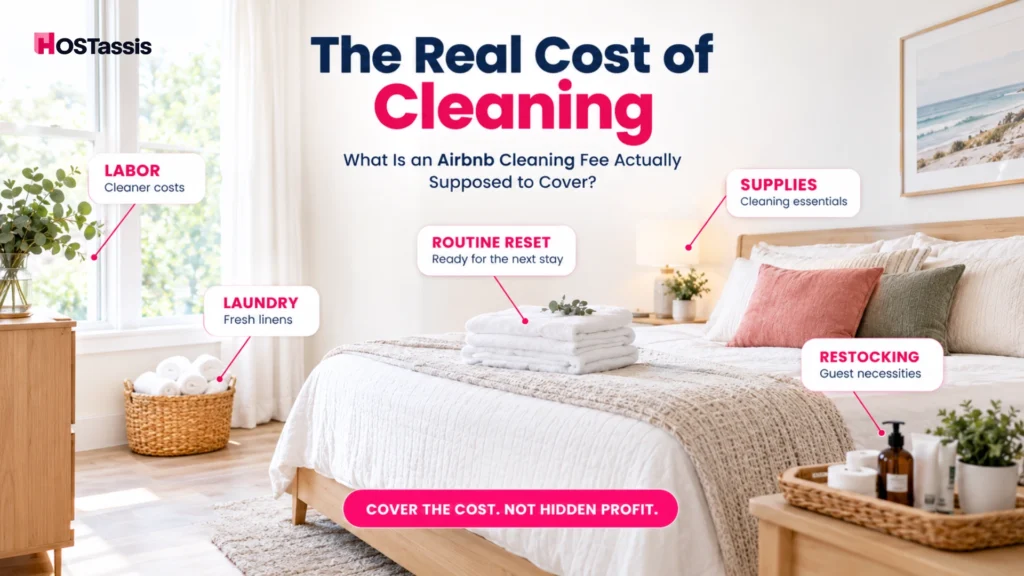
An Airbnb cleaning fee is a one-time charge the host adds to cover the cost of cleaning and resetting the property between guests.
It should cover:
- Cleaner labor
- Laundry and linen handling
- Cleaning supplies
- Items restocked at turnover
- Normal housekeeping after a stay
Airbnb calls it a fee for covering their anticipated housekeeping costs. It is not presented as an additional source of income. So add up your expected turnover costs and this will be your starting point.
What It Should Not Become
Avoid using the fee as:
- Hidden extra profit
- An automatic damage charge
- A penalty for guests who leave a mess
- A fix for a weak nightly rate
Damage claims go through their own process. Folding them into the cleaning fee only makes your total look padded.
When is an Airbnb Cleaning Fee Too High?
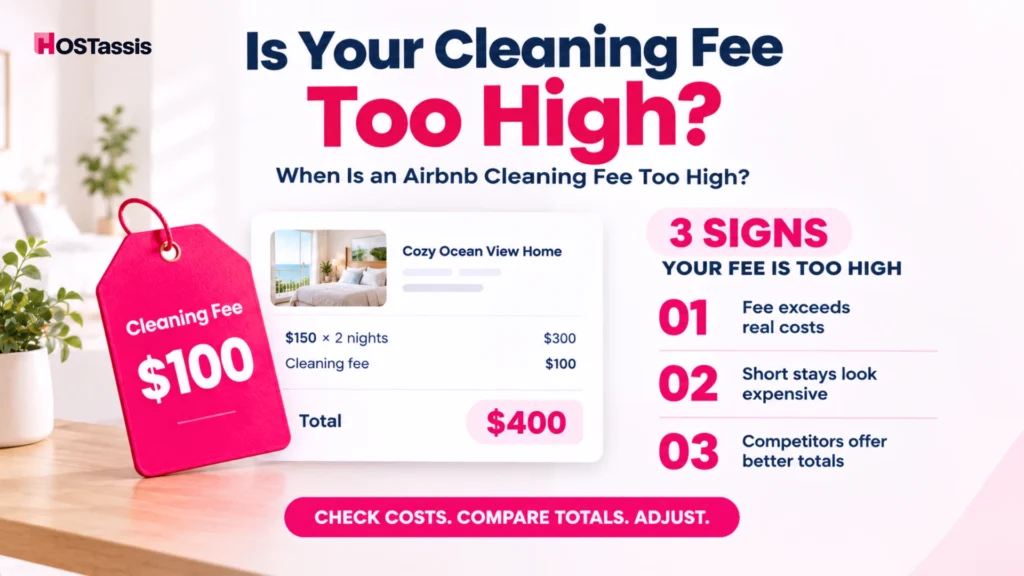
Three signs your fee is too high: it costs guests more than the turnover costs you, it makes short bookings look overpriced, or it runs well above comparable listings in your area.
Plenty of hosts search for “airbnb cleaning fee too high” hoping for a figure. None exists. What you can do is test your own fee against the market, your stay lengths, and your actual costs.
Test 1: The Guest’s Total Price
Add the nightly rate, cleaning fee, and taxes. Then set that total next to similar listings for the same dates.
- Is your total clearly above comparable homes?
- Is the cleaning fee the main reason?
If both answers are yes, the fee needs a second look.
Test 2: The Length of Stay
A $120 cleaning fee lands differently depending on the booking.
- 1 night: heavy
- 2 nights: still noticeable
- 5 nights: much easier to absorb
- 10 nights: hardly noticed
A fee that suits your longer bookings can be a real obstacle for the short ones.
Test 3: Your Real Turnover Cost
Suppose a turnover costs you $80 and you charge $180 without a solid reason. Guests will notice the gap even if they never mention it. Review how the whole price is built before you assume they’ll accept it. Most people don’t mind paying for the work. They mind paying for padding.
Why Cleaning Fees Hurt Short Stays More Than Long Stays
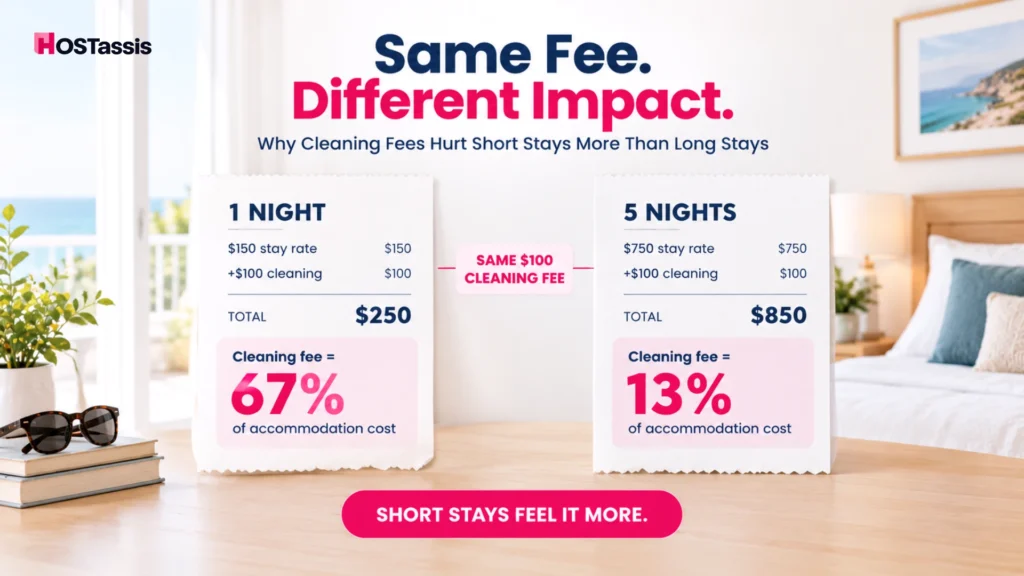
Hosts usually charge the cleaning fee once per reservation, so a one-night guest pays the same amount as someone staying ten nights. That makes the fee feel much larger on short trips and is why the average Airbnb cleaning fee says little on its own.
Take a nightly rate of $150 and a cleaning fee of $100.
One-Night Stay vs. Five-Night Stay
| Metric / Stay Length | One-Night Stay | Five-Night Stay |
| Accommodation Rate | $150 | $750 |
| Cleaning Fee (Flat rate) | $100 | $100 |
| Total Guest Cost | $250 | $850 |
| Fee as % of Accommodation | 67% | 13% |
| Effective Nightly Cost to Guest | $250 / night | $170 / night |
The dollar amount is identical in both columns, yet the one-night guest sees a fee worth two-thirds of the room price. A lake house booked for a week and a city studio booked for a weekend can’t sensibly share the same logic. If most of your reservations run one or two nights, your fee deserves closer attention than a host with mostly week-long guests.
Should You Use Airbnb’s Short-Stay Cleaning Fee?
Currently Airbnb allows hosts to charge lower cleaning fee for 1- and 2-night stays, but charge the standard cleaning fee for stays of 3 nights or more. The Airbnb short stay cleaning fee is most effective when short stays are a significant part of your demand.
It can help with:
- Weekend bookings
- City apartments
- Properties with frequent 1 to 2 night demand
- Small gaps between reservations
A guest planning two nights sees a friendlier total, and you may pick up dates that would otherwise sit empty.
When It May Not Work
If your cleaner charges the same amount whatever the length of stay, a lower fee for short bookings means you pay the difference. You would need to recover it through the nightly rate. Check your margins before turning it on. A booking that costs you money on every turnover isn’t worth winning.
Airbnb Cleaning Fee vs. Nightly Rate: Should You Bundle the Cost?

Whether you should incorporate the cleaning fee into your nightly rate depends primarily on how long your guests are staying and what the booking market in your area is like.
When hosts compare the value of the Airbnb cleaning fee vs nightly rate they often look at the wrong number, here are three common variations and what they should be looking at.
Model 1: Separate Cleaning Fee
Example: $180 per night + $90 cleaning.
- Suits longer average stays
- Suits properties with a high turnover cost
- Suits markets where guests expect a separate fee
Model 2: Higher Nightly Rate With a Lower Cleaning Fee
Example: $195 per night + $45 cleaning.
- Short stays can look more appealing
- The fee at checkout looks small
Model 3: No Separate Cleaning Fee
The cost sits inside the nightly price. Example: $225 per night, no fee.
- Fits high nightly rates
- Fits hotel-style stays
- Fits properties built around short bookings
Here is how the guest total moves with stay length.
Vacation Rental Pricing Model Comparison
| Stay Length | Model 1: $180 Base + $90 Cleaning | Model 2: $195 Base + $45 Cleaning | Model 3: $225 Flat (No Cleaning Fee) |
| 1 Night | $270 | $240 | $225 (Most competitive) |
| 2 Nights | $450 | $435 (Most competitive) | $450 |
| 5 Nights | $990 (Most competitive) | $1,020 | $1,125 |
Folding everything into the nightly rate looks best at one night and worst at five. Still, none of these models wins in every case. Compare the guest’s final price and your net revenue before you choose.
Don’t Compare Cleaning Fees. Compare Total Stay Prices.
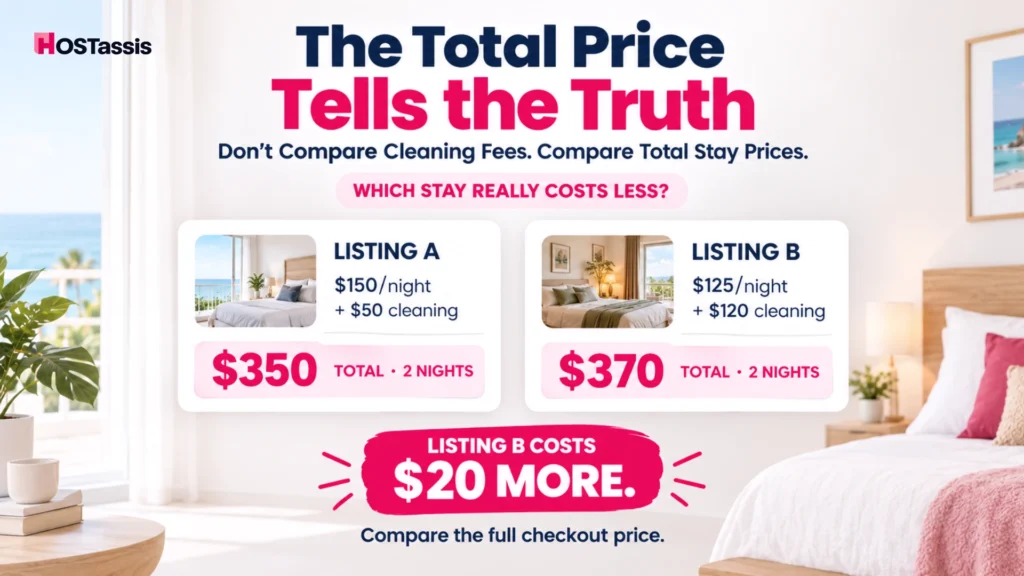
Compare the total price at checkout, not the nightly rate or cleaning fee on their own. That total includes the nightly rate, cleaning fee, service fees and taxes.
Take two competitors for a two-night stay.
| Metric / Detail | Competitor A | Competitor B |
| Nightly Rate | $150 | $125 |
| Nights | 2 | 2 |
| Accommodation Subtotal | $300 | $250 |
| Cleaning Fee | $50 | $120 |
| Guest Total | $350 (Lower overall cost) | $370 |
| Cleaning Fee % of Total | 14.3% | 32.4% |
On a nightly rate alone, B looks cheaper. On cleaning fee alone, A looks like the better deal. The total settles it, and A costs the guest $20 less.
At HOSTassis, this is how we approach a host’s pricing. We don’t judge the cleaning fee or the nightly rate in isolation. We build the full stay price for 1, 2, 3, 5, and 7 nights, then line it up against the listings guests are actually choosing between. Checking only one of the two numbers is a common blindness.
Airbnb also asks hosts to check overall prices and compare their offer with similar listings in the vicinity. It takes only about ten minutes and often tells you more than just the amount on one of the fees.
Can a High Cleaning Fee Reduce Airbnb Bookings?
Indeed, a high cleaning fee raises the guest’s overall cost, making other listings appear more affordable, particularly for short stays. Your ranking won’t automatically decline as a result. According to its cleaning fees article, Airbnb ranks based on both overall cost and quality.
Airbnb says total price and listing quality, measured against similar nearby properties, are important for search competitiveness. The effect on your bookings is indirect but real.
- A higher total can lead to fewer clicks
- Fewer clicks can lead to fewer bookings
- Short stays tend to feel it first
Treat the fee as one part of your overall price. For more on how search works, read our guide to Airbnb Search Algorithm Explained.
How Cleaning Fees Change Guest Expectations
A visible cleaning charge raises what guests expect to find. Airbnb says guests may look more closely at cleanliness when a separate fee is charged, so small misses can show up in your reviews.
Guests may reasonably expect:
- Spotless bathrooms
- Clean floors
- Fresh linen
- No obvious dust
- A clean kitchen
- A property that has been properly reset
One overlooked detail, such as a hair in the shower, can end up in a review. The larger the fee, the less patience guests tend to have.
Avoid the “High Fee + Long Chore List” Problem
Charging a large professional cleaning fee and then asking guests to strip beds, run the dishwasher, and take out every bin feels like paying twice. Keep checkout requests short and simple.
A Simple Airbnb Cleaning Fee Formula
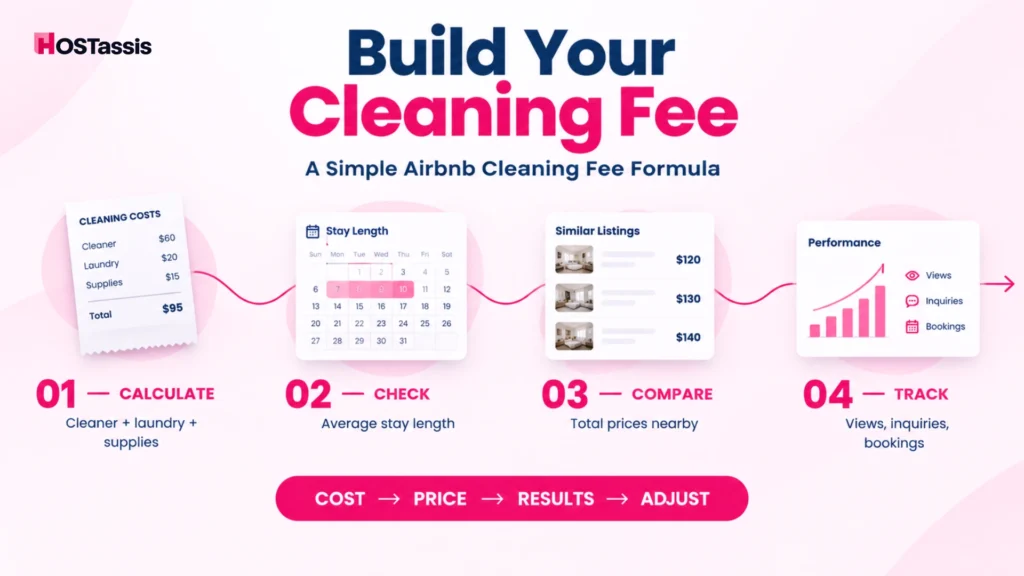
A Simple Formula for Setting Your Airbnb Cleaning Fee
Set a cleaning fee you can defend with real numbers. Work through these four steps:
Step 1: Find your true turnover cost.
Add up what each turnover actually costs you:
- Cleaner’s fee
- Laundry
- Restocked supplies
The total is your base cleaning cost.
Step 2: Look at your average length of stay.
Check your booking history to see how long your guests typically stay. A flat fee is the hardest to hit. For example, a $90 cleaning fee is easy to overlook on a seven nite stay, but can look like a second room rate on a single nite. If most of your visitors are only staying one or two nites then your fee needs a closer look.
Step 3: Compare total prices.
Calculate what a guest pays in total for 1, 2, 3, 5 and 7 nights, then conduct the same searches on similar listings in the area. Guests don’t care how the price breaks down, rarely. They look at the final number at checkout, and compare that. A low nightly rate and a high cleaning fee can still seem expensive compared to an all-in price from a competitor.
Step 4: Watch how bookings respond.
When you set or change the fee, give it a few weeks and watch your views, inquiries and bookings increase. Change one thing at the time. If you find your total cost is higher than the competition most of the time and your bookings are slow, try one of two fixes. Either reduce the fee, or factor some of the cost into your nightly rate so short stays feel cheaper.
The Formula
Cleaning Fee Ratio = Cleaning Fee ÷ Accommodation Revenue × 100
Say you charge a $100 fee on a three-night stay at $120 a night. That is $100 ÷ $360 × 100, or about 28%. A very high ratio on short stays can put guests off. There is no perfect ratio for every host. Use it to compare stay lengths and competitors, not as a target you have to hit.
Example: Choosing Between a $60, $100, or $150 Cleaning Fee
Say your nightly rate is $175 and a turnover costs you $100. A $60 fee improves your price, $100 covers your cost, and $150 adds margin but may hurt competitiveness. Your booking results should decide.
| Cleaning Fee | 1-Night Total | 2-Night Total | 2-Night Fee Ratio | What It Means for You |
| $60 | $235 | $410 | 17% | Best guest-facing price. You cover $40 of turnover cost (assuming $100 baseline cost). |
| $100 | $275 | $450 | 29% | Full cost recovery. Recovers your direct turnover cost in full without taking a margin hit. |
| $150 | $325 | $500 | 43% | Margin enhancement. Adds $50 of profit margin but creates price friction that may hurt short-stay bookings. |
The question to ask is whether that extra $50 brings in more than the bookings it may push away. If it doesn’t, the higher fee is quietly costing you money.
When Should You Lower Your Airbnb Cleaning Fee?
Lower your fee when several signs point the same way, not after one slow month. Weak short-stay conversion and totals well above competitors are the clearest signals. Look at them together before you act.
Possible signs:
- Weak conversion on 1- to 2-night stays
- Competitors with much lower total prices
- Calendar gaps that stay empty
- Guests mentioning fees or value in messages or reviews
- A drop in your cleaner’s rate
- A nightly rate that can absorb some turnover cost
- A fee that looks large next to short-stay room revenue
One sign alone proves little, while three or four together justify a change. The cleaning fee is also not always the cause. Photos, reviews, season, and nightly rate all play a part, so look at the whole listing before changing a single number.
When Should You Raise Your Cleaning Fee?
Raise your fee when your actual costs have climbed past what it covers. Compare the new total with similar listings first, so a reasonable correction doesn’t turn into lost bookings.
Consider a review when:
- Cleaner rates rise noticeably
- Laundry costs go up
- The property grows or gains rooms
- Turnover cost regularly exceeds the fee
- Inflation has left the fee out of date
When you pay more than you collect, the shortfall eats into your profit every month. Before raising anything, add the new fee, run total prices for a few stay lengths, and see where you land. A small, well-reasoned increase usually holds up. A large jump with nothing changed at the property is much harder to justify.
6 Airbnb Cleaning Fee Mistakes to Avoid
Most cleaning fee mistakes come from copying, guessing, or setting a number once and never looking at it again. These six are the ones that show up most often, and each is easy to correct.
- Copying another host’s fee without comparing property size
- Ignoring average stay length
- Pricing from cleaner cost alone
- Comparing nightly rates instead of total price
- Treating the fee as guaranteed extra profit
- Setting it once and never testing it again
A three-bedroom house and a studio shouldn’t share a fee just because they sit on the same street. A number that worked last year may also be wrong for this year’s costs and demand.
How Often Should You Review Your Cleaning Fee?
Check your fee when something important occurs, not on a weekly basis. It needs to remain steady long enough to observe its influence on bookings and revenue. Change one item at once and be firm in your reasoning.
Good moments to review:
- Your cleaner contract changes
- Your average stay length shifts
- Occupancy drops
- Market pricing moves
- You change minimum-stay rules
- A peak or slow season begins
Constant tweaking makes it impossible to tell what worked. Set a number, give it a few weeks, and read the results before you touch it again.
Airbnb Cleaning Fee FAQs
What Is the Average Airbnb Cleaning Fee?
The average airbnb cleaning fee varies widely by market, property size, and property type, so a single figure isn’t worth copying. A local set of comparable listings gives you a far more useful benchmark than any worldwide average.
Does Airbnb Charge a Service Fee on the Cleaning Fee?
Airbnb’s service fee calculation can include host-set fees such as the cleaning fee. Look at your net payout instead of what the guest pays. See Airbnb Service Fee Changes in 2026 for details.
Can I Charge Different Cleaning Fees for Short Stays?
Yes. Airbnb currently lets hosts offer a lower fee for 1 to 2 night stays while keeping the standard fee for longer ones.
Should the Cleaning Fee Equal What I Pay My Cleaner?
Not necessarily. Your cleaner’s rate is a sensible starting point, but laundry, supplies, and other routine turnover costs may belong in the number as well.
Is It Better to Have No Cleaning Fee on Airbnb?
Not always. The answer depends on your nightly rate, turnover cost, average stay, competitors, and the final price the guest pays.
Does a Higher Cleaning Fee Hurt Airbnb Ranking?
Not automatically. A higher fee does raise the total price, though, and that can make you less competitive against similar homes.
Is the Cleaning Fee Refundable if an Airbnb Guest Cancels?
It depends on Airbnb’s cancellation rules and the timing of the cancellation. Read Airbnb Cancellation Policy for Hosts in 2026 for the full picture.
Final Airbnb Cleaning Fee Strategy
A sound airbnb cleaning fee strategy works as a loop: know your cost, test different stay lengths, compare total prices, watch the results, and adjust only when the numbers support a change.
Know your actual turnover cost
→ Test the fee across different stay lengths
→ Compare total guest price with competitors
→ Measure booking performance
→ Adjust only when the numbers justify it
The right Airbnb cleaning fee is not the highest amount guests will tolerate. It is the amount that helps cover your turnover costs while keeping the total stay price competitive.
If tracking prices, cleaners, and competitors takes more time than you have, HOSTassis can help. Our team supports pricing, cleaning coordination, and guest communication so you can spend your time growing your rental. Book a free STR strategy call.