
Cancellation policy isn’t just about being strict or flexible; it is also about how quickly a guest can rebook after a cancellation. For example, a city apartment that gets many last-minute bookings should use Airbnb’s Flexible Cancellation policy. In contrast, a large holiday house that is usually booked a year ahead should use the Firm Cancellation policy. Airbnb offers four cancellation policies: Flexible, Moderate, Limited, and Firm.
Before deciding on the type of policy to use, think about the type of property, where it is located, your peak and off-season, the type of guests that are most suited to your property, and how long it takes you to reschedule any canceled reservations. Most guests prefer a no-cancellation-charge policy when booking.
Let’s explore all types of Airbnb cancellation policies in detail.
What is Airbnb’s Cancellation Policy
An Airbnb cancellation policy describes how a guest will be charged if they cancel their reservation. It tells the guest whether they will receive a full refund or only part of it and shows what percentage of the total amount paid goes to the host. A cancellation policy is chosen by a host for a particular listing; therefore, it differs depending on the reservation policy and timing of the guest’s cancellation.
The system uses an automatic cancellation policy when a guest cancels a reservation. Before canceling, the guest will see how much money they will be refunded. Usually, the host’s confirmation is not required. When the guest’s reservation qualifies for a refund, the system applies it based on the cancellation policy. Sometimes, the system refunds taxes and fees separately from the accommodation total.
Which Airbnb Cancellation Policies Are Available in 2026?
Flexible, Moderate, Limited, and Firm are the four categories of cancellation policy options for an Airbnb stay less than 28 nights in 2026. Flexibility means guests will receive a refund for cancellation at least 24 hours before check-in; Moderate for 5 days; Limited for 14 days; and Firm for 30 days before check-in.
A 24-hour cancellation policy is applicable on eligible bookings that are made 7 days or more before check-in date. Though a flexible cancellation policy may help you attract many customers, you have very little time to make another booking. The limited and firm policies earn more revenues and may be appropriate for a seasonal house, big houses, and hard-to-book days.
Airbnb Cancellation Policy Comparison Table
Airbnb offers four standard cancellation policies: Flexible, Moderate, Limited, and Firm. Flexible gives guests the most freedom to cancel, while Limited and Firm protect hosts more if guests cancel close to check-in. All four also include Airbnb’s 24-hour free-cancellation window after booking.
Let’s take a look at the table below for a quick comparison of Airbnb’s cancellation policies.
| Policy | Full Refund Until | After Main Refund Window | Host Protection |
| Flexible | 24 hours before check-in | Host generally receives nights stayed + 1 additional night | Lowest |
| Moderate | 5 days before check-in | Nights stayed + 1 additional night + 50% of remaining unused nights | Medium |
| Limited | 14 days before check-in | 7–14 days: 50%; under 7 days: 100% of nights | Medium-High |
| Firm | 30 days before check-in | 7–30 days: 50%; under 7 days: 100% of nights | Highest standard option |
Note: All four standard policies are subject to Airbnb’s qualifying 24-hour free-cancellation period after booking.
Which Airbnb Cancellation Policy Fits Your Property?
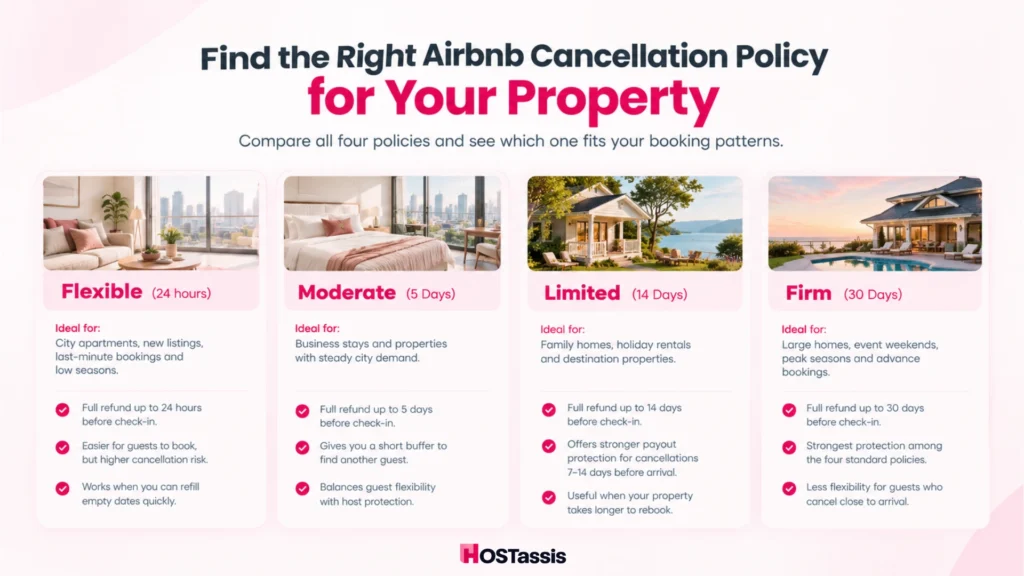
The best Airbnb cancellation policy depends on how easily you can refill a canceled date and how much flexibility you want to offer your guests. Flexible can work well if last-minute cancellations or bookings are frequent, while Moderate gives you more time to rebook. Limited is probably suitable for properties that are difficult to refill each year and require about two weeks between cancellations. A firm is ideal if it is hard to find substitutes for late cancellations.
Choose Flexible When Cancelled Dates Are Easy to Refill
Flexible policies are most beneficial when a replacement booking is likely to be found close to the arrival date, and guest-friendly policies are implemented to attract more visitors. Guests will always receive a full refund of the amount paid up to 24 hours before arrival, so they can decide without risking a loss.
The main downside is that you may lose more revenue from canceled bookings. One day before arrival may not be enough time to accommodate a new booking. Flexibility works best for city accommodations, where many guests are likely to change their travel plans. It also helps when demand is consistent, during the low season, or when the property hasn’t been booked yet and needs more reviews.
Choose Moderate When You Need a Short Rebooking Buffer
The Moderate plan offers guests a full refund if they cancel with at least five days’ notice before arrival. For hosts, this means that five days is enough time to re-open the dates, adjust the price if needed, and find another guest.
This plan is ideal for city stays, business trips, or any other listing where guests commonly book close to the arrival date. Compared with the Flexible policy, the Moderate plan offers guests flexibility and protects hosts from ‘last-minute’ cancellations.
For cancellations made outside the grace period, the host is guaranteed reimbursement for nights already stayed, one additional night, and 50% of the value of the remaining nights. The payout depends on the specific reservation and Airbnb’s policies.
Moderate is the preferred option when five days is enough to find another guest for the canceled dates. Hosts that frequently have vacant dates should consider a more protective plan.
Choose Limited When Two Weeks Is Your Real Rebooking Window
Limited is for hosts who need a longer cancellation period than a few days but still want to refund guests. It applies to eligible reservations booked from October 1, 2025, and requires a full refund if canceled 14 or more days before check-in.
Moreover, hosts are protected by even stronger terms as the arrival date approaches. If canceled 7-14 days before check-in, guests will pay 50% of the accommodation cost for the canceled nights. Moreover, if canceled less than 7 days before arrival, hosts will receive 100% of the nights canceled, depending on the terms set by Airbnb.
Limited flexibility is recommended for family homes, large homes or apartments, holiday homes or destination residences, and properties that are usually rented out for a longer stay in advance. They give you a better chance of finding another guest if the first guest cancels their reservation at the last minute.
The main question is whether your place is likely to be booked again within two weeks if someone cancels their reservation. If two weeks is enough to find a new guest, Limited cancellation protection is right for you.
Choose Firm When Late Cancellations Are Hard to Replace
Limited is for hosts who need a longer cancellation period than a few days but still want to refund guests. It applies to eligible reservations booked from October 1, 2025, and requires a full refund if canceled 14 or more days before check-in.
Moreover, hosts are protected by even stronger terms as the arrival date approaches. If guests cancel 7-14 days before check-in, they will pay 50% of the accommodation cost for the canceled nights. Moreover, if canceled less than 7 days before arrival, hosts will receive 100% of the nights canceled, depending on the terms set by Airbnb.
Limited flexibility is recommended for family homes, large homes or apartments, holiday homes or destination residences, and properties that are usually rented out for a longer stay in advance. This gives you a better chance of finding another guest if the first guest cancels at the last minute.
The Same Booking Under All 4 Policies: A Scenario Test
The easiest way to understand Airbnb’s cancellation policy is to review it on the same booking. For example, consider a hypothetical booking: 5 nights at $250 per night, for a total of $1,250, and try to cancel it under different terms. The figures below are for illustration only and do not include taxes or platform fees.
To understand how the cancellation policy works, let’s imagine one fictional reservation.
- 5 × $250 per night = $1,250
- Taxes, cleaning fee, and platform fees are excluded.
- These figures are provided for illustrative purposes only.
The actual payout may significantly differ depending on a particular reservation’s terms and conditions set by Airbnb.
Scenario A: Guest Cancels 40 Days Before Arrival
At this stage, the guest is still within the full-refund period for all four policies.
- Flexible: Host receives $0.
- Moderate: Host receives $0.
- Limited: Host receives $0.
- Firm: Host receives $0.
The guest receives a full refund. You keep no accommodation payment, so your income depends on whether you can rebook the dates.
Scenario B: Guest Cancels 20 Days Before Arrival
The firm begins to provide protection, while the other policies may still allow a full refund.
- Flexible: Host receives $0.
- Moderate: Host receives $0.
- Limited: Host receives $0.
- Firm: Host receives about $625, or 50% of the $1,250 accommodation amount.
Scenario C: Guest Cancels 10 Days Before Arrival
Limited and Firm now offer partial protection.
- Flexible: Host receives $0.
- Moderate: Host receives $0.
- Limited: Host receives about $625.
- Firm: Host receives about $625.
With Limited, the guest cancels 7 to 14 days before check-in, while with Firm, they cancel within the 7- to 30-day period. In both cases, the host generally receives about 50% for the unused nights.
Scenario D: Guest Cancels 4 Days Before Arrival
- Flexible: Offers the least protection and may reimburse only the nights covered by its formula.
- Moderate: Offers partial protection with an additional night or 50% reimbursement for other unutilized nights.
- Limited: The host earns about $1250, or 100% of the unused accommodation.
- Firm: Host earns about $1250 or 100% of the unused accommodation.
These examples exclude taxes and fees, and reimbursements can vary.
The key is to decide whether the extra protection is worth the loss of flexibility for your guests. Flexibility could be a good choice if you rent out a city apartment where it’s easy to accommodate new guests, while a firm might suit a large house rental.
Does Every Airbnb Booking Have a 24-Hour Free Cancellation Period?
Not all Airbnb cancellations have the same conditions. However, most short-stay cancellations follow a 24-hour cancellation policy. This policy means that you will receive a full refund when the guest cancels a stay 24 hours after the booking has been made. However, the guest must book the accommodation at least 7 days before the check-in date.
24-hour cancellation periods apply to all four default policies: flexible, moderate, limited, and firm policies. For example, if someone cancels 20 days before the check-out date, the 24-hour cancellation period will apply. However, if a person booked 2 or 3 days out, this period likely won’t apply because they booked less than a week before check-in. Local time is used when a listing is in another time zone, which is helpful for people who have listings and guests in different time zones.
This 24-hour period is separate from the listing’s cancellation policy. After this period expires, the refund policy (Flexible, Moderate, Limited, or Firm) takes effect.
Airbnb added this rule in their October 2025 updates. Some reservations require guests to contact the host directly to cancel; for example, long-term or local holiday stays may be subject to cancellation policies based on local laws. Therefore, it is best to double-check the terms when booking.
What Happened to Airbnb’s Strict Cancellation Policy?
Airbnb’s Strict policy is no longer one of the four standard cancellation options for most hosts and short-term guests. The current options are Flexible, Moderate, Limited, and Firm.
However, that doesn’t mean Strict policies are gone. Airbnb still lists Strict, Super Strict 30, and Super Strict 60 policies for some hosts who are invited to or have access to them. Strict policies are only available through invitations to a few hosts and are not found on most hosts’ cancellation policy menus.
Older listings or reservations may also have a Strict policy. To avoid confusion, check the cancellation policy for a specific reservation rather than rely on the policy name.
Most hosts select one of the following cancellation policy options: Flexible, Moderate, Limited, or Firm. Only some hosts have access to Strict cancellation policies, such as those who have been invited or granted access.
For those hosts, Strict policies are more likely to be found in their cancellation policy options. Overall, hosts encounter the Strict option less often than before, but it is still available for those who meet the requirements.
Can You Use Different Airbnb Cancellation Policies for Peak and Slow Dates?
Yes, Airbnb lets hosts set different stay cancellation policies for specific dates using their calendar. This feature lets you assign different rules to the same place within one booking and cancel based on the conditions set for your stay period. Moreover, hosts should understand that for periods with different policies, only the one corresponding to the day of arrival is applied.
For example, if you have fewer guests in February, say, in the middle of the month, you can set a Flexible or Moderate cancellation policy for this period. This way, you’ll attract more customers, since it’s easier for them to cancel if something goes wrong. It is a great option for low season, especially when it is difficult to reach an agreement with potential clients.
In contrast, the high season requires a more careful approach. If guests know in advance they want to visit during a busy weekend or holiday, when cancellation risk is high, choose a Limited or Firm policy. It will reduce your losses if someone decides to leave before their arrival date.
Moreover, stricter rules are a good option during periods when demand is high and supply is low, because people are more likely to change their minds about their stay. Some guests will always prefer Flexible cancellation rules so that you can set them for popular months. At the same time, Low season is a great opportunity to attract more clients by offering them extra benefits.
Does a More Flexible Cancellation Policy Help Airbnb Search Visibility?
Flexible cancellation policy can help you attract more guests and get featured faster with your free cancellation, but it doesn’t guarantee more visibility in searches. So choose your policy based on how much flexibility you need versus the protection it offers against cancellations.
What this means for hosts :
Increased visibility: A flexible cancellation policy can increase your exposure by showing your listing to more guests, but it won’t compensate for low-quality photos, poor ratings, or high prices.
Guests’ confidence: More flexibility means guests are more likely to feel confident in their decision not to cancel within the specified timeframe, so they’re more likely to book your property.
Higher risk of cancellation: The added flexibility comes with a downside. Guests can cancel with less notice, leaving you to deal with empty nights you otherwise wouldn’t have had.
Should You Offer a Non‑Refundable Discount on Airbnb?
Airbnb allows eligible hosts to offer guests a discounted, non-refundable rate alongside their standard cancellation policy. By booking a cheaper non-refundable option, guests can save up to 10%. Meanwhile, all payouts for canceled stays follow the standard cancellation rules, including full reimbursement for guests who cancel after the free cancellation period.
Consider this as an additional option, not a fifth type of cancellation:
- The standard rate offers flexibility for guests who want protection under the cancellation policy.
- A discounted rate is a cheaper option that requires greater commitment from the guest.
Therefore, it may help attract new customers and reduce costs for both sides in the case of cancellations. This cancellation type is mainly available for stays with a checkout date within 60 days and cannot be combined with special offers or invitations to chat. Thus, using this tool is a good way to improve your Airbnb performance during the low season and maintain high occupancy rates.
New 2026 Nuance: Airbnb’s Extended Cancellation Option
Airbnb now offers an Extended Cancellation option in select markets. Eligible guests can opt for an additional cancellation option that, for an additional fee, offers more flexibility by allowing guests to cancel up to 24 hours before check-in. Guests who use this option are still charged according to your cancellation policy as the host.
This feature is available in the following countries: The United States, Canada, Ireland, Netherlands, Sweden, Türkiye, Argentina, Chile, Colombia, Philippines, Poland, and Vietnam. Most listings with moderate, limited, firm, and strict cancellation policies are enrolled by default, but hosts may decline the option in their cancellation settings.
As a host, remember that if a guest purchases extra cancellation protection, it does not override your cancellation policy. This means payouts will still be based on your chosen cancellation policy, but Airbnb will cover the difference between what the guest was charged and what you will be paid.
When Your Cancellation Policy Can Be Overridden
Your cancellation policy typically dictates what percentage of the reservation cost a guest should receive back upon cancellation. Still, in some cases, Airbnb can grant refunds outside of your cancellation policy.
- A major event affects the stay: Natural disasters, government travel bans, or power outages could affect a guest’s ability to stay at the property or make it illegal for them to stay. In these cases, a guest could still receive a refund despite your cancellation policy.
- There is a serious problem with the stay: If you cancel the reservation, the property is substantially different from what was advertised, or another issue prevents the guest from staying, Airbnb can refund the guest under its Rebooking and Refund Policy and adjust your payout.
They can also deduct the refund amount from future payouts if they have already paid you. You don’t need to remember every rule, but keep in mind that natural disasters or property issues could override your cancellation policy.
Can You Change Your Airbnb Cancellation Policy After Someone Books?
Yes, you can change it at any time. However, this change will apply only to future bookings. Guests must follow the cancellation policy that was active at the time of booking.
For example, if you have a Moderate cancellation policy and someone books under it, then change it to Firm. The person who booked when your cancellation policy was Moderate can still cancel and pay 50% of the cost. The new cancellation policy, Firm, will apply to future bookings. The same applies to changes in the cancellation policy for specific dates—a previously confirmed booking will remain under the policy active at the time of booking.
What About Monthly Airbnb Stays?
Standard Flexible, Moderate, Limited, and Firm policies apply only to stays of 27 nights or fewer. Once a reservation is 28 nights or longer, Airbnb’s separate long-term cancellation framework applies.
For monthly stays, Airbnb currently offers long‑term Firm and long‑term Strict options, which have different refund windows and payout rules than short‑term policies
If you want the full breakdown of how to set and price these 28+ night bookings, see our dedicated guide: Airbnb Monthly Stays
The HOSTassis Cancellation Policy Decision Tree
The right cancellation policy depends on how easily you can get another booking after a cancellation and how much you need to protect your income. Use this simple guide to find the best fit for your property.
- Can you normally replace a canceled booking within 3 to 5 days?
- Yes, Consider Flexible or Moderate. You can afford to be more guest‑friendly without big income gaps.
- No, move to the next question.
- Can you usually replace it with 7 to 14 days’ notice?
- Yes, Consider Limited. This gives you a middle ground between flexibility and protection.
- No, Continue.
- Does your property rely on bookings, peak weeks, or event demand?
- Yes, Lean toward Firm. Long lead times and high‑value dates need stronger revenue protection. Does demand change dramatically by season?
- Does demand change dramatically by season?
- Yes, Use date‑specific policies instead of one policy year‑round (e.g., Flexible in low season, Firm for holidays and local events).
- Would some guests accept less flexibility for a discount?
- Yes, Evaluate Airbnb’s non‑refundable option as a second layer on top of your main policy.
Track These 4 Numbers Before Changing Your Policy
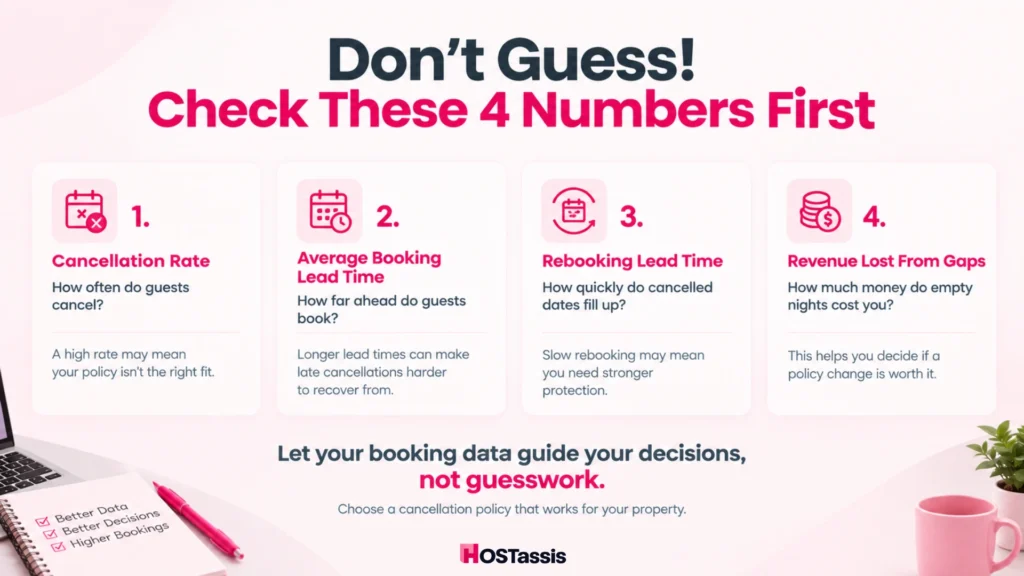
Do not recalculate your Airbnb policies on the fly. Even slight changes can noticeably affect your bookings, so review your Airbnb calendar before making any adjustments. As for the information that needs to be taken into account when deciding on what modifications to make, here are four figures of interest:
Cancellation Rate: The extent to which guests cancel their accommodation. It indicates how well your cancellation policy works.
Average Booking Lead Time: How many days in advance guests book your place. If they tend to book about 30 days before arrival, a cancellation 5 days out won’t be easy to rebook.
Rebooking Lead Time: How many days does it take to fill in cancellations? If there are large gaps, you may want to reconsider your cancellation policy.
Revenue Lost From Unfilled Cancellation Gaps: The value of unbilled vacancies that occur due to cancellations. It is useful to keep track of how your changes influence this statistic since it can help you understand how profitable your current cancellation policy is
These numbers can also help you find weak spots in your hosting process. Not sure where to begin? Try out Why your Airbnb Booking are Slowing Down or explore Performance Tracking with Hostassis to get a clearer picture of how your property is doing.
Frequently Asked Questions
Which Airbnb cancellation policy is the most flexible?
The Flexible policy is the most guest-friendly option. Guests can cancel up to 24 hours before check-in and receive a full refund, as long as they meet Airbnb’s terms.
Which standard Airbnb cancellation policy gives hosts the most protection?
From Airbnb’s four standard policies, the Firm offers the strongest host protection. It has the longest advance notice period for a full refund and stricter rules for late cancellations than Flexible or Moderate.
Is Airbnb Moderate or Flexible Better?
It depends on your property. Flexibility can work well if you attract last-minute guests and can fill canceled dates quickly. Moderate gives you a five-day buffer before check-in, which can help if guests in your area usually book well in advance.
Does Airbnb’s 24-hour cancellation rule apply to Firm bookings?
Yes, but only for eligible short stays. If a guest books at least seven days before check-in, they can cancel within 24 hours of booking and receive a full refund.
Can Airbnb guests cancel a Firm booking for free?
Yes, but it depends on when they cancel. Under Firm, guests can get a full refund if they cancel at least 30 days before check-in. After that, refunds depend on Airbnb’s 24-hour cancellation rule and other applicable conditions.
Can I make my Airbnb cancellation policy stricter for holidays?
Yes. Airbnb allows hosts to set different short-stay cancellation policies for specific dates on their calendar. So, you can choose a stricter policy for holidays or busy seasons without changing the policy for the rest of the year.
Does changing the policy affect confirmed reservations?
No. Any changes you make will only apply to new bookings. Existing reservations will still follow the cancellation policy in effect when the guest booked.
Does Airbnb refund the cleaning fee after cancellation?
It depends on when the guest cancels. If they cancel during the free-cancellation period, Airbnb fully refunds the cleaning fee. After that, the refund depends on the cancellation policy and Airbnb’s applicable rules.
Conclusion
No Airbnb cancellation policy is suitable for all Airbnb hosts. It should be more flexible if you have a high season or a place with many inquiries and last-minute cancellations. On the other hand, the Firm option may be a great choice for seasonal or special event rentals, peak season, and special events.
Before choosing between Flexible or Firm cancellation policy, analyze the data and see which option may be more beneficial for you. Take into account your cancellation rate, guests’ average booking days ahead, the frequency of canceled dates’ rebooking, and average nights lost due to cancellations. This data will help you see which option would be more beneficial for your Airbnb business.
Remember that a strict Airbnb policy does not necessarily mean higher income, and a flexible one does not automatically translate into more guests. In your case, the best choice would be to balance guest satisfaction and losses from cancellations and overpaid nights.
Periodically analyze the results and optimize your cancellation policy to get the most value out of it rather than randomly testing different policies.