A 20% Quote Can Cost More Than a 30% One
Here’s a thing nobody tells you when you start collecting Airbnb property management quotes. The lowest percentage on the page is often not the cheapest deal. A manager charging 20% on gross bookings, plus a setup fee, plus a 15% markup on every repair, plus a linen charge per turnover, can easily take more of your year than one charging a flat 25% with everything included.
So before we get into ranges, let’s agree on the only number that matters: what lands in your bank account after everyone’s been paid.
Quick answer: in the US, a full-service Airbnb property manager usually charges 20% to 30% of booking revenue, with published ranges running from 15% to 40%. A co-host typically takes 10% to 20%. A remote virtual assistant paired with your own local cleaner is priced by the hour instead, often a few hundred dollars a month per listing. On a $60,000-a-year listing, that’s roughly $15,000 to $18,000 for full service, $6,000 to $12,000 for a co-host, and about $3,900 to $6,250 for a VA setup, before you count your own time.
That last line is where most cost guides stop being useful, because they compare a manager with doing everything yourself and skip the middle option entirely. We’ll price all three on the same listing, show where the fees hide, and be honest about when the cheapest model on paper isn’t the cheapest for you.
If you’re still sorting out what each of these people actually does, read Airbnb co-host vs property management company first. This page is about the money.
Full-Service Management: 20% to 30%, Sometimes More
A full-service Airbnb property manager runs everything: listing, pricing, guest messages, cleaning, maintenance, restocking and owner reporting. In return they take a percentage of your booking revenue, most often 20% to 30% in the US. Guesty puts the overall range at 15% to 30% (Guesty), while PriceLabs reports full-service fees anywhere from 15% to 40% (PriceLabs).
Why such a wide band? Mostly three things.
- Market. Mountain and beach towns with heavy turnover and seasonal staffing usually sit at the top. A city condo with steady bookings sits lower.
- Property size and type. A five-bedroom house with a hot tub needs more cleaning, more checks and more repairs than a studio.
- What “full service” includes. Some managers fold cleaning coordination, linen and supplies into the percentage. Others bill them separately and quote a lower headline number.
What the percentage usually covers
| Usually included | Often billed on top |
|---|---|
| Listing creation and updates | Onboarding or setup fee |
| Dynamic pricing | Professional photos |
| Guest messaging and screening | Repairs (often with a markup) |
| Cleaner scheduling | Linen and laundry per turnover |
| Owner statements | Restocking supplies |
| Review management | Deep cleans, hot tub service, snow removal |
Onboarding is a common extra. Guesty lists one-time setup fees of $100 to $500 (Guesty), and some managers charge far more when photos and furnishing advice are bundled in. Maintenance is the other one. A 10% to 15% service charge on top of the vendor’s invoice is common (Guesty).
Gross or net? The question that changes everything
Almost every manager charges on gross booking revenue, not on your profit. Guesty notes the fee is usually taken on total reservation revenue excluding taxes, and often including the cleaning fee (Guesty). That last part matters. If guests pay a $150 cleaning fee and your manager takes 25% of it, you’re paying $37.50 per stay for a job someone else is doing for a separate fee. Ask about it in writing.
Who it’s for
Full service makes sense when you truly want zero involvement: you live far away, you own several homes, or your time is worth far more than the fee. It also tends to make sense for large, high-maintenance properties where a local team on call every day is not optional.
Co-Hosts: 10% to 20%, and You Keep Some of the Work
A co-host is a person or small company you add to your Airbnb listing to share the hosting. Most charge 10% to 20% of booking revenue, with Guesty putting partial management at 10% to 20% (Guesty) and PriceLabs listing half-service at 10% to 15% (PriceLabs). The lower fee comes with a trade: you usually keep some jobs, like paying vendors, buying supplies or making bigger decisions.
Three ways co-hosts get paid
- Percentage of bookings. The most common setup. Simple, and the co-host earns more when you earn more.
- Flat monthly fee. Predictable for you, but the co-host has less reason to push occupancy in slow months.
- Hybrid. A small base plus a lower percentage. Guesty gives the example of a $200 monthly base fee plus an 8% to 12% commission (Guesty).
How Airbnb handles the split
If your co-host is paid through Airbnb, only the listing owner can set it up. The options are a percentage, the cleaning fee, the cleaning fee plus a percentage, or a fixed amount, and Airbnb works the split out on your earnings after its host service fee and taxes (Airbnb Help). That’s a slightly smaller base than the gross bookings most traditional managers charge on, which quietly makes a 15% co-host cheaper than a 15% manager. Our guide to how Airbnb co-host payouts work walks through the math, including refunds.
What co-hosts don’t always cover
A co-host is not always a full replacement for a manager. Check whether yours handles:
- 24/7 guest messages, or only daytime
- Booking.com and Vrbo as well as Airbnb
- Repairs (do they book the plumber, or just tell you to?)
- Owner statements and receipts for your accountant
The answers change what you’ll still be doing at 11 p.m. on a Friday, which is the cost no fee schedule shows. For fee models, contract clauses and negotiation, see Airbnb co-host fees and contracts.
The Third Model: A Remote VA Plus Your Own Local Team
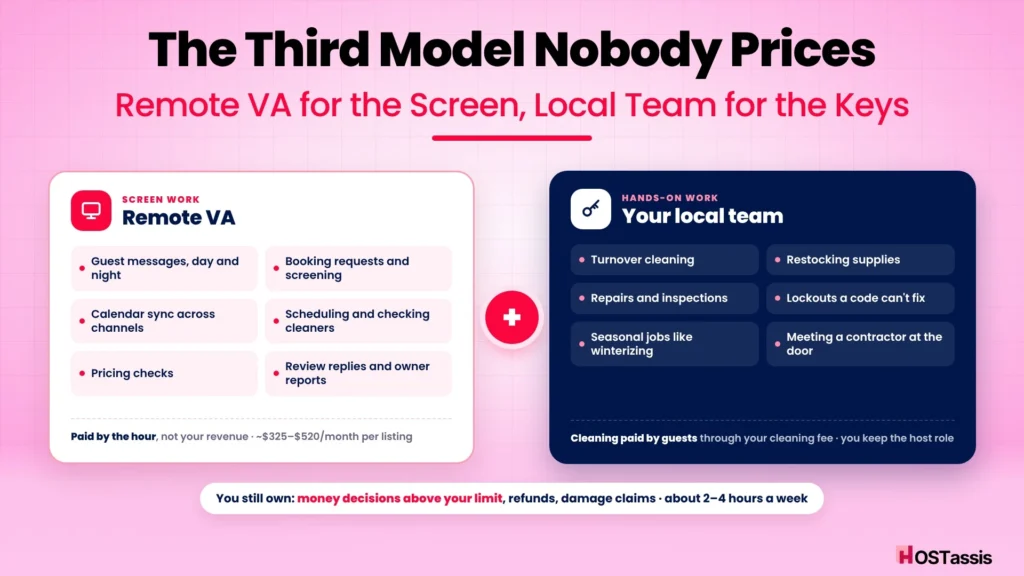
There’s a middle path that most cost guides skip: keep the host role yourself, hire a remote virtual assistant for the screen work, and keep your own local cleaner and handyman for the physical work. You pay the VA by the hour, not by your revenue, so a great month doesn’t make your management bill jump.
Think of it as splitting the job in two. A big share of short-term rental management happens on a screen. The rest needs someone who can turn a key.
| Screen work (the VA) | Hands-on work (your local team) |
|---|---|
| Guest messages, day and night | Turnover cleaning |
| Booking requests and screening | Restocking supplies |
| Calendar sync across Airbnb, Booking.com and Vrbo | Repairs and inspections |
| Scheduling and checking cleaners | Lockouts that a backup code can’t fix |
| Pricing checks in your pricing tool | Seasonal jobs like winterizing |
| Review replies and owner reports | Meeting a contractor at the door |
What it costs
In our own breakdown of Airbnb virtual assistant costs, a listing usually needs 5 to 8 hours of VA time a week for messaging, bookings and cleaner coordination. At typical agency rates of around $15 an hour, that’s about $325 to $520 a month, or roughly $3,900 to $6,240 a year. Offshore freelancers you hire and train yourself cost less per hour; US-based assistants cost more.
The cleaning itself is usually paid by guests through your cleaning fee, so it stays outside the comparison, just as it does with a manager.
What you still own
This is the honest part. With a VA setup you are still the host. You:
- Hire and manage your cleaner and handyman (or keep the ones you have)
- Approve anything that costs money above your limit
- Pay for your own tools, such as a pricing tool like PriceLabs or a PMS like Guesty if you use one
- Make the calls a VA shouldn’t: refunds, damage claims, guest removals
For most owners that’s two to four hours a week once things are running. Whether that time is a cost depends on you, and we’ll put a number on it in the worked example below.
If you want this model without hiring and training someone yourself, that’s what our Airbnb virtual assistant service is built for.
One $60,000 Listing, Three Bills
Ranges are easy to nod along to. Let’s run one property through all three models and see what’s left.
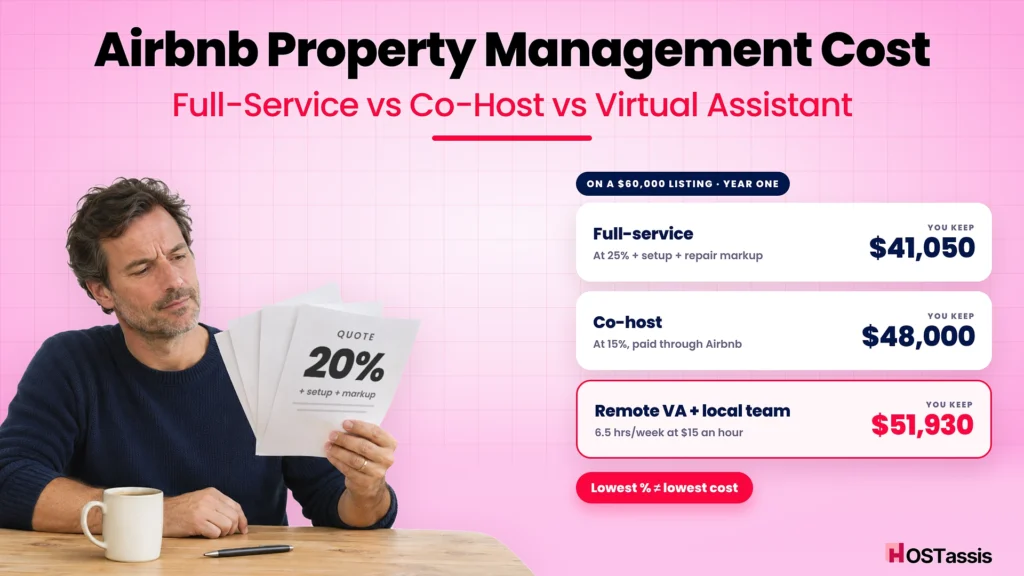
The listing: a three-bedroom house in a US vacation market earning $60,000 a year in booking revenue. Guests pay cleaning fees that go straight to the cleaner, so cleaning is left out of every column. The owner spends $3,000 a year on repairs at vendor cost. Airbnb’s own host fee applies the same way under every model, so it’s left out too.
The assumptions:
- Full-service manager at 25% of gross bookings, a $500 onboarding fee in year one, and a 15% markup on repairs.
- Co-host at 15%, paid through Airbnb, with repairs passed through at cost. (Airbnb calculates co-host splits after its host fee, so the real figure would be slightly lower. We’ve kept $60,000 to be conservative.)
- Remote VA at 6.5 hours a week and $15 an hour, plus the owner’s own local cleaner and handyman.
| Year one | Full-service (25%) | Co-host (15%) | Remote VA + local team |
|---|---|---|---|
| Management fee | $15,000 | $9,000 | $5,070 |
| Onboarding | $500 | $0 | $0 |
| Markup on $3,000 of repairs | $450 | $0 | $0 |
| Cash cost of management | $15,950 | $9,000 | $5,070 |
| Repairs at vendor cost | $3,000 | $3,000 | $3,000 |
| Owner keeps (before mortgage, utilities, tax) | $41,050 | $48,000 | $51,930 |
| Owner’s own hours per week | Under 1 | About 1 | About 3 |
On cash alone, the VA route keeps $10,880 more than full service and $3,930 more than the co-host. But look at the last row.
Now put a price on your time
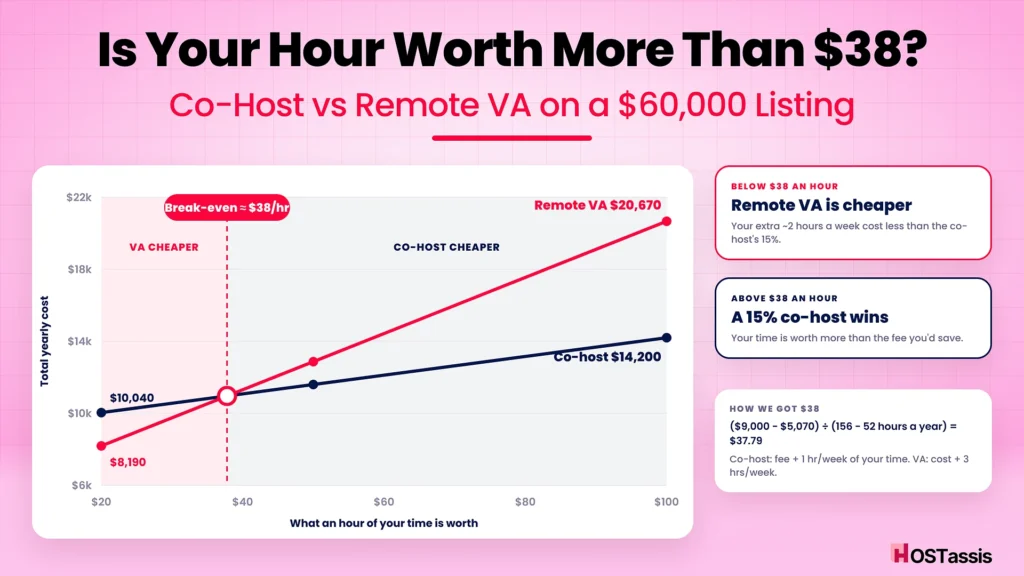
The VA setup asks for about two more hours a week than a co-host does. Over a year that’s 104 hours. Whether that’s “free” depends entirely on what your hour is worth.
| Your time is worth | Co-host total (fee + 1 hr/week) | VA total (cost + 3 hrs/week) | Cheaper option |
|---|---|---|---|
| $20/hour | $10,040 | $8,190 | VA |
| $38/hour | $10,976 | $10,998 | About even |
| $50/hour | $11,600 | $12,870 | Co-host |
| $100/hour | $14,200 | $20,670 | Co-host |
So here’s the honest rule of thumb from this example: if an hour of your time is worth less than about $38, the VA route is cheaper; above that, a 15% co-host wins. Full service only comes out ahead when you need almost zero involvement, or when the property is so demanding that even a co-host can’t keep up.
Your numbers will be different. Swap in your own revenue, fee quotes and hours, and the break-even point moves. The method doesn’t.
Seven Places a Management Fee Hides Money
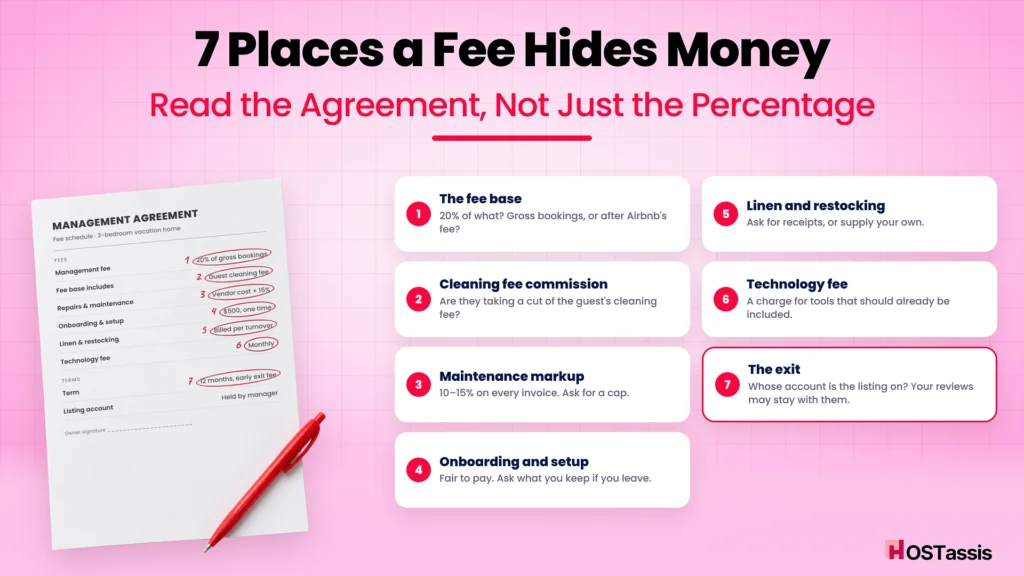
The headline percentage is only the first line of the bill. These are the places where two quotes with the same percentage turn into very different years.
1. The fee base
“20%” of what? Gross bookings, gross bookings including the cleaning fee, or what’s left after Airbnb’s fee and taxes? On $60,000, the difference between charging on gross and charging on the post-fee amount can be several hundred dollars. Get the base written into the contract with an example.
2. Cleaning fee commission
Some managers take their percentage on the cleaning fee guests pay, then pay the cleaner separately. Others keep part of the cleaning fee as margin. Neither is illegal. Both are worth knowing about before you sign.
3. Maintenance markup
A 10% to 15% charge on top of every vendor invoice is common (Guesty). On a quiet year that’s pocket change. On the year the water heater dies and the deck needs rebuilding, it isn’t. Ask for a cap, or a threshold above which you can hire the contractor directly.
4. Onboarding and setup
Photos, listing writing, smart lock installation and a supply starter kit are often billed once at the start. Guesty cites $100 to $500 (Guesty); some managers charge well over that. It’s fair to pay for real work. It’s also fair to ask what you get to keep if you leave.
5. Linen, laundry and restocking
Per-turnover linen charges and restocking with a markup add up quickly on a busy listing. PriceLabs’ own example deducts $300 a month for restocking from a $5,000 month (PriceLabs). Ask for receipts, or ask whether you can supply your own.
6. Software and “technology” fees
Some companies add a monthly platform or tech fee on top of the percentage. It’s rarely large, but it’s a fee for tools that should already be part of the service you’re paying 25% for.
7. The exit
Contracts of one year or longer, notice periods and early termination fees are where owners get stuck. Worse, some managers own the listing on their account, which means your reviews stay with them when you leave. Before you sign, ask in writing: whose account is the listing on, and what happens to the reviews if we part ways? Our guide to the legal and operational side of hiring a co-host covers the clauses worth negotiating.
If you already have a manager and the monthly statement leaves you guessing, the hidden cost of owner statements and what every vacation rental owner statement should include will help you read it line by line.
Which Model Fits You? Five Owner Profiles
The right model depends less on the property and more on the owner. Find the profile closest to you.
The hands-off investor
Owns three homes in a market two states away. Has a full-time job and no interest in guest messages.
Full-service management, or a strong co-host who also runs vendors. The fee is high, but this owner’s alternative isn’t doing it themselves; it’s not owning short-term rentals at all. The job is to negotiate the extras, not the percentage.
The local owner who likes being involved
Lives 20 minutes from the cabin. Enjoys the hosting but hates the 2 a.m. messages.
Remote VA plus the local team they already have. They keep the parts they enjoy, hand off the screen work, and keep the 10% to 20% a manager would take. Our 24/7 guest messaging service is built for exactly this owner.
The remote owner with a trusted cleaner
Moved out of state but still has the same cleaner they’ve used for four years.
VA plus that cleaner is often the sweet spot. The cleaner covers the physical side; the VA covers messages, scheduling and pricing checks. The missing piece is someone who can be at the door in 30 minutes for emergencies, so line up a local backup. Can you run an Airbnb without being there? covers that setup.
The first-time host
One listing, just launched, still learning what a turnover even takes.
A co-host for the first six to twelve months, then reassess. You’ll learn from watching someone experienced, and the percentage costs less when revenue is still building. Once you know the job, you can decide whether to keep paying a percentage or switch to hourly help.
The small property manager
Runs 15 listings for other owners and is drowning in inbox work.
This owner’s question isn’t which model to buy; they are the model. The cost question is whether to hire in-house staff or outsource the back office. We cover that in how property management companies scale with co-host partnerships.
12 Questions to Ask Before You Sign Anything
Print this list and take it to every call. A good manager, co-host or VA company will answer all twelve without flinching. Hesitation on any of them tells you something.
About the money
- What exactly is your percentage charged on: gross bookings, the cleaning fee, or earnings after Airbnb’s fee?
- Can you show me last month’s statement for a property like mine, with the owner’s name removed?
- What do you charge on top of the percentage: setup, linen, restocking, technology?
- Do you mark up repairs or supplies, and by how much?
- Is there a spending limit above which you need my approval?
About the work
- Who answers guests at 3 a.m. on a Sunday, and how fast?
- Do you manage Booking.com and Vrbo as well, or only Airbnb?
- Who sets my prices, and how often are they checked?
- How many listings does each person on your team handle?
About leaving
- How long is the contract, and what does it cost to end it early?
- Is the listing on my Airbnb account or yours?
- If we part ways, what happens to my reviews, photos and guest history?
For co-hosts specifically, also check which Airbnb co-host permission level they’re asking for. Someone who only messages guests doesn’t need to see your payouts.
FAQ: Airbnb Management Costs
How much does Airbnb property management cost?
In the US, full-service Airbnb management usually costs 20% to 30% of booking revenue, with published ranges from 15% to 40%. Co-hosts typically charge 10% to 20%. A remote virtual assistant is billed hourly instead, often $325 to $520 a month per listing for messaging, bookings and cleaner coordination.
What percentage do Airbnb property managers take?
Most take 20% to 30% of gross booking revenue for full service, and 10% to 15% for partial or half service. The percentage is usually calculated before your expenses, and sometimes includes the cleaning fee guests pay, so always ask what it’s charged on.
Is a property manager worth it for one Airbnb?
It can be, if you live far away or your time is worth more than the fee. For a single listing near home, a co-host or a remote VA with your own cleaner usually leaves more money in your pocket. Run the worked example above with your own numbers before deciding.
Are Airbnb co-hosts cheaper than property managers?
Usually, yes. Co-hosts charge less, typically 10% to 20%, because you keep some jobs yourself. When paid through Airbnb, their share is also calculated after Airbnb’s host fee and taxes, which makes the effective cost a little lower than the same percentage on gross bookings.
What does a property manager do that a VA can’t?
Anything that needs hands on the property: cleaning, repairs, inspections, meeting contractors and dealing with lockouts that a backup code can’t fix. A VA covers the screen work. Pair a VA with a reliable local cleaner and handyman and you cover both halves.
Can I switch from a property manager to a co-host or VA?
Yes, but check your contract’s notice period and early termination fee first, and confirm the listing is on your own Airbnb account. If it’s on the manager’s account, your reviews may not come with you.
Are Airbnb management fees tax deductible?
Management fees are generally treated as a business expense for rental property, but how they’re treated depends on your situation. Ask your accountant, and keep every statement and invoice.
The Cheapest Model Is the One That Fits Your Week
There’s no single right answer to what Airbnb management should cost. There’s only the right answer for your property, your market and how many hours you’re willing to give it. A 25% manager is a bargain for an owner who’d otherwise sell. A remote VA is a bargain for an owner who enjoys hosting but can’t be awake at 2 a.m. A co-host often sits right in the middle.
What isn’t negotiable is doing the math on the whole bill: the base the percentage is charged on, the extras, the markups, the exit terms and your own time. Do that, and the quotes on your desk will look very different.
Want help running your numbers? Book a free 20-minute ops audit. We’ll look at your listing’s revenue, your current costs and how much time you’re spending, and tell you honestly which model fits. If it’s not ours, we’ll say so. You can also see what a HOSTassis setup costs on our pricing page.