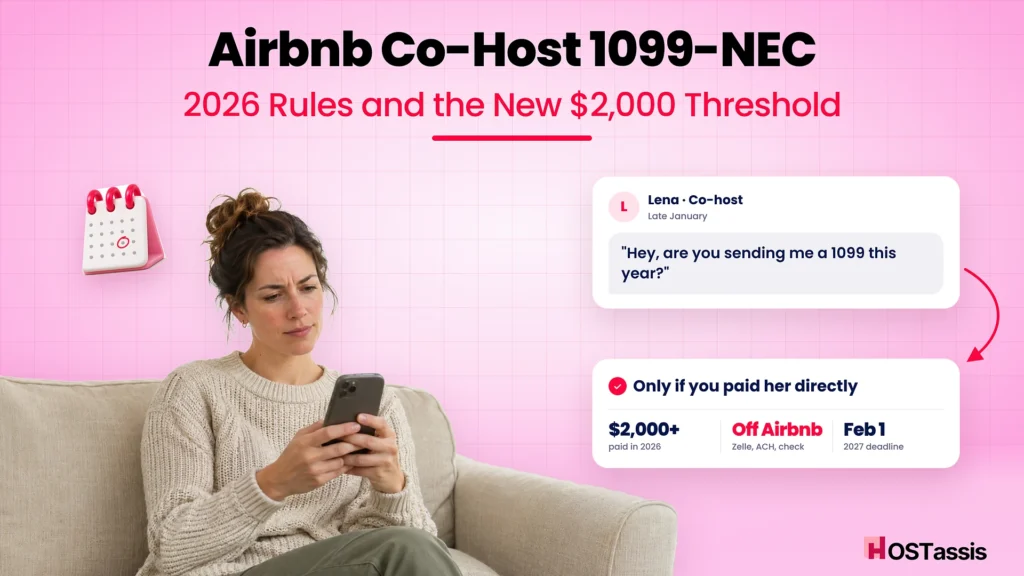
Quick Answer : You only need to send your Airbnb co-host 1099-NEC if you paid them directly, outside Airbnb, by a method like bank transfer, Zelle or check, and those payments reached $2,000 or more during 2026 as part of your rental business. If your co-host was paid through Airbnb’s co-host payouts feature, Airbnb handles their tax form and you should not send a 1099-NEC for that money. Card and third-party payment network payments (like PayPal or Venmo business payments) are also excluded, because those platforms report them. For 2026 payments, the form is due to your co-host and the IRS by February 1, 2027.
It’s late January. You’re finally sitting down with your rental numbers when your co-host texts: “Hey, are you sending me a 1099 this year?”
You freeze. You paid her through Airbnb for most of the year. But then there were those three months when you switched to Zelle because the split wasn’t working. And the $400 you sent by check for the holiday deep clean. Does any of that count? Did the rules change? Is there a penalty if you get it wrong?
If that sounds familiar, you’re in good company. The 1099-NEC is one of the most confusing parts of co-hosting, partly because Airbnb reports some co-host income for you and not the rest, and partly because the rules changed for 2026.
This guide clears it up. You’ll get a simple decision flow, a table showing which payment methods need a form, four real-world examples, the exact steps to file, the 2026 deadlines and the mistakes to avoid.
This article is general information, not tax advice. Your situation may be different, so confirm with a qualified tax professional before filing.
What Is a Form 1099-NEC?
Form 1099-NEC (“nonemployee compensation”) is the form a business uses to report what it paid an independent contractor for services. You send one copy to the contractor and file one with the IRS. The contractor then reports that income on their own tax return.
For Airbnb hosts, a co-host is usually an independent contractor. They provide a service (guest messaging, cleaning coordination, check-ins, pricing) and you pay them for it. So if you pay a co-host directly, the 1099-NEC is the form that may apply.
1099-NEC vs 1099-K: what’s the difference?
This is where most of the confusion starts, so let’s separate the two clearly.
| Form 1099-NEC | Form 1099-K | |
|---|---|---|
| Who sends it | You, the person or business paying the contractor | A payment platform, such as Airbnb, PayPal or a card processor |
| What it reports | Payments you made directly for services | Payments that went through the platform |
| When it applies to co-hosts | When you pay your co-host directly, outside Airbnb | When Airbnb pays your co-host through co-host payouts |
| 2026 federal threshold | $2,000 or more in the year | More than $20,000 and more than 200 transactions |
The key idea: the same dollar should only be reported once, by whoever actually paid it. If Airbnb sent the money to your co-host, Airbnb’s 1099-K covers it. If you sent the money yourself, the 1099-NEC is your job.
How Airbnb reports co-host payouts
Airbnb is clear about its side. When you use the co-host payouts feature, your co-host adds their own taxpayer details and “will receive their own Form 1099 from within their own Airbnb account” (Airbnb Help). Meanwhile, your own 1099-K still shows the full gross amount of your bookings, including the co-host’s share.
If you want the full picture of how splits, cleaning fees and fixed fees work, see our guide to how Airbnb co-host payouts work.
What Changed in 2026: The New $2,000 Threshold
For years, the magic number was $600. If you paid a contractor $600 or more in a year, you sent a 1099-NEC.
That changed for 2026. Airbnb’s tax FAQ puts it plainly: beginning with the 2026 tax year, “the reporting threshold for both Form 1099-MISC and Form 1099-NEC will increase to $2,000, from $600 in 2025” (Airbnb Help). The IRS instructions add that the $2,000 figure may be adjusted for inflation starting in 2027.
What the change means in practice
| Tax year | 1099-NEC threshold | Form due |
|---|---|---|
| 2025 | $600 or more | February 2, 2026 (Jan 31 fell on a Saturday) |
| 2026 | $2,000 or more | February 1, 2027 (Jan 31 falls on a Sunday) |
| 2027 onward | $2,000, possibly adjusted for inflation | January 31, or the next business day |
A few things to keep in mind:
- It’s based on when you paid, not when the work happened. A December 2025 clean you paid for in January 2026 counts toward 2026.
- It’s the total for the year, per co-host. Ten payments of $250 add up to $2,500, which is over the line.
- Below the threshold, the income is still taxable. Your co-host must report every dollar they earn, form or no form. The threshold only decides whether you have to send the form.
- Your state may have its own rules. Some states have their own filing requirements for contractor payments. Check yours before you assume $2,000 is the only number that matters.
The bigger threshold is good news for small hosts. A co-host who helped out occasionally may no longer need a form at all. But for a co-host you pay every month, $2,000 is easy to pass, so most full-time arrangements will still need one.
Do You Need to Send One? A 4-Question Check
Run each co-host through these four questions, in order. Most hosts have their answer by the second one.
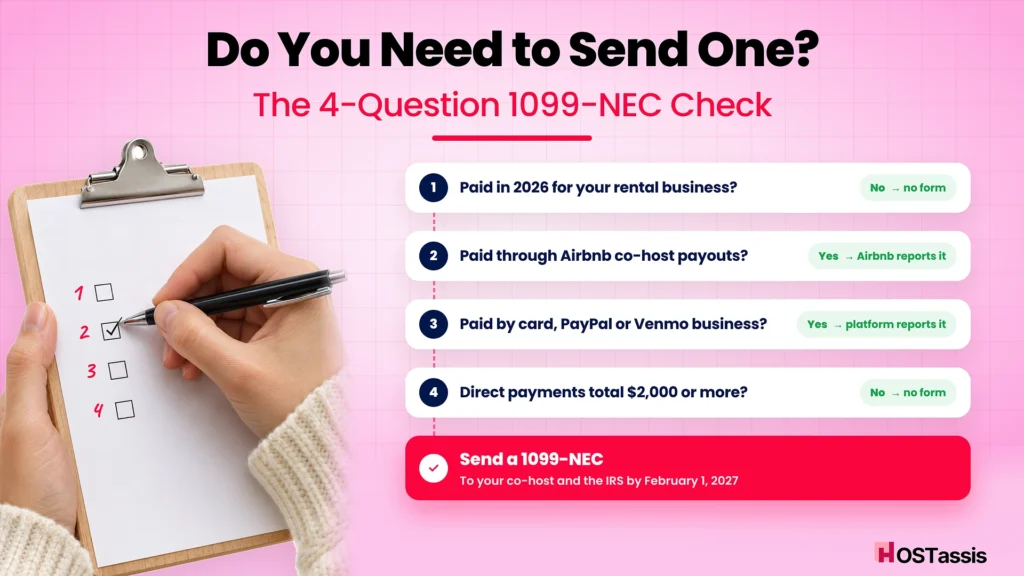
1099-NEC decision flow for Airbnb co-hosts · 2026
The order matters because each question removes money that someone else already reports. By the time you reach the last box, the only payments left are the ones you made directly, by a method no platform covers. Those are the payments the $2,000 rule applies to.
If you paid your co-host several different ways, run the flow separately for each method, then add up only the payments that make it to the last question.
Which Form Applies? It Depends on How You Paid
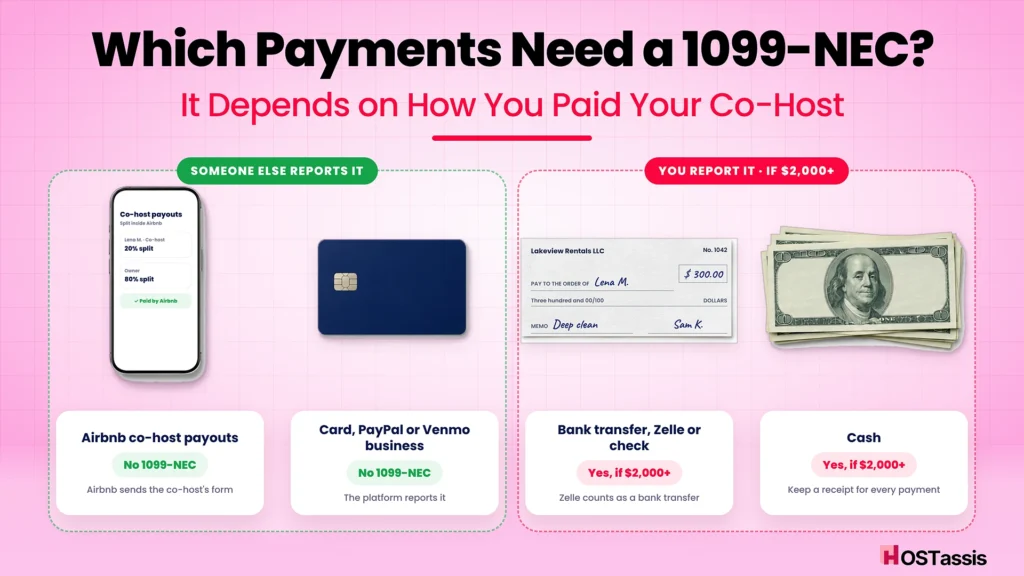
The payment method decides almost everything. Find the way you paid your co-host in the table below.
| How you paid your co-host | Who reports it | Do you send a 1099-NEC? |
|---|---|---|
| Airbnb co-host payouts (split inside Airbnb) | Airbnb, on the co-host’s own 1099 | No |
| Bank transfer (ACH or wire) | You | Yes, if $2,000+ in 2026 |
| Zelle (bank-to-bank) | You | Yes, if $2,000+ in 2026 |
| Paper check | You | Yes, if $2,000+ in 2026 |
| Cash | You | Yes, if $2,000+ in 2026 (and keep receipts) |
| Credit or debit card | The card or payment processor | No |
| PayPal, Venmo or similar as a business payment | The payment platform, on a 1099-K | No |
| Mix of the above | Split by method | Only for the part you paid directly |
Why card and app payments are different
The IRS instructions say payments made by credit card, payment card or through a third-party payment network are not reported on Form 1099-NEC. Those are covered by the platform’s own Form 1099-K instead. That’s why paying a co-host through a business payment app can take the form off your plate.
Two cautions here:
- Zelle is not the same as PayPal or Venmo for this rule. Zelle moves money directly between bank accounts, so treat it like a bank transfer.
- “Friends and family” payments are a bad idea for business. If you pay a co-host through a personal payment option, it may not be reported by the app at all, and your records get messy. Use business payments, or a bank transfer you track yourself.
What about mixed payments?
Many hosts end up with a mix: most of the year through Airbnb, plus some direct payments for extras like restocking, a deep clean or a one-off bonus. Only add up the money you paid directly, using methods that need a 1099-NEC. If that total reaches $2,000, send a form for that amount only. Don’t include what Airbnb paid.
Clean records make this easy. Set up a “co-host fees” account in your chart of accounts, with a separate line for each payment method.
When You Don’t Need to Send a 1099-NEC
Even if you paid your co-host directly, there are situations where a 1099-NEC isn’t required. Here are the main ones.
1. You paid less than $2,000 in 2026
If your direct payments to one co-host total less than $2,000 for the year, you don’t have to send a form. Your co-host still has to report the income.
2. Airbnb paid them
Anything paid through Airbnb’s co-host payouts feature is Airbnb’s to report, not yours (Airbnb Help). Sending a 1099-NEC for the same money reports it twice.
3. You paid by card or a third-party payment network
As covered above, these are reported by the card processor or payment platform on a 1099-K, not by you.
4. Your co-host is a corporation
Payments to corporations are generally not reported on Form 1099-NEC. This is the exception that trips people up, because “LLC” doesn’t automatically mean “corporation.” A single-member LLC is often taxed like a sole proprietor, and payments to it usually are reportable. Ask your co-host to tick the right tax classification on their W-9, and you’ll know.
5. It wasn’t a business payment
The IRS says to report payments “only when payments are made in the course of your trade or business. Personal payments are not reportable.” Most hosts who rent out a short-term rental regularly treat it as a business. But if you only rent your home for a few nights a year, ask your tax professional whether the rule applies to you.
6. Your co-host is your employee
If your co-host is on payroll, you report their wages on a W-2, not a 1099-NEC. Most Airbnb co-hosts are independent contractors, but it’s worth confirming in your co-host contract, along with the other legal and operational considerations of the arrangement.
Four Real-World Examples
Rules are easier to understand with numbers. Here are four common co-hosting setups, all for the 2026 tax year.
Example 1: Everything through Airbnb
Maria owns a lake house. Her co-host, Jake, receives 20% of each booking through Airbnb’s co-host payouts. Over 2026, Jake receives $14,000.
- Maria pays Jake nothing directly.
- Airbnb handles Jake’s tax form.
- Maria sends no 1099-NEC.
Example 2: A monthly fee by bank transfer
David pays his co-host, Priya, a flat $500 a month by ACH transfer. Airbnb’s co-host payouts aren’t used.
- Total paid directly in 2026: 12 × $500 = $6,000.
- That’s over $2,000, and Priya is a sole proprietor.
- David sends Priya a 1099-NEC for $6,000.
Example 3: A mix of Airbnb and Zelle
Sam paid his co-host, Lena, through Airbnb’s co-host payouts for nine months. For three months, while he sorted out a payout issue, he paid her $800 a month by Zelle. He also paid her $300 by check for a holiday deep clean.
- Airbnb payouts: reported by Airbnb. Not Sam’s job.
- Direct payments: 3 × $800 + $300 = $2,700.
- Sam sends Lena a 1099-NEC for $2,700, only the direct part.
Example 4: Small and occasional
Aisha hosts her spare room. A friend covers check-ins when Aisha travels, and Aisha paid her $1,200 by Venmo business payments and $400 by bank transfer in 2026.
- Venmo business payments: reported by the platform, if the friend meets its 1099-K threshold.
- Direct bank payments: $400, well under $2,000.
- Aisha sends no 1099-NEC. Her friend still needs to report all $1,600 as income.
What these examples show
The question is never just “how much did my co-host earn?” It’s “how much did I pay them directly, by a method that isn’t already reported?” Get that number right and the rest is simple.
How to Send a 1099-NEC to Your Co-Host: Step by Step
If you’ve worked out that you need to send a form, here’s the process from start to finish.
Step 1: Collect a Form W-9 before you pay
A W-9 gives you your co-host’s legal name, business name if any, tax classification (individual, LLC, corporation) and taxpayer identification number (a Social Security number or EIN). Ask for it when you sign your co-host agreement, not in January.
If a co-host won’t give you a correct taxpayer ID, the IRS may require you to withhold tax from their payments, known as backup withholding, currently at 24%. That’s a headache for both of you, so get the W-9 up front.
Keep the W-9 somewhere secure. It contains sensitive information, so don’t leave it in a shared inbox or messaging thread.
Step 2: Track every direct payment
Record each payment with the date, amount, method (ACH, Zelle, check, cash) and what it was for. A simple spreadsheet works, or a dedicated “co-host fees” category in your bookkeeping software. Keep Airbnb co-host payouts in a separate line so you never mix them up.
Step 3: Add up the year in early January
Total the direct payments to each co-host for the calendar year. If one co-host is at $2,000 or more, you’ll need a form for them.
Step 4: Fill in the form
Form 1099-NEC is short. You’ll need:
- Your name, address and taxpayer ID (SSN or EIN)
- Your co-host’s name, address and taxpayer ID from the W-9
- The total paid, entered in Box 1 (Nonemployee compensation)
- Any federal tax withheld (usually zero, unless backup withholding applied)
Step 5: File with the IRS
You can file electronically or on paper. The IRS requires electronic filing if you file 10 or more information returns in total (all 1099s and W-2s combined). The IRS has its own online portal for e-filing information returns, and many accounting and payroll tools can file for you.
If you file on paper, you’ll need the official red-ink IRS copy (not a printout from the website) plus a Form 1096 summary.
Step 6: Send a copy to your co-host
Your co-host gets their copy by the same deadline. Mail it, or send it electronically if they’ve agreed to receive it that way.
Step 7: Check your state
Some states require you to file 1099s with them too, or have their own rules. Look up your state tax agency’s requirements, or ask your preparer.
Step 8: Keep copies
Save the W-9, the 1099-NEC, your payment records and your owner statement for the year. If the IRS or your co-host ever asks, you’ll have everything in one place.
Deadlines and Penalties for 2026 Forms
The 1099-NEC has one of the tightest deadlines in the tax calendar, and it doesn’t wait for your regular tax return.
The 2026 deadline: February 1, 2027
Form 1099-NEC is normally due by January 31, both to your co-host and to the IRS. In 2027, January 31 falls on a Sunday, so the deadline moves to the next business day: Monday, February 1, 2027.
There’s no automatic extension for the 1099-NEC like there is for some other forms. Plan to have everything ready in the third week of January.
What happens if you’re late or skip it
The IRS charges penalties per form for late, missing or incorrect information returns. The amount goes up the later you file, and it’s higher if the IRS decides you intentionally ignored the requirement. Penalty amounts are adjusted each year, so check the current figures with your preparer.
The practical risk for most hosts isn’t a huge fine. It’s the hassle: notices, corrected forms, and an awkward conversation with a co-host whose own tax return doesn’t match what you reported.
Made a mistake?
If you sent a 1099-NEC with the wrong amount or details, you can file a corrected form. Don’t just ignore it. Fix it as soon as you notice, and let your co-host know so they file using the right number.
A simple January timeline
| When | What to do |
|---|---|
| Early January | Total direct payments per co-host; confirm you have a W-9 for each |
| Mid-January | Prepare the forms, or send the numbers to your preparer |
| By Feb 1, 2027 | Send copies to co-hosts and file with the IRS (and your state, if required) |
| After filing | Save copies with your year-end records |
7 Common 1099-NEC Mistakes Hosts Make
Most 1099 problems aren’t complicated. They’re small slips that snowball. Watch out for these.
1. Sending a 1099-NEC for Airbnb co-host payouts. If Airbnb already paid your co-host, their income is already reported. A second form makes it look like they earned twice as much. This is probably the most common mistake.
2. Forgetting the off-platform payments. The opposite problem. You remember the Airbnb split but forget the Zelle payments in March, the check for the deep clean and the cash for the extra turnover. Add them all up.
3. Still using the old $600 rule. For 2026 payments, the line is $2,000. Sending forms you don’t need isn’t a disaster, but it’s extra work and can confuse your co-host.
4. Chasing the W-9 in January. If your co-host has moved, changed numbers or simply gone quiet, you’re stuck. Ask for the W-9 before the first payment.
5. Mixing personal and business payments. Paying a co-host through a personal “friends and family” option, or from a personal account, makes records unreliable. Keep rental money in a dedicated account.
6. Assuming “LLC” means “no 1099”. Only payments to corporations are generally exempt. Many LLCs are taxed like individuals. Check the box your co-host ticked on the W-9.
7. Missing the deadline. Unlike your tax return, there’s no automatic extension. Put February 1, 2027 in your calendar now.
Many of these come down to bookkeeping habits. Our article on common bookkeeping mistakes covers the ones that cause trouble well beyond 1099s, and it’s worth reconciling your payouts monthly using an OTA reconciliation routine.
If You’re the Co-Host: What to Expect
This article is mostly for property owners, but co-hosts ask the same question from the other side: “Will I get a 1099, and what do I do with it?”
Which forms you might receive
- From Airbnb: a 1099-K for co-host payouts, if you meet Airbnb’s federal threshold (more than $20,000 and more than 200 transactions) or your state’s lower threshold. You’ll find it in your own Airbnb account (Airbnb Help).
- From each owner: a 1099-NEC if that owner paid you $2,000 or more directly in 2026.
- From payment apps: a 1099-K if you were paid through business payments and met the platform’s threshold.
Report all your income, form or no form
This is the part co-hosts sometimes miss. Thresholds only decide who has to send a form. Every dollar you earn from co-hosting is taxable, whether or not anyone sends you paperwork.
Keep your own record of payments from every owner and every channel, and compare it with the forms you receive. If an owner sends a 1099-NEC for money Airbnb already reported, ask them to correct it before you file.
Give owners what they need
Make it easy for owners to get this right. Send your W-9 when you start working together. Tell them which payments come through Airbnb and which don’t. And if you set up co-host payouts inside Airbnb, make sure your co-host permissions and payout settings are correct.
Self-employment basics
Most co-hosts are self-employed, which usually means paying self-employment tax and making estimated tax payments during the year. A tax professional can help you set this up. It’s much easier than catching up at the end of the year.
If you’re still defining your role, our guide to the key tasks a co-host handles is a useful reference for your agreement.
Your 1099-NEC Year-End Checklist
Use this list in December and January to get it done without stress.
In December
- List every co-host, cleaner, handyman or helper you paid directly this year
- Check you have a current W-9 for each one
- Ask anyone missing a W-9 to send it now
- Separate Airbnb co-host payouts from direct payments in your records
- Note which direct payments were by card or business payment app (not reportable by you)
In early January
- Total direct payments per person for 2026
- Flag everyone at $2,000 or more
- Confirm each person’s tax classification (corporation or not)
- Decide how you’ll file: accounting software, the IRS portal, your preparer, or paper
By February 1, 2027
- Send each 1099-NEC to the recipient
- File with the IRS (and your state, if required)
- Save copies with your year-end records
The same rules apply to other contractors, not just co-hosts. If you paid a handyman, landscaper or cleaner $2,000 or more directly, they may need a 1099-NEC too.
Frequently Asked Questions
Do I need to send my Airbnb co-host a 1099-NEC?
Only if you paid them directly (bank transfer, Zelle, check or cash) and those payments reached $2,000 or more in 2026 as part of your rental business. Payments made through Airbnb’s co-host payouts feature are reported by Airbnb.
What is the 1099-NEC threshold for 2026?
$2,000, up from $600 in 2025. Airbnb confirms the change in its tax FAQ, and the IRS says the amount may be adjusted for inflation from 2027.
When is the 1099-NEC due for 2026 payments?
By February 1, 2027, both to your co-host and to the IRS, because January 31, 2027 falls on a Sunday.
What if Airbnb already split the payout with my co-host?
Then you don’t send a 1099-NEC for that money. Airbnb issues your co-host’s tax form from their own account, and your own 1099-K still shows the full gross amount.
Do I need a 1099-NEC if I paid my co-host with PayPal or Venmo?
Not for business payments made through a third-party payment network or by card. Those are reported by the payment platform. Personal “friends and family” payments are a different story, so avoid using them for business.
Does Zelle count as a third-party payment network?
Zelle moves money between bank accounts, so treat Zelle payments like a bank transfer. If they reach $2,000, a 1099-NEC is usually needed. Confirm with your preparer.
My co-host has an LLC. Do I still send a 1099-NEC?
Usually yes, unless the LLC is taxed as a corporation. Check the tax classification your co-host selected on their W-9.
What happens if I don’t send a 1099-NEC?
The IRS can charge penalties per form for late or missing information returns, and the amount increases the longer you wait. Your co-host’s income is still taxable either way.
Conclusion
The 1099-NEC question has a simple core: did you pay your co-host directly, by a method the platforms don’t report, and did it reach $2,000 in 2026? If yes, send the form by February 1, 2027. If Airbnb paid them, or you paid by card or business payment app, it’s not yours to send.
The hosts who find this stressful are usually the ones without clean records. Collect a W-9 at the start, keep Airbnb payouts and direct payments in separate lines, and total everything in early January. It turns a confusing tax question into a 20-minute job, and it’s the same habit that keeps your revenue and profit easy to see all year.
At HOSTassis, we help short-term rental owners keep their books ready for tax season: monthly owner statements, payout reconciliation, contractor payment tracking and year-end reports your CPA can use. It’s also worth knowing what Airbnb charges hosts, so your fee deductions are right too.
Want your 2026 records ready before January? Contact us for a free bookkeeping and operations review.