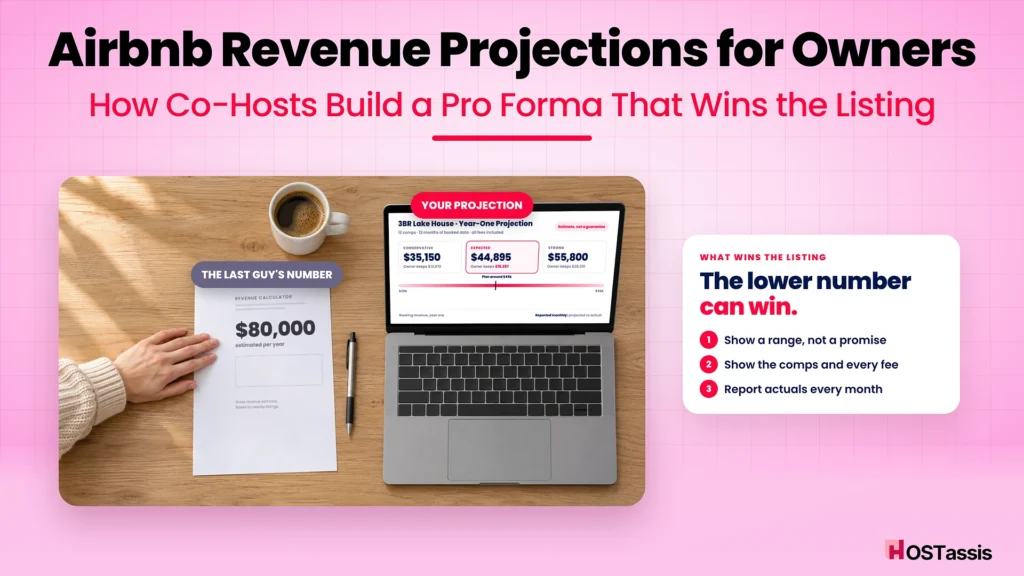
“The Last Guy Said $80,000”
You’re sitting at the owner’s kitchen table with a laptop open to your projection. Before you can say a word, she slides a printout across: a calculator result from six months ago. $80,000 a year. Your number is $45,000.
There are two ways this meeting can go. Either you look like the cautious one who’ll leave money on the table, or you look like the only person in the room who’s told her the truth. Which one depends almost entirely on how you built the number and how you show it.
Quick answer: to estimate Airbnb revenue for an owner, pull 8 to 15 truly comparable active listings, take their nightly rates and occupancy for the last 12 months, and project month by month so seasonality is built in. Then show three scenarios (conservative, expected and strong), subtract every cost the owner will pay (Airbnb’s host fee, your management fee, utilities, supplies, insurance, maintenance) and hand over a net figure with your assumptions written next to it. Present it as a range, never a promise, and commit to reporting actual results against the projection every month.
This guide is for co-hosts and small property managers. It covers the inputs, the tools and their blind spots, a sample pro forma you can copy, how to present it so owners trust it, and the mistakes that win a listing on Monday and lose the client by spring. If you’re the owner reading this, it’s a fair checklist for judging any projection someone puts in front of you.
Why Owners Don’t Believe Your Number (Yet)
Most owners who are thinking about short-term renting have already typed their address into at least one free calculator. Many have also been pitched by someone else. So by the time you show up, they’ve seen big numbers, and they’ve usually seen them disagree.
That’s not because one calculator is lying. Guesty’s explainer on revenue calculators points out that two tools give different answers mainly because of how fresh their data is and how wide a radius they pull comparables from, and that most calculators show gross revenue while skipping cleaning fees, platform commissions and management costs (Guesty). Put those together and an owner can easily be looking at a gross, peak-weighted figure from a tool that included the waterfront house three streets away.
What owners are actually worried about
- “Is this number real?” They want to know where it came from, not just what it is.
- “What do I actually keep?” Gross revenue means little to someone paying a mortgage. PriceLabs’ own income guide warns that a single headline figure “is never real” and should be treated as the middle of a range (PriceLabs).
- “What happens in a bad year?” Owners remember slow winters, new regulations and the summer everyone listed their place.
- “Are you just saying this to get the contract?” The honest answer is that everyone pitching has an incentive to inflate. Your job is to show you’re not doing it.
The opportunity hiding in their doubt
Here’s the good news. Because owners have been burned by big numbers, a careful, well-explained estimate stands out. A co-host who says “here’s a range, here’s why, and here’s how I’ll report against it every month” is offering something the calculator can’t: accountability. That’s what wins the listing, even when your number is lower.
If you’re newer to the role, it’s worth reading what an Airbnb co-host actually does and how Airbnb co-hosts increase occupancy and revenue before your first owner meeting. Owners will ask how you plan to hit the number.
The Six Inputs Every Projection Rests On
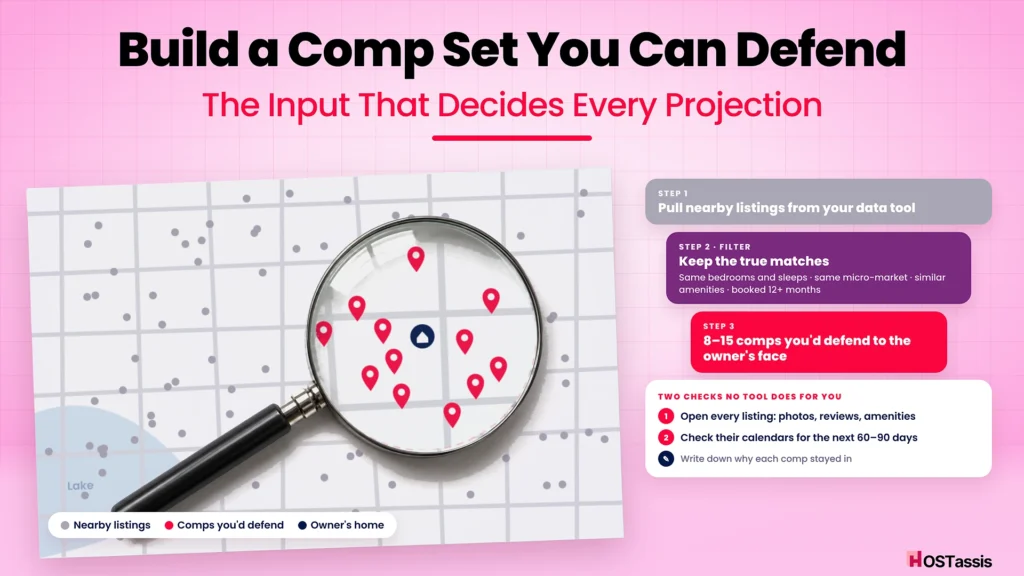
Every revenue estimate, from a free calculator to a paid tool, comes down to the same short list. The difference between a good projection and a bad one is how carefully you choose each input and whether you say out loud what you assumed.
1. Comparables (comps)
The listings you compare against decide almost everything. A good comp matches on bedrooms and sleeping capacity, sits in the same micro-market (same side of the lake, same school-district-style pocket of the city), has similar standout amenities like a hot tub or parking, and has been actively booked for at least a year. Guesty’s calculator guide suggests building projections around the middle of market performance rather than the extremes (Guesty). We’d add: throw out any comp you wouldn’t be comfortable defending to the owner’s face.
2. Average daily rate (ADR)
The average price per booked night, not the listed price. Comps that list at $300 but book mostly on discounted weekdays might average far less. Use booked rates wherever your tool shows them.
3. Occupancy
Booked nights divided by available nights. Be careful with comps that block a lot of nights for owner stays; their occupancy can look higher than it really is.
4. Seasonality
This is where most quick estimates go wrong. ADR times occupancy times 365 assumes every month looks like the average month. They don’t. PriceLabs’ worked example splits the year into summer, shoulder and winter seasons with different rates and occupancy for each (PriceLabs). Do it month by month if you can.
5. Fees
Airbnb’s host fee depends on which fee structure the listing is on. Under the split-fee model it’s about 3%; under the host-only fee that many hosts are now on, it’s around 15.5%. Use the one that will apply to this owner, and write it down. Our guide to what Airbnb charges hosts walks through the options. Then add your own management fee, stated the same way your contract will state it.
6. Operating costs
Utilities, internet, streaming, supplies, insurance, routine maintenance, software, licensing and local taxes the owner pays directly. Cleaning is usually covered by the guest’s cleaning fee, so treat it as a pass-through unless the owner is subsidizing it. If you skip this line, your “net” isn’t net.
If you’re helping an owner who hasn’t bought yet, the same inputs feed how to research a new STR market before buying a property.
The Tools, and What Each One Can’t See
Professional co-hosts rarely rely on one tool. They pull comps from a data provider, sanity-check the result against what they see live on Airbnb, and then build the final projection in a spreadsheet they control. Here’s how the common tools fit in.
| Tool | What it gives you | Blind spot to watch |
|---|---|---|
| PriceLabs Revenue Estimator (free) | Quick projected revenue, ADR and occupancy from a location and bedroom count | Very few inputs; no amenities, condition or photos |
| PriceLabs Revenue Estimator Pro (paid) | Monthly low, middle and high figures; PriceLabs says it uses the nearest 350 active listings within 15 km over the last 12 months, weighted toward similar properties (PriceLabs); branded PDFs for owners | 15 km can mix very different micro-markets in some areas; you still need to sanity-check comps |
| AirDNA and similar data providers | Address-level estimates and market data | Estimates are only as good as the comp set and data freshness |
| BNBCalc and other investor calculators | Full pro formas with loan and return math | Built for buyers; most owners you pitch already own the home |
| Live Airbnb search | What guests actually see for your dates | Shows asking prices, not what booked |
| Your own portfolio data | Real results from similar homes you manage | Only as broad as your portfolio |
The two checks no tool does for you
Walk through the comps one by one. Open each listing. Look at the photos, reviews and amenities. If the top comp has a private dock and the owner’s house is three blocks from the water, take it out. Ten minutes of this does more for accuracy than any filter.
Check the calendar, not just the summary. Look at a few comps’ calendars for the next 60 to 90 days. If they’re wide open in a month your tool calls peak season, ask why.
Where your own data beats every tool
If you already manage similar homes in the same area, your actual results are the strongest evidence you have. Owners trust “here’s what a similar house I run earned last year, with the owner’s permission” far more than any chart. If you’re building that track record now, how an Airbnb co-host can boost your listing performance is worth a read.
Building the Pro Forma, Step by Step
A pro forma is just a forward-looking income statement: what the property is expected to earn, what it will cost to run, and what the owner keeps. For an owner pitch, keep it to one page. Here’s the order we build it in.
- Visit the property, or get a detailed walkthrough. Note bedrooms, real sleeping capacity, parking, outdoor space, standout amenities and anything that needs fixing before launch. Photos from a phone are fine at this stage.
- Check the rules first. Confirm the property can legally operate as a short-term rental: city permits, HOA rules, minimum-stay limits. A projection for a home that can’t get a permit is worse than no projection.
- Build a comp set of 8 to 15 listings. Pull candidates from your data tool, then remove anything that doesn’t really match. Write down why each one stayed.
- Pull 12 months of results for the comps. Booked ADR and occupancy by month. If your tool gives a low, middle and high figure, keep all three.
- Adjust for the owner’s home. Better or worse than the comp median? Adjust ADR by a small, explained amount (for example, “no hot tub, so 5% below the comp median”). Never adjust upward because you’re confident you’ll do a great job. Put that in the strong scenario instead.
- Account for the ramp-up. A brand-new listing has no reviews. Build a slower first two or three months into year one.
- Calculate three scenarios. Conservative (lower-quartile comps), expected (median) and strong (upper-quartile). Month by month if possible, then total.
- Subtract every cost. Airbnb’s host fee at the rate that will actually apply, your management fee exactly as your contract will calculate it, and the owner’s operating costs.
- Add the owner’s alternative. If they’d otherwise rent the home long-term, put that number next to yours. It’s the comparison they’re making in their head anyway.
- Write the assumptions on the page. Comp count and radius, data window, fee structure, ramp-up, cost estimates. If it’s not written down, it will be remembered differently later.
A note on management fees in the projection
Show your fee on the same base your contract uses. If you charge 20% of booking revenue, calculate it on booking revenue, not on what’s left after costs. If you’re paid through Airbnb’s co-host payout, remember Airbnb works out the split after its host fee and taxes (Airbnb Help). Owners compare your projection with your contract line by line, and a mismatch costs you trust fast. For the payout mechanics, see how Airbnb co-host payouts work.
A Sample Pro Forma You Can Copy
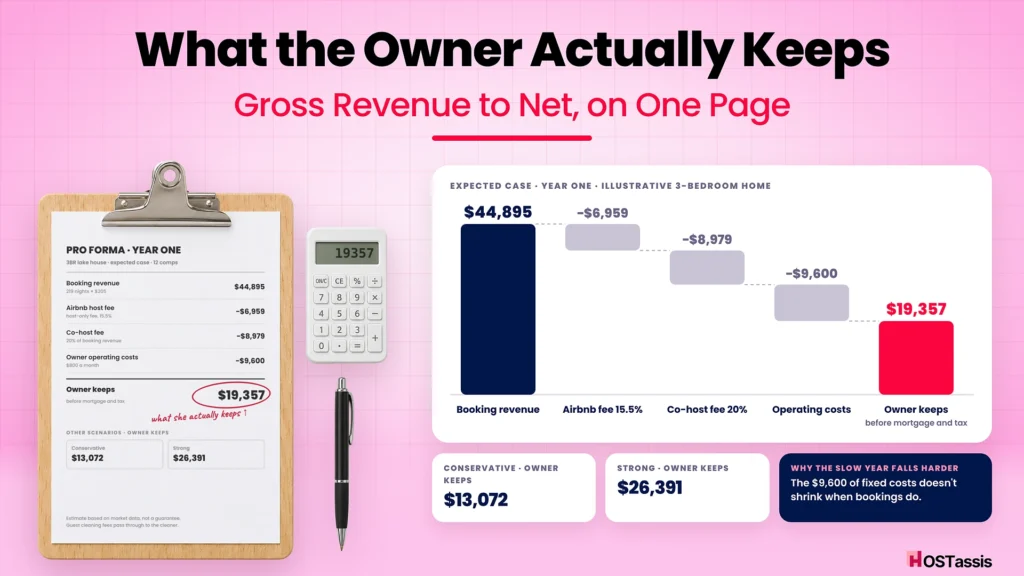
Here’s what a one-page projection looks like for an illustrative three-bedroom home in a US vacation market. The numbers are made up for the example, but the structure is exactly what we’d hand an owner.
Assumptions (always on the page): 12 comparable three-bedroom listings within the same area, 12 months of booked data. Conservative uses lower-quartile comps, expected uses the median, strong uses the upper quartile. Airbnb host-only fee of 15.5%. Co-host fee of 20% of booking revenue. Guest-paid cleaning fees pass straight to the cleaner and are left out. Owner operating costs of $800 a month for utilities, internet, supplies, insurance and routine maintenance. Mortgage and income tax not included.
| Year one | Conservative | Expected | Strong |
|---|---|---|---|
| Average nightly rate (booked) | $185 | $205 | $225 |
| Occupancy | 52% | 60% | 68% |
| Booked nights | 190 | 219 | 248 |
| Booking revenue | $35,150 | $44,895 | $55,800 |
| Airbnb host fee (15.5%) | −$5,448 | −$6,959 | −$8,649 |
| Co-host fee (20% of booking revenue) | −$7,030 | −$8,979 | −$11,160 |
| Owner operating costs | −$9,600 | −$9,600 | −$9,600 |
| Owner keeps, before mortgage and tax | $13,072 | $19,357 | $26,391 |
| Long-term rental alternative | [local monthly rent × 12, minus owner’s costs] |
How to read it with the owner
- Lead with the expected column, then point at both sides. “Most years should land around here. A slow year looks like this. A great year looks like that.”
- Notice the fixed costs. The $9,600 doesn’t shrink in a slow year, which is why the conservative column falls further than revenue does. Owners appreciate being told this up front.
- The gap between columns is the honest part. Revenue swings by about $20,000 between conservative and strong in this example. Pretending that range doesn’t exist is how projections lose credibility.
Add a monthly view if you can
A one-line annual figure hides the cash-flow problem owners care about: the slow months. If your tool gives monthly low, middle and high figures, add a second page that shows them, and mark the two or three months where the owner should expect revenue to be lower than costs. That single page answers “what happens in winter?” before they ask it.
If you’d like this built for your next owner pitch, our team prepares projections and monthly owner statements for co-hosts and property managers. See how property management companies scale with co-host partnerships.
Presenting It: What to Say at the Kitchen Table
The numbers get you in the door. How you talk about them decides whether the owner signs. A simple structure works well.
1. Start with their question, not your deck
Ask what they’ve already seen and what worries them. If they have a calculator printout, ask to look at it. You’ll learn what number you’re up against and what they believe drives it.
2. Explain the method in one breath
“I picked 12 homes like yours that have been booked for at least a year, looked at what they actually earned each month, and adjusted for the differences.” If you can’t explain your method that simply, the owner won’t trust it.
3. Show the comps
Open two or three of them on your laptop. Point to why each one is comparable. This is where most pitches skip ahead, and it’s the moment owners start to trust you.
4. Give the range, then your expectation
Show conservative, expected and strong side by side, then say plainly which one you’d plan around and why. Owners don’t expect certainty. They expect you to have an opinion and to own it.
5. Address the other number directly
If they’ve seen a higher figure, don’t dismiss it. Walk through it: is it gross or net? Does it include fees? Which comps might it be using? Usually the gap closes on its own once both numbers are on the same basis.
6. Promise reporting, not revenue
This is the part that wins listings. “I can’t promise you $45,000. I can promise that every month you’ll get a statement showing what we projected and what actually happened, and if we’re off, I’ll tell you why.” Then do it. A clean owner statement is the follow-through; see what every vacation rental owner statement should include.
Words to avoid
- “Guaranteed” or “you’ll make” anywhere near a number
- “Easily” (as in “this will easily do $60k”)
- “Passive income.” Owners who’ve hosted before know it isn’t.
A projection is an estimate, not a promise. Writing “estimate based on market data, not a guarantee of future results” on the page protects you and reassures the owner that you know the difference. If your agreement includes anything that sounds like a revenue guarantee, have it reviewed. Our guide to the legal and operational side of co-hosting covers the agreement basics.
Seven Mistakes That Win the Listing and Lose the Client
Some projection mistakes cost you the pitch. The worse ones win it, then blow up six months later when the owner compares your number with their statement.
| Mistake | Why it happens | What it costs you later | The fix |
|---|---|---|---|
| Showing gross as if it were income | Gross is the biggest, most impressive number | Owner feels misled at the first statement | Always end the page on what the owner keeps |
| Using peak-season rates for the whole year | Summer comps look great in a quick search | A brutal first winter | Project month by month |
| Cherry-picking the best comps | You want the number to win | Constant underperformance against your own projection | Write down why each comp is in, and include weaker ones |
| Ignoring the ramp-up | New listings feel like they should start strong | Months one to three miss badly | Build a slower start into year one |
| Wrong Airbnb fee | Fee structures changed and quick estimates still use old numbers | A 12-point gap between projection and payout | State the fee structure the listing will use |
| Fee on a different base than the contract | Projection written before the contract | “You said 20%, but this is more” | Copy the contract’s wording into the pro forma |
| No follow-up after signing | The pitch is over, so the projection gets forgotten | Owner keeps comparing to it anyway, without your explanation | Report projected vs actual monthly |
The last one matters most. A projection doesn’t go away when the contract is signed; the owner keeps it in a drawer. If you keep reporting against it, an off month becomes a conversation. If you don’t, it becomes a grievance.
Turn the projection into your monthly report
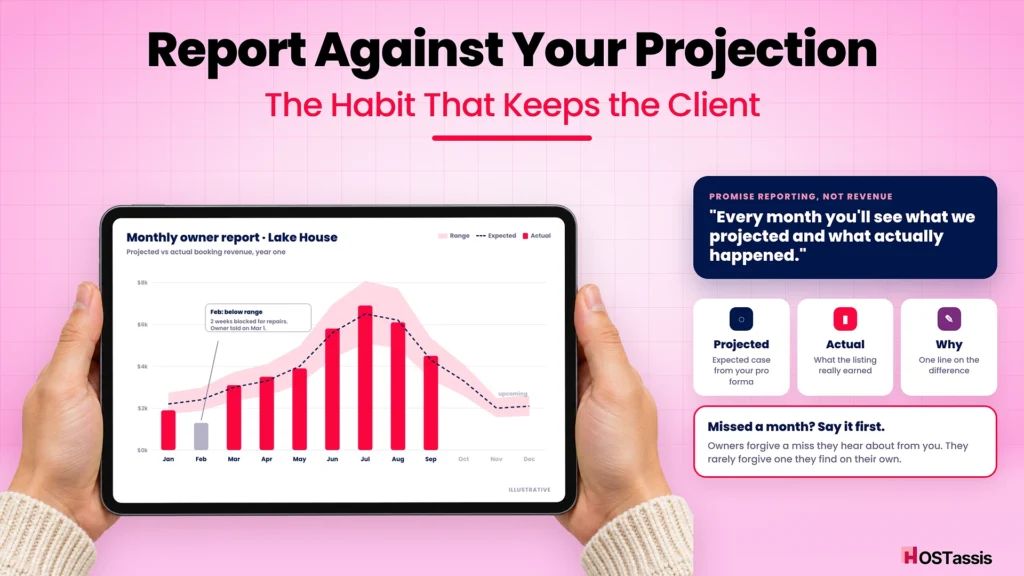
Once the listing is live, add two columns to your monthly owner report: projected (expected case) and actual. Then one line on why they differ. Over a year, that report becomes your best sales asset, because it’s real proof you can show the next owner (with permission). Owners who see that kind of reporting tend to stay. Owners who don’t tend to start looking at whether Airbnb co-hosting is worth it all over again.
FAQ: Airbnb Revenue Projections
How do professional co-hosts estimate Airbnb revenue for an owner?
They build a set of 8 to 15 comparable listings, pull 12 months of booked nightly rates and occupancy, adjust for the owner’s home, and project month by month. Then they show conservative, expected and strong scenarios, subtract Airbnb’s fee, their management fee and operating costs, and present what the owner keeps.
What tools do co-hosts use for revenue estimates?
Common choices are PriceLabs’ Revenue Estimator (a free version and a paid Pro version), AirDNA and similar data providers, and investor calculators like BNBCalc. Most professionals use a tool to find comps and data, then build the final projection in their own spreadsheet.
How accurate are Airbnb revenue estimates?
They’re estimates, not forecasts you can bank. Different tools give different answers depending on how fresh their data is and how wide a radius they use for comparables. Treat any single figure as the middle of a range, and judge an estimate by how well its comps match the home.
Should I show owners gross or net revenue?
Both, but end on net. Show booking revenue, then subtract every cost the owner will pay, and make the last line what they keep before mortgage and tax. Owners who only see gross tend to feel misled later.
How many scenarios should a pro forma include?
Three works well: conservative, expected and strong. It shows the owner the realistic range without overwhelming them, and it gives you a clear way to say which one you’d plan around.
Can I guarantee an owner a certain income?
We’d strongly advise against it. Revenue depends on the market, season, regulations and guest demand, none of which you control. Present projections as estimates, write that on the page, and offer transparent monthly reporting instead.
What should I do if actual revenue comes in below the projection?
Say so first, before the owner notices. Show which month missed, why (pricing, a slow market, reviews, a maintenance issue), and what you’re changing. Owners forgive a miss they hear about from you; they rarely forgive one they find on their own.
The Lower Number Can Win
Back at the kitchen table, the owner still has the $80,000 printout. You’ve shown her 12 real comps, a range from $35,000 to $56,000 in booking revenue, exactly what she’d keep in each case, and a promise to report against it every month. The other number was bigger. Yours is the one she can check.
That’s the whole game. Owners don’t hire the co-host with the highest projection; they hire the one they believe. Build the number carefully, show your work, and keep showing it after you’ve signed.
Want help building owner projections or monthly reports? HOSTassis supports co-hosts and property managers with the back-office work behind the pitch: comp research, pro formas, owner statements and guest operations. Book a free 20-minute call or see our Airbnb virtual assistant services.