“We’ll List Your Home for You”
Maybe it arrived as a DM. Maybe it was a friendly stranger in a Facebook group for local homeowners. “I do Airbnb co listing. I’ll set up your listing, run it, and we split the income. You don’t have to do a thing.”
It might be a great deal. It might also be the start of a very awkward conversation eighteen months from now, when you want to part ways and find that the listing, the five-star reviews and the Superhost badge all live on someone else’s account.
Before you say yes, it helps to know what “co-listing” actually means. Short version: it doesn’t mean one thing.
Quick answer: “co-listing” isn’t an official Airbnb term. It’s a label used mostly by co-hosting courses for an arrangement where someone runs another person’s property on Airbnb for a share of the revenue, usually 10% to 25%. It’s legitimate when it uses Airbnb’s own co-host tools: the listing sits on the owner’s account, the other person is added as a co-host with set permissions, and any payout split runs through Airbnb or a written agreement. It gets risky when the listing sits on the manager’s account, because reviews belong to the listing and Airbnb doesn’t offer a simple way to move a listing between accounts.
This guide is written for the property owner. If you’re on the other side and want to run listings for others, the mechanics are the same, and the Airbnb co-host setup checklist is a good next read.
Three Things People Mean by “Co-Listing”
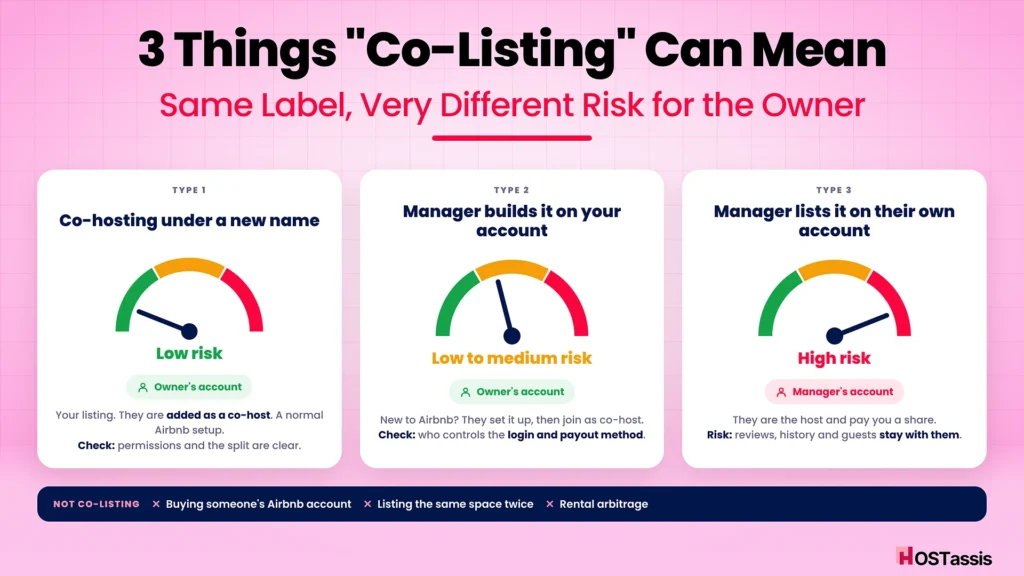
Search the term and you’ll find three definitions, often on pages written by people selling courses about it. One training site calls it “another name for co-hosting.” Another describes it as a business model where you create a listing for a property that isn’t on Airbnb yet, “under the owner’s account (or your own).” A third frames it as a management role paid by revenue share.
They overlap, but the difference between them is exactly where owners get burned. Here’s how to tell them apart.
| What they mean | Whose Airbnb account | How Airbnb sees it | Risk to the owner |
|---|---|---|---|
| 1. Co-hosting under a new name. The owner’s listing; the manager is added as a co-host | Owner’s | A normal co-host setup | Low, if permissions and the split are clear |
| 2. Manager builds the listing on the owner’s account. Property wasn’t on Airbnb yet; manager sets it up, then is added as co-host | Owner’s | A normal co-host setup | Low to medium: check who controls the login and payout method |
| 3. Manager lists the property on their own account and pays the owner a share | Manager’s | The manager is the host | High: reviews, listing history and guest relationships stay with the manager |
The first two are just co-hosting with a marketing label. Airbnb supports them directly: a host invites a co-host from the listing, sets their permissions, and can choose to share part of the payout for each booking through Airbnb (Airbnb Resource Center).
The third is the one to slow down on. It isn’t automatically a scam, and some owners prefer it because they never touch Airbnb at all. But it means you don’t own your listing, and that matters more than the split.
What co-listing is not
- It’s not buying or renting someone’s Airbnb account. Even one co-listing course warns that buying a verified account violates Airbnb’s Terms of Service.
- It’s not listing the same home twice to get more visibility. Multiple listings for one property are fine when they’re genuinely different spaces, like a private room and the entire place, and Airbnb lets the primary host link their calendars (Airbnb Help). Copies of the same space aren’t the same thing.
- It’s not rental arbitrage. In arbitrage, the operator rents the property from the owner and sublets it. In co-listing, the owner still owns the business.
If you’re weighing a co-lister against a traditional manager, our guide to co-hosts vs property management companies covers the roles, and what an Airbnb co-host actually does lists the day-to-day tasks.
Reviews: The Part Nobody Puts in the Pitch
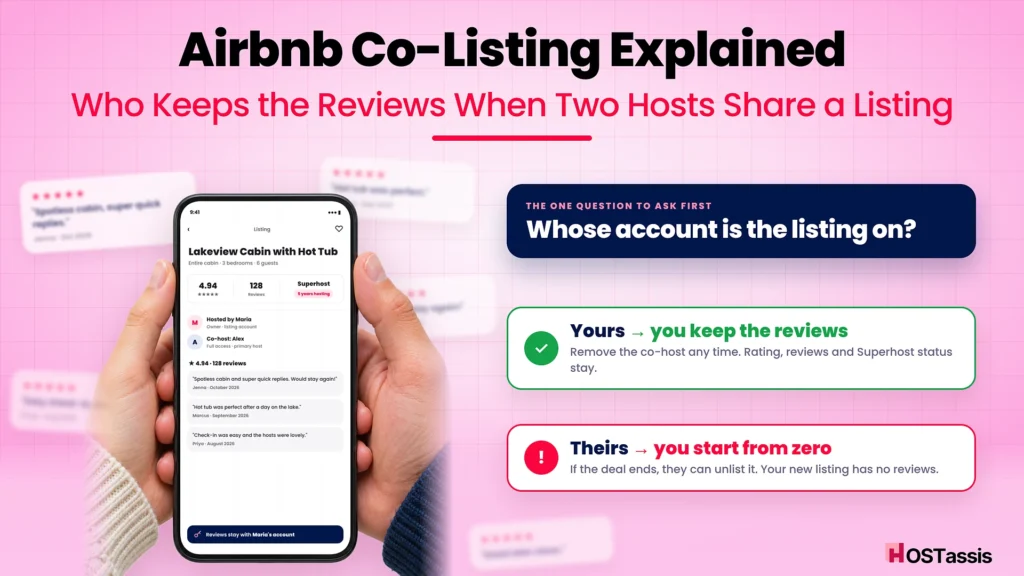
Reviews follow the listing, and the listing lives on one account. That single fact decides most of what happens to your reviews in a co-listing deal.
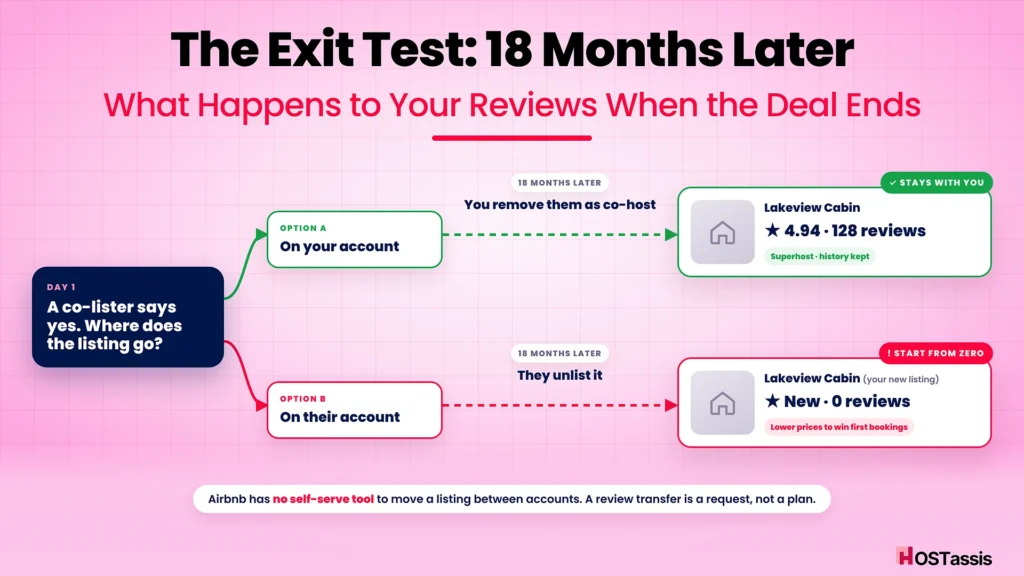
If the listing is on your account
This is the clean version. Your co-host’s work earns reviews on your listing. If the arrangement ends, you remove them as a co-host and the listing, its reviews and its booking history stay exactly where they are. Nothing moves, because nothing needs to.
A co-host’s own profile can still show ratings from the listings they help run. Airbnb notes that co-host ratings in its Co-Host Network are based on guest reviews for listings they host or co-host (Airbnb Resource Center). That’s a credit to them; it doesn’t take anything away from you.
If the listing is on the manager’s account
This is where owners get stuck. Every review the property earns is attached to a listing you don’t control. If you part ways, the manager can unlist it, and you start over on your own account with zero reviews.
Airbnb doesn’t offer a simple, self-serve way to move a listing from one account to another. Vacasa’s owner guide on selling a rental puts it bluntly: hosts can’t transfer their listings, even when the property is sold, though you can ask Airbnb about moving guest reviews. Treat any review transfer as a request that may or may not be granted, not as a plan.
What a reset costs you
Starting from zero isn’t just an ego hit. A new listing has to earn trust again, and new listings often need lower prices to get their first bookings. If you’ve spent a year building a 4.9 rating, losing it can mean months of weaker occupancy. For context on how ratings feed into visibility, see how the Airbnb search algorithm works and Guest Favorite vs Top 1%, 5% and 10%.
Who can deal with a bad review
On a properly set up listing, both the owner and a full-access co-host can ask Airbnb to remove a review that breaks its Reviews Policy (Airbnb Help). Decide in your agreement who handles that, and who writes public replies. Our Airbnb review removal guide covers which reviews qualify.
Payouts: Two Ways to Split the Money
When two people share a listing, the money can be split inside Airbnb or outside it. Inside Airbnb is cleaner. Outside is more flexible. Either way, write it down.
Option 1: Airbnb’s co-host payout
If the listing is on your account, Airbnb can pay your co-host directly. Only the listing owner can set this up, and the choices are the cleaning fee, the cleaning fee plus a percentage, a percentage, or a fixed amount. Airbnb calculates the split on the host’s potential earnings after its host service fee and taxes, and the co-host has 14 days to confirm. Changes apply only to bookings that start after the co-host confirms (Airbnb Help).
Two details owners like: the co-host can’t set up or edit payouts for themselves, and the split is visible in Airbnb rather than buried in a spreadsheet. If a guest cancels, the co-host’s share shrinks along with yours (Airbnb Help). Our guide to how Airbnb co-host payouts work walks through refunds and edge cases.
Option 2: The manager collects, then pays you
If the listing is on the manager’s account, every dollar lands with them first. You’re paid on whatever schedule your agreement says, usually monthly, minus their percentage and any expenses. This is how most traditional property managers work too, so it isn’t unusual. But it means:
- You rely on their statements to know what the property earned
- A late payment is a contract problem, not an Airbnb problem
- Tax reporting can get messy, because the platform reports the income to whoever receives the payout
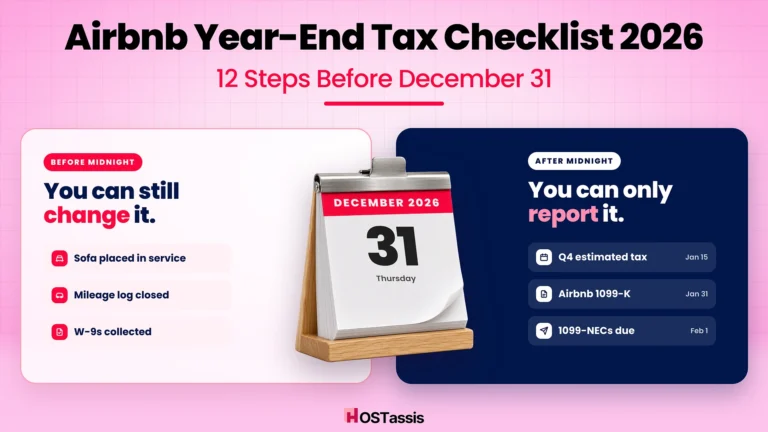
That last point catches people out every January. If the money flows through someone else’s account, talk to your accountant before the first booking, and read Airbnb co-host 1099-K double reporting so you know what to expect.
What co-listers usually charge
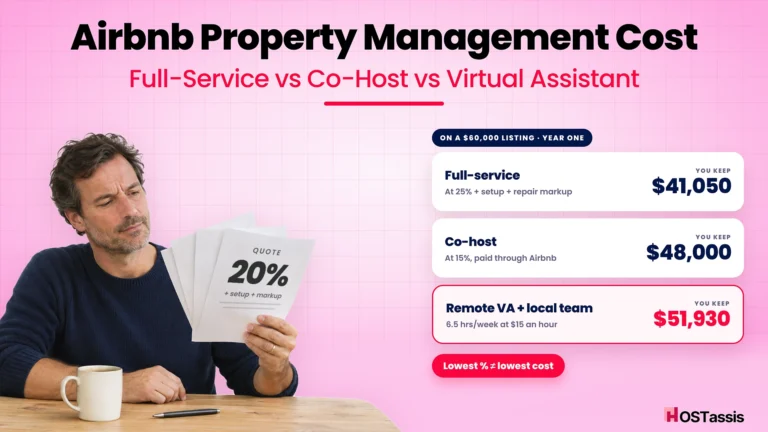
Published ranges for this kind of arrangement run from about 10% to 25% of booking revenue, depending on how much the manager does. Lower percentages usually mean you still pay vendors and make the bigger decisions; higher ones should include cleaning coordination, maintenance and full guest communication. For a side-by-side with full-service management and a remote VA, see what Airbnb property management really costs.
Insist on a statement you can check
Whichever option you choose, ask for a monthly statement that lists every booking, the gross amount, Airbnb’s fee, the manager’s share and any expenses with receipts. If the listing is on your account, you can check it against your own Airbnb earnings. If it isn’t, the statement is all you have. What every vacation rental owner statement should include has a template.
Permissions: How Much Control to Hand Over
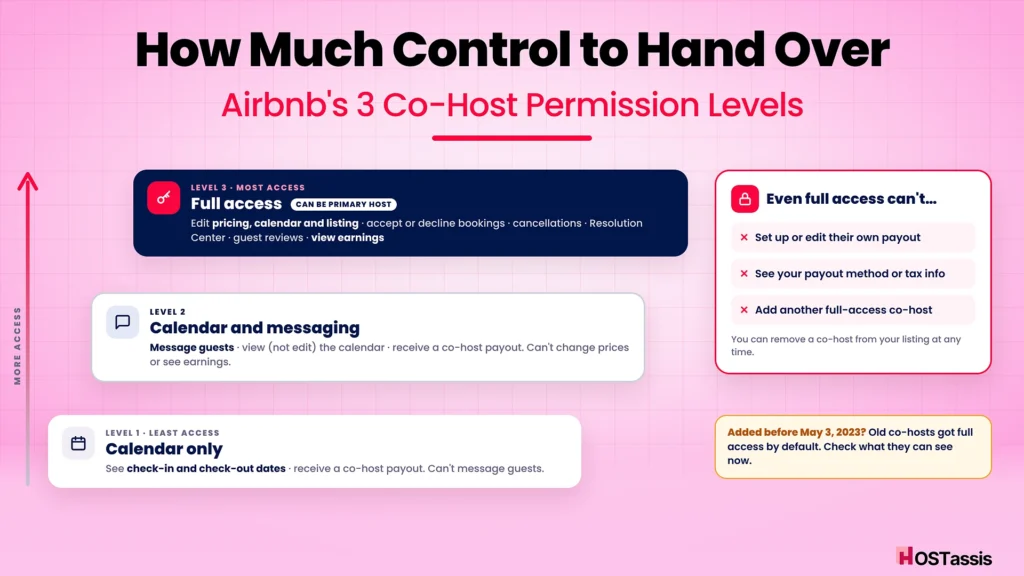
If the listing stays on your account, you decide exactly what your co-lister can touch. Airbnb has three co-host levels (Airbnb Help: What co-hosts can do):
| Level | What they can do | What they can’t |
|---|---|---|
| Full access | Edit pricing, calendar and listing details; accept or decline bookings; handle cancellations; use the Resolution Center; write guest reviews; view earnings and payouts; add or remove other co-hosts (not other full-access ones) | Set up or edit their own payout, see your payout method or taxpayer info |
| Calendar and messaging | Message guests, view (not edit) the calendar, receive a co-host payout | Change prices, accept bookings, see your earnings |
| Calendar only | See check-in and check-out dates, receive a co-host payout | Message guests |
A co-lister who’s really running the property usually needs full access, because they’ll be accepting bookings and adjusting prices. That’s fine, as long as you understand what full access includes.
The “primary host” setting
Here’s the setting most owners don’t know about. A full-access co-host can be set as the primary host on a listing (Airbnb Help). The primary host is the lead host on the listing, which is often what you want when someone else is doing the day-to-day hosting. It doesn’t make them the owner of the listing, but it’s worth agreeing on in writing.
One side effect: Airbnb only lets you link calendars for listings that share the same primary host, and co-hosts can’t link calendars themselves (Airbnb Help). If you have a room and a whole-home listing in the same house, sort out who the primary host is before you change anything.
Old co-hosts may have more access than you think
Co-hosts added before May 3, 2023 got full access by default (Airbnb Help). If you’ve had the same helper on your listing for years, check what they can see now. Our full guide to Airbnb co-host permissions shows how to change a level or remove a co-host.
So, Is Co-Listing on Airbnb Legit?
Yes, when it’s co-hosting done properly. Airbnb built tools for exactly this: co-host invitations, permission levels, payout sharing and a whole Co-Host Network for finding help. Airbnb’s own advice is to consider putting the details of your partnership in a formal agreement (Airbnb Resource Center). What makes a deal risky isn’t the label. It’s the setup.
Green flags
- The listing is created on your Airbnb account, with your payout method.
- They ask to be added as a co-host, and explain which permission level they need and why.
- The split runs through Airbnb’s co-host payout, or there’s a written agreement with a monthly statement.
- They can show you other listings they co-host, with real reviews.
- They bring up licensing, taxes and your local short-term rental rules without being asked.
Red flags
- “I’ll list it on my account, it’s easier.” Easier for them. Ask why it can’t be on yours.
- They want your Airbnb password. Co-host tools exist so nobody has to share a login.
- They promise a specific income. Revenue depends on the market, season, pricing and reviews. A range with reasoning is fine; a guarantee isn’t.
- No written agreement. A handshake works right up until it doesn’t.
- They’re mostly selling the dream. If their own story is about the course they took, ask how many listings they actually run today.
- They dodge the exit question. “What happens to the listing and reviews if we stop working together?” should get a clear, one-sentence answer.
The local rules still apply to you
Short-term rental permits, occupancy taxes and HOA rules sit with the property, not the platform. Some cities also require anyone managing rentals for others to hold a license. A co-lister who knows your market should raise this early. If they don’t, check with your city before the first booking, and look at the legal and operational side of working with a co-host.
How to Set Up a Co-Listing Deal the Safe Way
This is the order we’d follow if a friend asked us to help them say yes to a co-lister.
- Create the listing on your own Airbnb account. Even if the co-lister writes the description and arranges the photos, the listing and payout method are yours. If they insist on doing the setup, sit with them while they do it in your account.
- Invite them as a co-host. From your listing, send the invitation and pick the permission level. Airbnb’s Co-Host Network page notes invitees get two weeks to accept (Airbnb Resource Center).
- Decide who’s primary host. If they’re the one guests will talk to, making them primary host often makes sense. Write down that it’s a hosting role, not ownership.
- Set the payout. Either set up a co-host payout in Airbnb, or agree on monthly invoicing with statements. Don’t do both for the same bookings.
- Sign a short agreement. Use the checklist below.
- Agree on a review rhythm. A 15-minute call after the first month, then quarterly. Look at occupancy, average nightly rate, reviews and anything that cost money.
Agreement checklist
- The listing stays on the owner’s Airbnb account
- Co-host permission level and who is primary host
- The fee: percentage, base it’s calculated on, and whether the cleaning fee is included
- How payouts are made (Airbnb split or invoice) and when
- Spending limit before the owner must approve
- Who handles cleaning, maintenance and restocking, and who pays
- Pricing: who sets it, and any floor the owner wants
- Who responds to reviews and who requests removals
- Insurance and who’s responsible for guest damage claims
- Licensing and tax responsibilities
- Notice period and how either side ends the deal
- What happens to future bookings already on the calendar at exit
If a co-lister won’t sign something this simple, that tells you plenty. For a fuller contract, see hiring an Airbnb co-host: cost and contracts.
The middle path: keep hosting, outsource the screen work
Some owners look at co-listing because they want the income without the 2 a.m. messages, not because they want to hand over the business. If that’s you, there’s another way: keep the listing and the decisions, and hire a remote team for guest messaging, calendar management and cleaner scheduling. That’s what our Airbnb virtual assistant service does, billed by the hour rather than a cut of your revenue.
Airbnb Co-Listing FAQ
Is co-listing on Airbnb legit?
Yes, when it uses Airbnb’s co-host tools: the listing stays on the owner’s account, the other person is added as a co-host, and the payout split runs through Airbnb or a written agreement. The risk comes from setups where the listing sits on the manager’s account or the owner shares a password.
Is co-listing the same as co-hosting?
Mostly. “Co-listing” is a marketing term, often used by training courses, for running someone else’s Airbnb property for a share of the revenue. When it’s set up through Airbnb’s co-host feature, it is co-hosting. Airbnb itself doesn’t use the word.
What happens to reviews in a co-listing arrangement?
Reviews stay with the listing. If the listing is on your account, you keep every review when the co-lister leaves. If it’s on their account, the reviews stay with them, and Airbnb doesn’t offer a simple way to move a listing between accounts.
Can reviews be transferred to a new Airbnb listing?
Don’t count on it. Some owner guides say you can ask Airbnb about moving guest reviews when a property changes hands, but there’s no self-serve tool, and a request may not be granted. The safest plan is to keep the listing on your own account from day one.
How much does a co-lister charge?
Published ranges run from about 10% to 25% of booking revenue. The lower end usually means you still handle vendors and bigger decisions; the higher end should cover cleaning coordination, maintenance and full guest communication.
Can two hosts share one Airbnb listing?
Yes. One account owns the listing and invites others as co-hosts. Airbnb’s help pages note you can add up to 10 co-hosts to a listing, each with their own permission level.
Can a co-host take over my listing?
Not through Airbnb’s co-host feature. A full-access co-host can be made primary host, but they can’t edit their own payout, see your payout method or taxpayer info, or add another full-access co-host. You can remove a co-host from your listing at any time.
One Question Before You Say Yes
Co-listing can be a smart way to earn from a property without running it yourself. Plenty of owners do it happily for years. The ones who regret it almost always skipped the same question at the start: whose account is this listing on?
Get that answer in writing. If it’s yours, most of the other risks shrink to normal business details you can negotiate. If it’s theirs, make sure you’re comfortable starting from zero reviews the day the deal ends.
Not sure whether to hand it over? Book a free 20-minute ops audit. We’ll look at your listing and your week, and tell you honestly whether a co-lister, a full manager or a remote assistant makes the most sense. You can also compare costs on our pricing page.