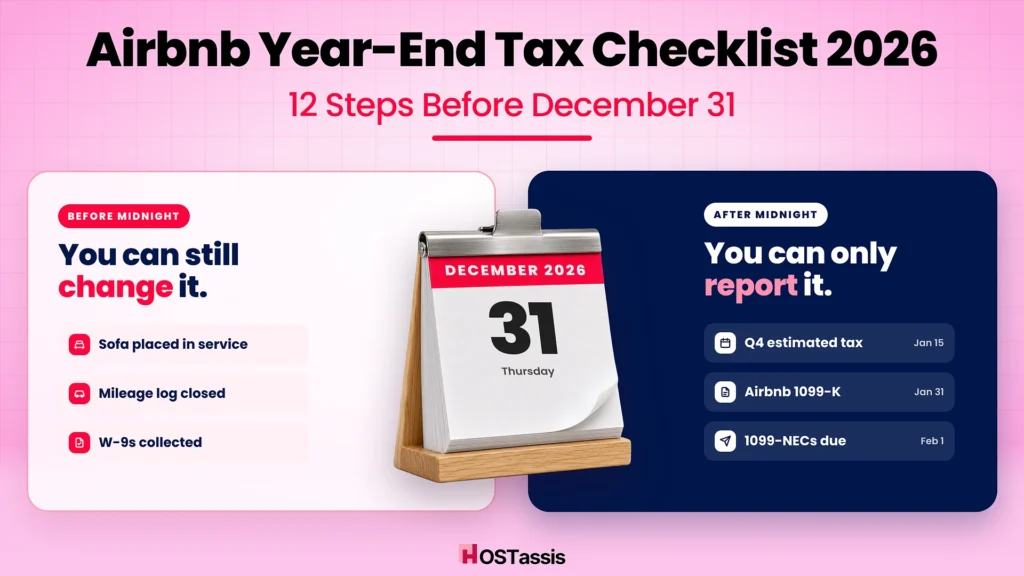
The last day for most moves that change your 2026 tax bill. After midnight, you can only report it.
That one fact explains why some Airbnb hosts save real money every year and others just hand a shoebox of receipts to their accountant in March and hope for the best. The furniture you buy on December 30 can count this year. The same couch bought on January 2 waits a whole year. The co-host W-9 you collect in November takes ten seconds. The one you chase in late January can hold up your forms.
Quick answer: Before December 31, Airbnb hosts should reconcile their 2026 income against their payout records, put any planned purchases in service, log mileage and personal-use days, and tidy up co-host paperwork (W-9s, payment records, split payouts). In early January, collect your Airbnb tax forms, send any 1099-NECs, make your last estimated tax payment and hand your accountant a clean year-end pack.
This checklist breaks that into 12 steps, in the order the deadlines hit. It’s written for hosts in the US, and it has a co-host section most year-end guides skip entirely, because so many owners now share the work (and the payouts) with someone else.
This is general information, not tax advice. Tax rules depend on your situation and state. Run your plan past a qualified tax professional before you act on it.
The 12 Steps at a Glance
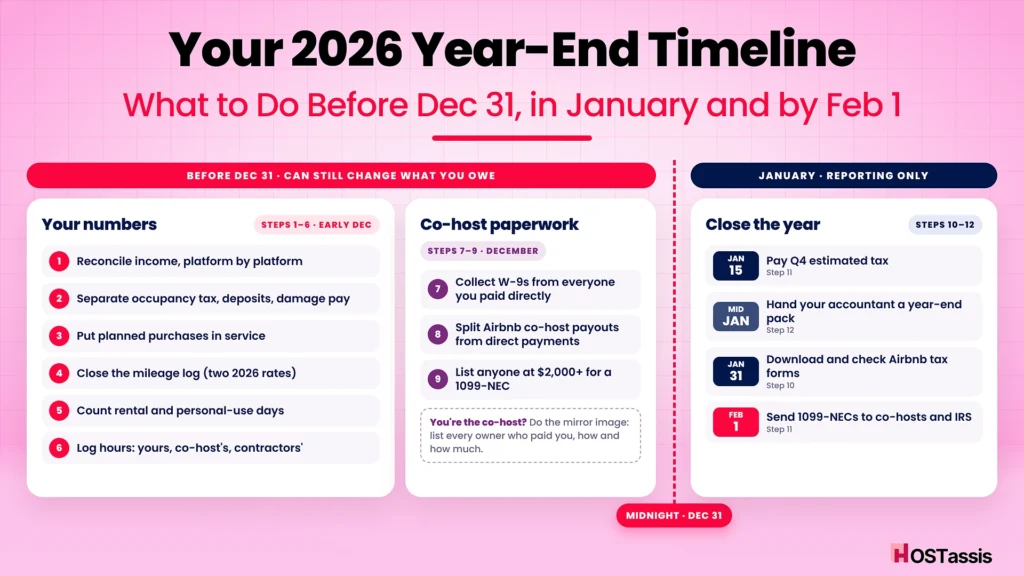
Here’s the whole season on one timeline. Everything before the dashed line can still change what you owe. Everything after it is reporting.
2026 year-end tax timeline for Airbnb hosts
| # | Step | When |
|---|---|---|
| 1 | Reconcile income platform by platform | Before Dec 31 |
| 2 | Separate occupancy tax, deposits and damage payments | Before Dec 31 |
| 3 | Place planned purchases in service | Before Dec 31 |
| 4 | Finish the mileage log (two 2026 rates) | Before Dec 31 |
| 5 | Count rental and personal-use days | Before Dec 31 |
| 6 | Log hours: yours, co-host’s, contractors’ | Before Dec 31 |
| 7 | Collect W-9s | December |
| 8 | Split co-host payouts from direct payments | December |
| 9 | Prepare the 1099-NEC list | December |
| 10 | Download and check platform tax forms | By Jan 31 |
| 11 | Send 1099-NECs; pay Q4 estimated tax | Jan 15 / Feb 1 |
| 12 | Hand your accountant a year-end pack | Mid-January |
Part 1: Before December 31 (Steps 1–6)
These six steps are the ones that can still change your numbers. Do them in the first half of December so you’re not making decisions on New Year’s Eve.
Step 1: Reconcile your 2026 income, platform by platform
Do this: match what each platform says you earned with what actually hit your bank account.
Your Airbnb tax form (if you get one) will show gross booking amounts, not your payouts. Airbnb says the owner’s Form 1099-K “will include the full gross reservation amount,” including cleaning fees, Airbnb’s fees and any co-host payouts (Airbnb Help). If you don’t reconcile now, January’s form will look wrong and you’ll waste a week finding out why.
For each channel, export the year’s earnings:
- Airbnb: Earnings dashboard → transaction history CSV for January to today.
- Booking.com: the reservations and finance reports in the Booking.com extranet.
- Vrbo and direct bookings: your payout reports and payment processor statements.
- Your PMS: if you use one such as Guesty, its owner or revenue reports can pull all channels into one view.
Then do a simple check per channel: gross bookings, minus platform fees, minus co-host payouts, minus refunds should roughly equal what landed in your bank. Our guide to OTA reconciliation walks through it line by line.
Step 2: Separate money that was never really yours
Do this: flag occupancy taxes, refunded deposits and damage reimbursements so they’re not counted as rental income by mistake.
In many places, Airbnb collects and pays occupancy taxes on your behalf (Airbnb Help). Where it doesn’t, or on other channels, you may have collected tax yourself and paid it to your city or state. Either way, list those amounts separately for your accountant.
Do the same for security deposits you returned and damage claims you were paid. A damage payment that covered a repair isn’t the same as booking income. Our post on security deposits explains how those work on Airbnb.
Step 3: Put planned purchases in service before the year ends
Do this: if you were going to buy furniture, appliances, a hot tub or a smart lock in early 2027 anyway, think about buying and setting it up before December 31.
The key words are placed in service. A sofa sitting in a warehouse doesn’t count. A sofa in the living room, ready for guests, does.
The rules got more generous recently. The 2025 tax law (the One Big Beautiful Bill Act) brought back 100% first-year bonus depreciation for qualifying property acquired and placed in service after January 19, 2025, and made it permanent. It also raised the Section 179 expensing limit to $2.5 million, indexed for inflation from 2026. For most hosts, the practical point is simple: qualifying furnishings and equipment bought this year may be deductible this year, rather than spread over many years.
Smaller items may also fall under the de minimis safe harbor, which generally lets you expense items up to $2,500 each instead of depreciating them.
Two cautions: don’t buy things you don’t need just for a deduction, and ask your accountant which method suits you before you spend. If you’re deciding what’s actually worth buying, our list of amenities that increase bookings is a good filter.
Step 4: Finish your 2026 mileage log (two rates this year)
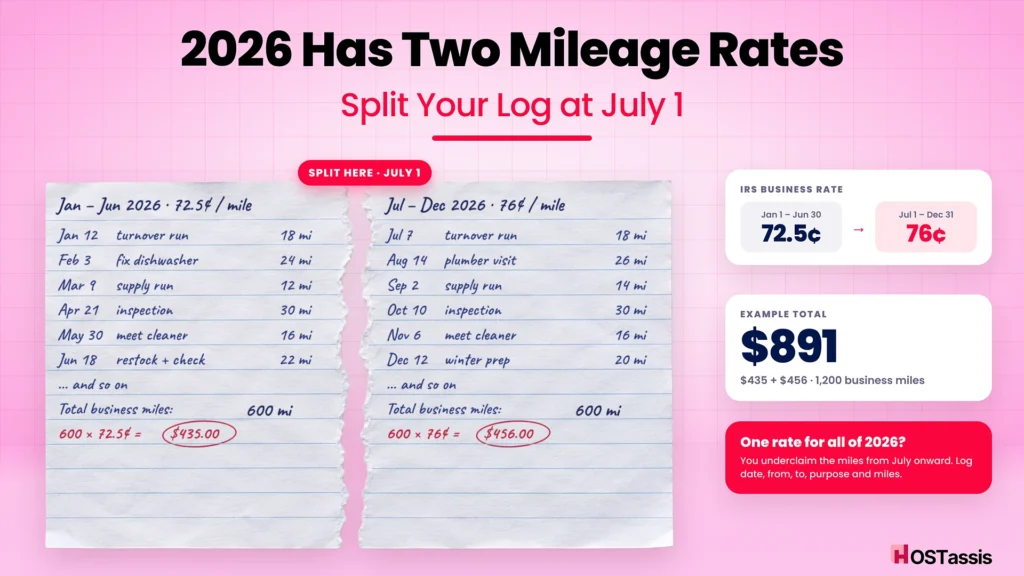
Do this: total your business miles for 2026, split by date.
This is the one most hosts will get wrong this year. The IRS set the 2026 business mileage rate at 72.5 cents per mile from January 1, then raised it to 76 cents for miles driven from July 1, 2026, citing fuel costs. That means your log needs two totals:
| Period | Business rate | Example: 600 miles each half |
|---|---|---|
| Jan 1 – Jun 30, 2026 | 72.5¢ per mile | $435.00 |
| Jul 1 – Dec 31, 2026 | 76¢ per mile | $456.00 |
| Total | $891.00 |
Count trips to the rental for turnovers, repairs, inspections, supply runs and meetings with cleaners. Whether trips from your home count can be tricky, so keep a simple log (date, from, to, purpose, miles) and let your accountant decide what counts.
Step 5: Count rental days and personal-use days
Do this: write down how many nights the property was rented at fair price, and how many days you, your family or friends used it.
These two numbers decide a lot. If you used the place personally for more than the greater of 14 days or 10% of the days it was rented, it may be treated as a residence for tax purposes, which limits your deductions. And if you rented it out for fewer than 15 days in the whole year, special rules may let you skip reporting that income altogether.
Check your calendar now, while you still remember who stayed when. Blocked nights for maintenance usually aren’t personal use, but note why each night was blocked.
Step 6: Total the hours you (and others) spent on the rental
Do this: estimate how many hours you personally spent running the property in 2026, and how many your co-host, cleaners and VA spent.
This matters if you want to use rental losses against other income. For short-term rentals with an average stay of seven days or less, whether you “materially participate” depends heavily on hours, and hiring a co-host can tip the balance. It’s a deep topic and your accountant will want specifics, so start with a rough log from your calendar, messages and invoices.
Part 2: The Co-Host Steps (Steps 7–9)
This is the section most year-end checklists leave out. If someone else helps run your listing, there’s extra paperwork, and it’s much easier in December than in January.
Step 7: Collect W-9s from everyone you paid directly
Do this: make a list of every co-host, cleaner, handyman and helper you paid outside Airbnb in 2026, and make sure you have a current Form W-9 for each one.
A W-9 gives you their legal name, tax classification and taxpayer ID. You’ll need it if you have to send them a 1099-NEC. If someone won’t give you a correct taxpayer ID, you may have to withhold tax from future payments, which nobody enjoys. Ask now, while everyone’s still answering messages.
Step 8: Separate Airbnb co-host payouts from direct payments
Do this: split everything you “paid” your co-host into two buckets.
- Paid through Airbnb’s co-host payouts feature. Airbnb handles the co-host’s tax form, and the co-host “will receive their own Form 1099 from within their own Airbnb account” (Airbnb Help). Your own 1099-K still includes these amounts in your gross.
- Paid by you directly (bank transfer, Zelle, check, cash). These are your responsibility to report if they cross the threshold.
If you switched methods during the year (it happens more than people admit), mark the date you switched. Our guide on how co-host payouts work explains the split settings, and your co-host contract should say which method you agreed on.
Step 9: Prepare your 1099-NEC list now
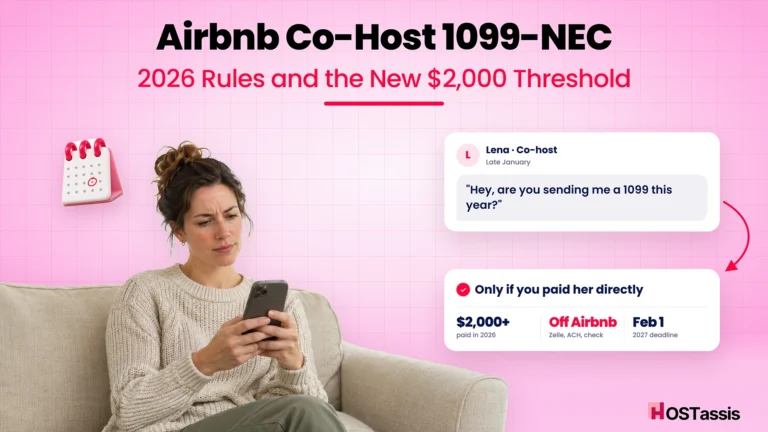
Do this: add up direct payments per person and flag anyone at $2,000 or more.
For payments made in 2026, the 1099-NEC threshold rose to $2,000, up from $600 in 2025 (Airbnb Help). Payments by card or through a business payment app are generally reported by the platform, not by you. Payments to corporations are usually exempt. Everything else at $2,000+ needs a form.
You can’t send the 1099-NECs until January, but having the list ready in December turns January into a 20-minute job instead of a scramble.
A quick word for co-hosts
If you’re the co-host reading this: do the mirror image. List every owner who paid you, how they paid, and how much. Compare it with the forms you’ll receive in January. And remember that every dollar is taxable, whether or not anyone sends you a form. Set aside money for your own estimated tax before the January deadline.
Part 3: Early January (Steps 10–12)
The year is closed. Now it’s about getting the right paper to the right people on time.
Step 10: Collect your platform tax forms and check them
Do this: download your Airbnb tax documents as soon as they’re available and compare them with the reconciliation you did in Step 1.
Airbnb issues Form 1099-K by January 31 following the tax year (Airbnb Help). For 2026, a federal 1099-K is required when gross payments are more than $20,000 and there are more than 200 transactions. Plenty of single-listing hosts won’t hit 200 bookings, so they may not receive a federal form at all. But some states have lower thresholds, and Airbnb lists Arkansas, the District of Columbia, Illinois, New Jersey, Maryland, Massachusetts, Montana, Vermont and Virginia as places where it may still issue one.
No form doesn’t mean no tax. If you earned rental income, it’s reportable either way. That’s why the reconciliation in Step 1 matters more than the form.
If you list on Booking.com or other channels, check what they issue too, and download their annual statements while you’re at it.
Step 11: Send 1099-NECs and pay your last estimated tax
Do this: two deadlines, one in mid-January and one at the start of February.
- 1099-NECs for 2026 payments are due to recipients and the IRS by February 1, 2027 (January 31 falls on a Sunday). Use the list from Step 9.
- The fourth-quarter estimated tax payment for 2026 is generally due on January 15, 2027. If your rental income grew this year and you haven’t paid enough during the year, this payment can help limit underpayment penalties. Ask your accountant what to pay.
Step 12: Hand your accountant a clean year-end pack
Do this: put everything in one shared folder, named clearly, before your first tax meeting.
Your accountant charges for time. A tidy folder means fewer billable hours spent hunting for numbers, and fewer questions in April.
Your 2026 year-end pack:
- Platform tax forms (Airbnb, Booking.com, others) and annual earnings exports
- Your Step 1 reconciliation (one page per channel is enough)
- Occupancy tax collected and paid, by period
- Receipts for repairs, supplies, utilities, insurance, software and cleaning
- Purchases placed in service in 2026, with dates and invoices
- Mileage log with the two 2026 rate periods
- Rental-days and personal-use-days count
- Hours log (yours, co-host, contractors)
- W-9s and your 1099-NEC list
- Co-host agreement and a summary of co-host payouts by method
- Mortgage interest and property tax statements
- Your monthly owner statements, if you or a manager produced them
If your expense categories are a mess, use this year as the push to set up a proper chart of accounts for 2027.
2026 Numbers Every Airbnb Host Should Know
Pin this table somewhere. These are the figures that come up again and again in year-end conversations.
| Item | 2025 limit, higher in 2026 after inflation | Why it matters |
|---|---|---|
| Form 1099-K (federal) | More than $20,000 and more than 200 transactions | Decides whether Airbnb sends you a federal 1099-K |
| Form 1099-NEC / 1099-MISC | $2,000 (up from $600 in 2025) | Decides whether you send a co-host or contractor a form |
| Business mileage rate | 72.5¢ (Jan 1–Jun 30), 76¢ (Jul 1–Dec 31) | Two rates in one year; log dates |
| Bonus depreciation | 100% for qualifying property acquired and placed in service after Jan 19, 2025 | Furnishings and equipment may be deducted in year one |
| Section 179 limit | $2.5 million (2025), indexed for inflation from 2026 | Another route to expensing equipment |
| De minimis safe harbor | Generally up to $2,500 per item or invoice | Expense small items instead of depreciating |
| Personal-use test | More than the greater of 14 days or 10% of rented days | Can limit deductions |
| Short-rental exception | Rented fewer than 15 days in the year | Income may not be reportable |
| Airbnb 1099 deadline | By January 31 | When to expect your form |
| 1099-NEC deadline (2026 forms) | February 1, 2027 | When your forms are due |
| Q4 estimated tax | January 15, 2027 | Last 2026 estimated payment |
A note on accuracy: these figures were checked against Airbnb’s Help Center, IRS announcements and published coverage of the 2025 tax law as of November 2026. Tax numbers change, so confirm anything important with your tax professional before you rely on it.
Owner vs Co-Host: Who Handles What at Year-End?
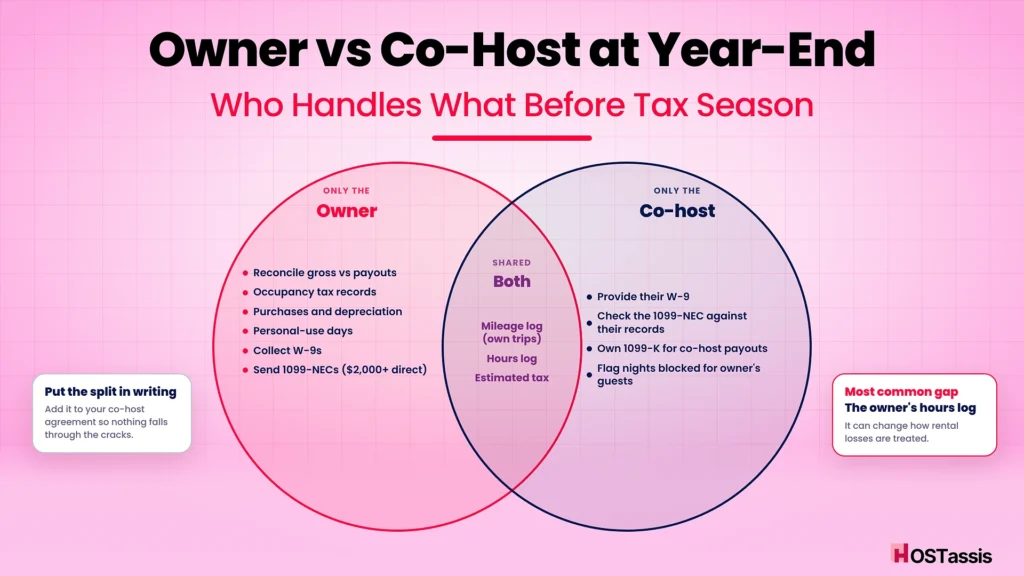
When two people share a listing, year-end jobs fall through the cracks because each assumes the other has it. Settle it with this split, and put it in writing.
| Year-end task | Listing owner | Co-host |
|---|---|---|
| Reconcile gross bookings vs payouts | ✔ Main job | Help with booking data if they manage the calendar |
| Occupancy tax records | ✔ Usually responsible | Supply records if they filed on the owner’s behalf |
| Purchases and depreciation | ✔ Owner’s assets | Only for items the co-host owns (their own tools, laptop) |
| Mileage log | ✔ For the owner’s trips | ✔ For their own trips, on their own return |
| Personal-use days | ✔ | Flag any nights blocked for the owner’s guests |
| Hours log | ✔ Own hours | ✔ Own hours (shared with the owner if asked) |
| W-9s | ✔ Collects | ✔ Provides theirs |
| 1099-NEC | ✔ Sends, for direct payments of $2,000+ | Receives; checks it against their records |
| Airbnb 1099-K | Receives one for the full gross | Receives their own for co-host payouts, if over threshold |
| Estimated tax | ✔ On rental profit | ✔ On co-host income (often self-employment income) |
The most common gap is the hours log. Owners who hand most of the work to a co-host are often surprised by how few hours they put in themselves, and that can affect how rental losses are treated. Talk to your accountant about it before you change who does what in 2027.
If you’re a property manager or co-host business, a short year-end checklist in your owner agreement saves a lot of January back-and-forth. Our guide on why revenue doesn’t equal profit explains what owners expect to see from you.
Records to Pull From Each Platform (and Where to Find Them)
Downloading your data takes about 15 minutes per channel if you know where to look. Do it before January, when platforms sometimes slow down under tax-season traffic.
Airbnb
- Earnings and transaction history: export gross earnings, payouts, fees and adjustments for January 1 to December 31. Airbnb says the Gross Earnings total corresponds to Box 1a of your Form 1099-K (Airbnb Help).
- Tax documents: available in your account once issued (by January 31).
- Co-host payouts: check the payout settings for each listing so you can show which amounts went to your co-host.
- Occupancy taxes: see which taxes Airbnb collected for your location in its occupancy tax info (Airbnb Help).
Booking.com
- Reservation and finance statements from the Booking.com extranet, including commission invoices. Booking.com charges hosts commission, which is a deductible cost, so keep every invoice.
- Payment method details: whether guests paid Booking.com or paid you directly affects how you reconcile.
Your PMS and pricing tools
- PMS reports: if you use a property management system like Guesty, run the annual revenue, owner statement and expense reports. They’re often the cleanest single view across channels.
- Software subscriptions: your PMS, a pricing tool like PriceLabs, smart lock apps and messaging tools are business expenses. Download the year’s invoices.
Your bank and cards
- Statements for any account used for the rental. If personal and rental spending are mixed, highlight the rental items now, while you still remember what that $86 hardware store receipt was for.
The fee side matters as much as the income side. If you’re unsure what each platform takes, our breakdown of what Airbnb charges hosts is a quick refresher.
Special Situations: Small Hosts, New Hosts and Part-Year Rentals
Not everyone fits the standard checklist. Here’s what changes in a few common cases.
You started hosting this year
Your first year is when good records matter most. Note the date the property was first available for rent (not the date of your first booking). Keep every startup cost, from furniture to photography, and give your accountant the list. Some costs are treated differently before you’re open for business. If you bought the property in 2026, keep the closing statement too. If you’re still in the buying stage, our guide on how to research a new STR market covers the numbers to check first.
You only rented for a few weeks
If you rented your home for fewer than 15 days in the whole year, the income may not be reportable, but you also generally can’t deduct rental expenses. Keep proof of the exact rental days anyway. If you got close to 15, count carefully.
You live in the property part of the year
This is the vacation-home situation. Your expenses may need to be split between personal and rental use based on days, and your deductions may be limited. Your days count from Step 5 is the most important number you’ll give your accountant.
You stopped hosting this year
Note the date you stopped offering the place for rent and what you did with the furniture. If you sold the property, keep the sale documents. Depreciation you’ve claimed can affect the tax on a sale, so this is one to discuss early.
You have several listings in different states
Each state, and sometimes each city, may have its own income and occupancy tax rules. Keep a separate folder per property and note which platform collected which tax where. Multi-state hosts should talk to an accountant who handles short-term rentals specifically.
Where Airbnb Year End Tax Prep Usually Goes Wrong
A checklist only helps if you know where people trip. These are the slip-ups that show up most often when hosts hand over their numbers in January, along with what each one costs and the quick fix.
| Slip-up | What it costs you | The fix |
|---|---|---|
| Reporting payouts instead of gross bookings | A mismatch with your 1099-K and a possible IRS letter | Report gross, then deduct fees, co-host payouts and refunds |
| Using one mileage rate for all of 2026 | Underclaimed miles from July onward | Split the log at July 1: 72.5¢ before, 76¢ after |
| Buying furniture on Dec 30 but setting it up in January | The deduction may slide into 2027 | It has to be in the rental and ready for guests by Dec 31 |
| Forgetting the Zelle and check payments to your co-host | A missed 1099-NEC and a co-host whose return doesn’t match | Total every direct payment, by method, in December |
| Counting occupancy tax as income | Overstated income | List collected and remitted tax separately |
| No record of personal-use nights | Deductions questioned or limited | Note who stayed and why every blocked night was blocked |
| Receipts in three inboxes and a glovebox | Paying your accountant to dig | One shared folder, named by month |
Notice that none of these are about obscure tax rules. They’re all about records. The hosts who pay the least tax in April are rarely the ones with clever strategies. They’re the ones who can find a receipt in under a minute.
There’s a second payoff to getting this right. Clean, reconciled numbers tell you whether your rental actually made money this year, which is the question that should shape your 2027 pricing, your cleaning fees and whether to keep paying for every subscription. Tax prep and business planning turn out to be the same job.
Frequently Asked Questions
When does Airbnb send 1099s for 2026?
By January 31, 2027. You’ll find them in your Airbnb account. A federal 1099-K is issued when gross payments exceed $20,000 and there are more than 200 transactions, though some states have lower thresholds.
What should Airbnb hosts do before December 31?
Reconcile income with payouts, separate occupancy taxes and deposits, place planned purchases in service, finish the mileage log, count rental and personal-use days, log hours, and collect W-9s from anyone you paid directly.
What is the 2026 mileage rate for Airbnb hosts?
The IRS business rate was 72.5 cents per mile from January 1 to June 30, 2026, and 76 cents per mile from July 1, 2026. Keep your log split by date.
Do I need to send my co-host a 1099?
Only for payments you made directly (not through Airbnb’s co-host payouts) that reached $2,000 or more in 2026, and not for card or business-app payments. The form is due February 1, 2027.
Can I still buy furniture for my rental and deduct it this year?
Potentially, if it’s bought and placed in service (ready for guests) by December 31 and it qualifies. Bonus depreciation is back at 100% for qualifying property acquired after January 19, 2025. Ask your accountant before you buy.
I didn’t get a 1099-K. Do I still report my Airbnb income?
Yes. Rental income is reportable whether or not you receive a form. Use your Airbnb earnings export instead.
Make January the Easy Month
Most tax stress isn’t about the rules. It’s about doing a year’s worth of sorting in a few panicked weeks. Spread the 12 steps over December and early January and tax season becomes a handover, not a hunt.
Then fix the root cause for 2027: a separate bank account, a simple monthly reconciliation and a habit of saving receipts the day you get them. Our list of common bookkeeping mistakes is a good place to start.
At HOSTassis, we keep short-term rental books tidy all year: monthly owner statements, payout reconciliation across Airbnb and Booking.com, co-host payment tracking and a ready-made year-end pack for your CPA.
Want your 2026 year-end pack done for you? Contact us for a free bookkeeping review before the January rush.