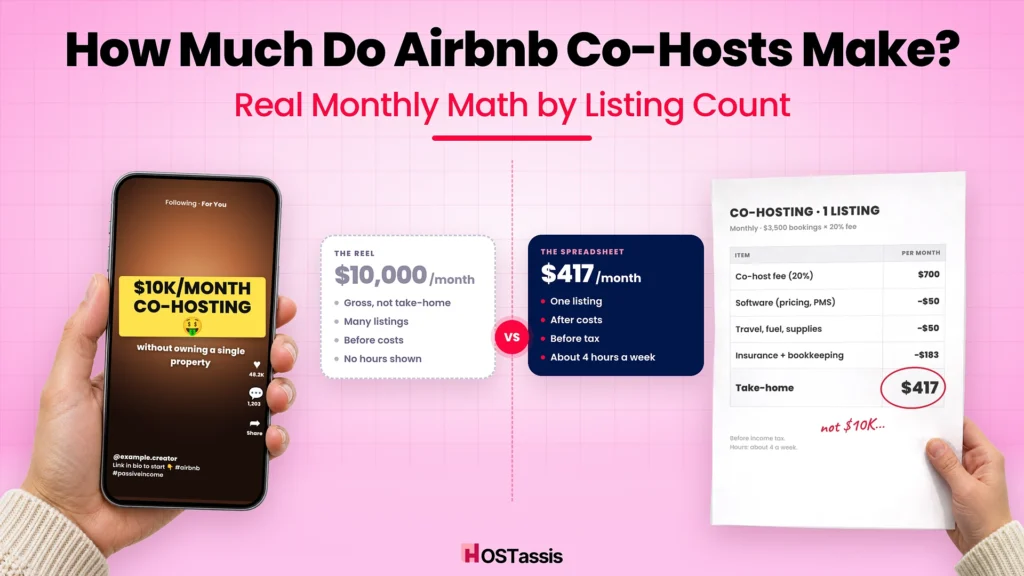
The Reel Says $10,000. The Spreadsheet Says $417.
You’ve seen the videos. Someone in a nice kitchen explains how they make per month $10,000 of co-hosting Airbnbs without owning a single property. The comments are full of people asking how to start.
The number isn’t always a lie. But it’s almost always a gross number, from someone with a lot of listings, before costs, and without the hours attached. Strip those back and the first year often looks very different. A single listing might leave a co-host around $400 a month after basic costs. That’s a nice side income. It isn’t quitting-your-job money.
So let’s do the math properly, with every assumption on the table.
Quick answer: most US Airbnb co-hosts charge 10% to 25% of booking revenue, so a listing earning $3,500 a month pays a co-host at 20% about $700 a month before costs. After software, travel, insurance and bookkeeping, one listing leaves roughly $400 a month, five listings around $2,800 and ten listings around $5,800, before tax. Ten listings is close to a full-time job on your own, so most co-hosts who go past that add back-office help, which costs money but raises what each hour of your time earns.
Below is the formula, a listing-by-listing earnings ladder, the costs income posts leave out, your real hourly rate, what stops co-hosts from growing, and the tax basics. If you’re an owner trying to work out what a co-host should cost you, read Airbnb co-host fees and contracts instead. This page is written from the co-host’s side of the table.
The Formula: What One Listing Pays You
Co-host income from one listing comes down to two numbers multiplied together: how much the listing earns, and what share you take.
\text{Monthly co-host fee} = \text{Listing’s monthly booking revenue} \times \text{Your fee \%}
Simple, but each half hides choices that change your income more than most people expect.
The listing’s revenue
A $2,000-a-month city studio and a $7,000-a-month lake house are both “one listing.” At 20%, one pays you $400 and the other $1,400, often for a similar number of hours. That’s why experienced co-hosts are picky about which properties they take on. In this guide we use $3,500 a month in booking revenue as a middle-of-the-road US listing. Swap in your own market’s numbers; if you need help estimating them, see how co-hosts build Airbnb revenue projections for owners.
Your fee
Published co-host fees in the US mostly run 10% to 25% of booking revenue, with full-service arrangements at the top of that range. What you can charge depends on what you do:
| What you handle | Typical fee range |
|---|---|
| Guest messaging and calendar only | 10% to 15% |
| Messaging, pricing, cleaner scheduling, reviews | 15% to 20% |
| Full service: everything above plus maintenance, restocking, owner reporting | 20% to 25%+ |
What base the fee is calculated on
This small detail moves your income. If you’re paid through Airbnb’s co-host payout, Airbnb calculates your share on the host’s potential earnings after its host service fee and taxes, and only the listing owner can set it up (Airbnb Help). If you invoice the owner directly, your contract decides the base. 20% of gross bookings and 20% of the post-fee payout are not the same number, so agree on it in writing. Our guide to how Airbnb co-host payouts work shows the split options.
Flat fees
Some co-hosts charge a flat monthly fee instead. It makes your income predictable, which helps in slow seasons, but it caps your upside in strong months. A hybrid (small base plus a lower percentage) splits the difference.
The Earnings Ladder: 1, 5, 10 and 15 Listings
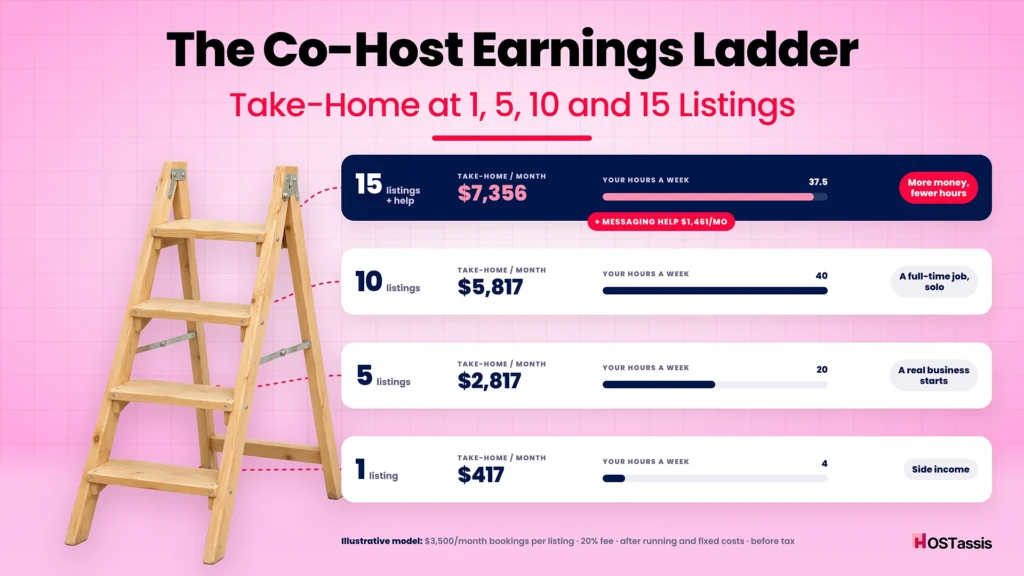
Here’s what a co-hosting business looks like as it grows, using the same listing each time so the comparison is fair.
Assumptions: Each listing earns $3,500 per month. At a 20% co-host fee, you earn $700 per listing.
Running costs are $100 per listing each month. Insurance and bookkeeping add $183 in fixed monthly costs.
With up to 10 listings, you work solo for about 4 hours per listing per week.
At 15 listings, an assistant handles guest messages for 1.5 hours per listing per week at $15 per hour. Your own time drops to 2.5 hours per listing per week.
The table shows monthly dollar amounts before income tax and weekly work hours.
| Listings | Fees earned | Running costs | Fixed costs | Back-office help | Take-home before tax | Your hours per week |
|---|---|---|---|---|---|---|
| 1 | $700 | $100 | $183 | $0 | $417 | 4 |
| 5 | $3,500 | $500 | $183 | $0 | $2,817 | 20 |
| 10 | $7,000 | $1,000 | $183 | $0 | $5,817 | 40 |
| 15 | $10,500 | $1,500 | $183 | $1,461 | $7,356 | 37.5 |
What the ladder tells you
- One listing is a side income, not a business. The fixed costs eat a big share of the first $700. It gets much better at three to five listings.
- Ten listings is a full-time job. At around 40 hours a week, you’ve basically hired yourself. Any growth past here needs either more efficient systems or more people.
- At 15 listings, help pays for itself. You spend $1,461 a month on an assistant, and still take home more while working fewer hours than at 10 listings. That’s the jump most income posts skip.
The number that moves everything: revenue per listing
If your listings earn $5,000 a month instead of $3,500, every fee line in that table goes up by more than 40%, but your hours barely change. Co-hosts who earn well tend to be selective about properties, not just busy. Better listings, priced properly and kept full, are worth more than more listings. Our guide to how Airbnb co-hosts increase occupancy and revenue shows where that extra revenue comes from.
The Costs Income Posts Leave Out
The ladder above uses lean costs on purpose. Your real list may be longer. These are the expenses that most often turn a “$700 a listing” claim into less than you expected.
Software
A dynamic pricing tool like PriceLabs is close to essential once you manage more than one listing, and a PMS or channel manager such as Guesty becomes essential around three to five, especially if your listings are on more than one platform. Some owners pay for these; many expect the co-host to. Decide who pays before you sign, and check current plan prices on each tool’s site.
Insurance
General liability, and possibly professional liability, protects you if a guest is injured or an owner claims you mismanaged their property. Airbnb’s own protections are built around hosts and guests; don’t assume they cover your business. Get a quote early; it’s one of the few costs that doesn’t scale with listings.
Travel and time on site
If you also handle in-person jobs like inspections, restocks or meeting contractors, every drive costs fuel and an hour you can’t spend on anything else. Remote-only co-hosts avoid this, but they then pay a local cleaner or handyman for those jobs, or ask the owner to.
Unreimbursed supplies and small fixes
A guest needs a phone charger at 10 p.m. A lightbulb goes. A co-host who pays for these and forgets to bill the owner quietly loses money every month. Track them.
Your business setup
Bookkeeping, a business bank account and possibly an LLC. None of these is huge, but together they’re a real monthly line.
The slow season
Percentage fees fall when bookings fall. A winter month where your listings earn half their average means half your fees, while software and insurance stay the same. Budget on your slowest quarter, not your best one.
Turnover of clients
Owners sell, move back in or decide to self-manage. Every lost listing means time spent finding and onboarding a new one, which is unpaid. A few clear habits keep owners longer: honest monthly statements, quick replies and no surprise charges. See what every vacation rental owner statement should include.
Your Real Hourly Rate
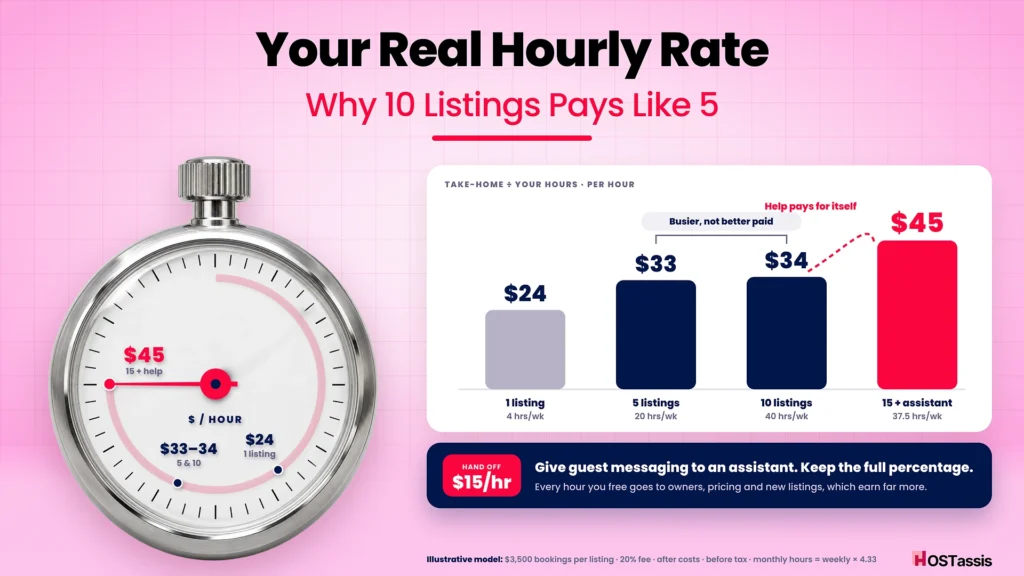
Monthly income tells you whether co-hosting is worth it as a side gig. Hourly income tells you whether it’s worth it as a business. Here’s the same ladder divided by the hours.
| Listings | Take-home per month | Your hours per month | Effective hourly rate |
|---|---|---|---|
| 1 | $417 | 17 | about $24 |
| 5 | $2,817 | 87 | about $33 |
| 10 | $5,817 | 173 | about $34 |
| 15 (with a messaging assistant) | $7,356 | 162 | about $45 |
Monthly hours = weekly hours × 4.33.
Why the rate barely moves from 5 to 10 listings
Because you’re doing the same work, just more of it. Every listing brings its own messages, cleaner schedules and pricing checks. Without better systems, income and hours grow together, so your hourly rate stays flat. You get busier, not better paid.
Why it jumps at 15
The assistant takes the most frequent, most interrupt-driven work (guest messages) off your plate at $15 an hour, while you keep earning the full percentage. Each hour you hand off at $15 frees an hour you can spend on owner relationships, pricing and adding listings, which earn far more. That’s the basic economics of every service business, and co-hosting is no exception.
How many hours does a listing really take?
Honest answer: it varies more than anything else in this guide. Published estimates range from a handful of hours a week across several listings to 5 to 10 hours a week for a single one. What drives the difference:
- Scope. Messaging-only co-hosting takes far less time than full service with maintenance and restocking.
- Automation. Scheduled messages, smart locks and a PMS cut hours sharply. See 15 Airbnb tasks every host should automate.
- Turnover frequency. A listing with two-night stays creates far more work than one with weekly stays.
- The owner. Some owners need a weekly call. Some want a monthly statement and nothing else.
Track your own hours for the first two months with each new listing. It’s the only number in this guide that’s truly yours, and it tells you which listings are worth keeping.
What Caps Your Income, and How Co-Hosts Get Past It
Most co-hosts hit the same wall somewhere between 6 and 12 listings. It isn’t a shortage of owners. It’s the inbox, the calendar and the phone that rings while you’re at a turnover.
The three things that stop growth
- Guest messages. They arrive at all hours, and Airbnb tracks how quickly hosts answer new inquiries and booking requests. Response rate affects Superhost status and search placement (Airbnb Help). One person can’t be available for 15 listings at 2 a.m. without burning out.
- Coordination. Cleaners, handymen, restocking and inspections multiply with every listing. If it all runs through your phone, every listing you add makes your day more fragile.
- Owner management. Statements, questions and the occasional difficult conversation. Each owner adds a relationship to maintain.
Three ways co-hosts scale
| Approach | What it looks like | Good for | Watch out for |
|---|---|---|---|
| Better systems | PMS, scheduled messages, smart locks, cleaner apps, written SOPs | Every co-host, from listing one | Systems don’t answer a guest who’s locked out |
| Remote back-office help | A VA or team for guest messaging, calendar checks and cleaner scheduling | Co-hosts at 5+ listings who want more time for growth | Training time; choose help that knows Airbnb |
| Local staff | A field person for inspections, restocks and emergencies | Dense portfolios in one area | Payroll, scheduling and employment rules |
The usual order is systems first, then remote help for the screen work, then local staff once the portfolio is dense enough to keep someone busy. Our guide to Airbnb SOPs is a good place to start on systems.
Where HOSTassis fits
We’re the remote back-office option: a trained team that handles guest messaging, calendar checks across Airbnb, Vrbo and Booking.com, cleaner scheduling and owner reports for co-hosts and small property managers. You keep the owner relationships and the percentage; we take the work that keeps you up at night. See our Airbnb virtual assistant service and how property management companies scale with co-host partnerships.
If you manage listings across several platforms, the Airbnb + Vrbo virtual assistant guide explains how to keep calendars in sync as you grow.
Taxes and Paperwork: The Part After “Take-Home”
Every number above is before tax. Co-hosting income in the US is usually self-employment income, which changes how much of it you actually keep. This isn’t tax advice, but these are the basics every new co-host should know before the first payout lands.
Self-employment tax
On top of income tax, self-employed people pay Social Security and Medicare themselves. The IRS sets the self-employment tax rate at 15.3%. Combined with income tax, a sensible rule of thumb is to set aside a meaningful slice of every payout from the first month, and let an accountant tell you the right percentage for your situation.
Estimated tax payments
No employer is withholding tax for you, so the IRS generally expects quarterly estimated payments once you owe enough. Missing them can mean penalties. Put the four due dates in your calendar.
Tax forms and double reporting
How your income is reported depends on how you’re paid. If you receive a co-host payout through Airbnb, the platform may report that income to you directly. If the owner pays you, they may need to issue you a form instead. Mix-ups are common: the same money can end up reported to both the owner and the co-host. Our guide to Airbnb co-host 1099-K double reporting explains how this happens and how to fix it.
Expenses you can track
Software, insurance, a share of your phone, mileage for property visits, supplies you weren’t reimbursed for and bookkeeping are typical business expenses for co-hosts. Keep receipts and log mileage from day one; it’s much harder to rebuild a year later. If you need a simple structure, our short-term rental chart of accounts works for co-hosting businesses too, and common STR bookkeeping mistakes covers what to avoid.
Licensing
Some cities and states require a license to manage property for others, and some short-term rental ordinances name the local contact or manager responsible for a listing. Check before you take on your first owner. The legal and operational side of co-hosting is a good starting checklist.
FAQ About Co-Host Income
How much does an Airbnb co-host make per month?
At a 20% fee on a listing earning $3,500 a month, a co-host earns about $700 a month per listing before costs. After software, travel, insurance and bookkeeping, that’s roughly $400 for one listing, $2,800 for five and $5,800 for ten, before income tax. Your numbers depend most on how much your listings earn.
What percentage do Airbnb co-hosts charge?
Most US co-hosts charge 10% to 25% of booking revenue. Messaging-only help sits at the low end; full service including maintenance, restocking and owner reporting sits at the high end. Some charge a flat monthly fee or a small base plus a lower percentage instead.
Can you make a living as an Airbnb co-host?
Yes, but it usually takes 8 to 10 well-earning listings or more, and at that point it’s a full-time job. Most co-hosts who earn a comfortable living have either chosen higher-revenue properties or added help so they can manage more listings without working longer hours.
How many listings can one co-host manage?
Working alone with good systems, many co-hosts top out somewhere between 6 and 12 listings. Past that, guest messages, coordination and owner management usually need extra help. The real limit depends on scope, automation and how often guests turn over.
How do Airbnb co-hosts get paid?
Either through Airbnb’s co-host payout, where the listing owner sets up a percentage, cleaning fee or fixed amount and Airbnb pays the co-host directly, or by invoicing the owner under a written agreement. Through Airbnb, only the listing owner can set up the payout.
Do Airbnb co-hosts pay taxes on their income?
Yes. In the US, co-host income is usually self-employment income, so you’ll typically owe income tax plus self-employment tax, often through quarterly estimated payments. Keep records of every expense and speak with an accountant.
Is co-hosting more profitable than owning an Airbnb?
It needs far less money up front, because you don’t buy a property, but you earn a share of revenue instead of all of it, and you can lose a listing when an owner changes plans. Many people start as co-hosts to learn the business before buying.
Build the Business, Not the Screenshot
Co-hosting can be a genuinely good business. It needs little capital, it rewards people who care about details, and a handful of well-run listings can add up to a real income. What it isn’t is passive, or as quick as the reels suggest.
The co-hosts who do well tend to share three habits: they pick listings that earn well rather than taking every one, they track their hours as closely as their fees, and they bring in help before burnout forces them to. Do the math on your own listings with the ladder above, and you’ll know exactly which of those habits you need first.
Growing past a handful of listings? Book a free 20-minute call and we’ll look at where your hours go and which tasks a back-office team could take off your plate. You can also compare our plans on the pricing page.